

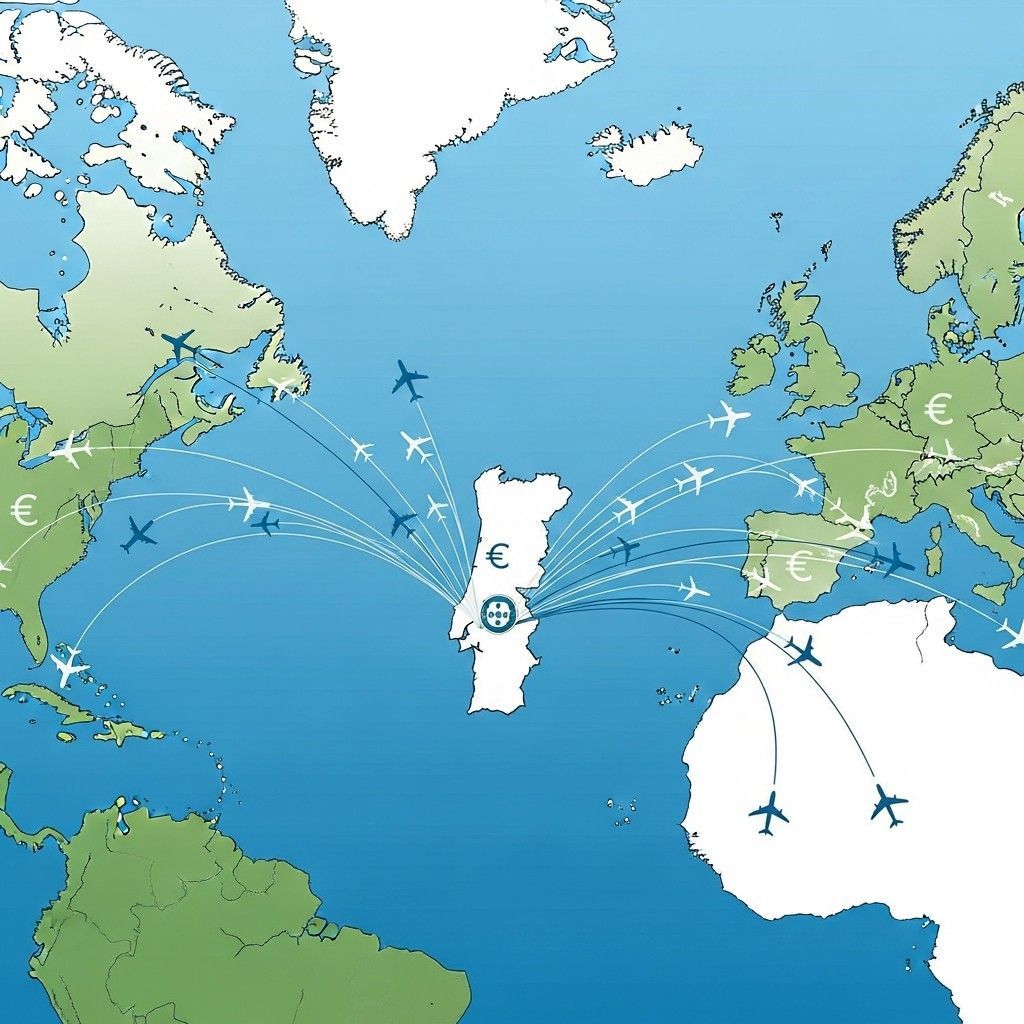
Why TAP's Recovery Has Sparked a Continental Bidding War
Two of Europe's largest airline networks are now competing to acquire a minority stake in TAP Air Portugal, each convinced that a partnership will unlock more global reach than they could build independently. Lufthansa Group confirmed its non-binding proposal submission on April 2, 2026, joining Air France-KLM in formal pursuit, while International Airlines Group (IAG)—owner of British Airways and Iberia—has withdrawn from the race entirely. The outcome will reshape which European airline group dominates routes to Brazil, North America, and Africa over the next decade.
Why This Matters
• Your flight options are about to change: The winning bidder will determine which international destinations receive investment and which secondary routes face cutbacks, affecting travelers across Portugal's regions.
• Job security has structural protections: The Portuguese government retains 51.1% ownership and reserves 5% for employees, meaning no buyer can implement radical workforce reductions without government and labor approval.
• A 30-day evaluation phase begins now: Parpública, the state holding company, has until early May to assess proposals and move to binding offers, with a final decision expected by summer 2026.
The Fundamental Disagreement That Killed IAG's Interest
IAG's departure from the bidding process exposed a core strategic tension. The London-based group—which controls Iberia, British Airways, and several other carriers—has consistently pursued a particular model: acquire airlines fully or secure a clear pathway toward eventual majority ownership. According to previous IAG investor presentations and statements made during past acquisition processes, the group has long argued that meaningful operational restructuring and cost optimization require decision-making authority.
The Portuguese privatization model, which enshrines government majority control at 51.1% plus a 5% employee stake, simply cannot accommodate this demand. When Bloomberg reported last week that IAG might abandon the process, the group offered only a carefully worded statement: they had until April 2 to decide. That deadline passed without an IAG submission.
The practical consequence is significant for Portugal. With IAG eliminated, the two remaining bidders have already signaled acceptance of the government's ownership framework. This removes the most contentious negotiation point and shifts focus toward genuine operational and financial details rather than fundamental arguments about control. For residents watching the process, IAG's withdrawal actually reduces uncertainty about the final ownership structure.
Lufthansa's Atlantic Architecture
Lufthansa Group, Europe's largest airline network by market capitalization, positioned itself through a clear strategic logic: TAP is essential infrastructure for building what the group calls its "Atlantic hub" strategy. The German conglomerate confirmed via the Portugal news agency Lusa that it has submitted its non-binding proposal, framing TAP not as an acquisition target but as a geographic cornerstone.
Lufthansa currently has Frankfurt and Munich as European anchors. Lisbon offers something neither hub can replicate: direct access to South America paired with natural geographic position as a transatlantic crossing point. According to industry analysts tracking European airline capacity, TAP controls a substantial portion of Europe-Brazil market share, a concentration of capacity that would take years and billions of euros to build through new aircraft deployments and route launches. More importantly for Lufthansa, acquiring minority ownership lets the group redirect traffic through Lisbon instead of saturating Frankfurt's already congested infrastructure.
Investment Priorities and Integration Plans
The group has outlined several investment priorities in internal discussions with Portuguese aviation unions, according to reports from those briefings. Modernizing the cabin experience ranks high—specifically adding in-flight connectivity powered by Starlink, a capability that many legacy European carriers lack. Lufthansa also highlighted its scale advantages in fuel procurement and technology contracts, capabilities that TAP as a standalone carrier cannot negotiate. The group explicitly stressed that its strategy centers on expansion rather than consolidation; no mention of route abandonment or workforce reduction appears in the proposal.
Critically, Lufthansa has publicly endorsed the minority-stake arrangement. This signals the group has likely developed a detailed integration roadmap that operates within government ownership constraints rather than viewing them as temporary obstacles to overcome. The distinction from IAG's approach is absolute: Lufthansa sees opportunity in the current structure, not impediment.
Air France-KLM's Multi-Hub Vision
Air France-KLM, the second-largest airline network on the continent, submitted its proposal with fundamentally different geographic logic. For the Franco-Dutch group, TAP is less about Brazil expansion and more about completing a European super-hub architecture.
Air France currently operates major hubs in Paris and Amsterdam. Both cities serve transatlantic routes effectively but operate independently. Adding Lisbon as a third hub—controlled through TAP—would create what Air France-KLM describes as a natural southern anchor complementing the northern hubs. The advantage: passengers traveling from Africa or South America can route through the most efficient hub rather than being forced to connect through Paris or Amsterdam. This efficiency generates cost savings and also reduces passenger frustration with longer layovers.
Regional Development and Sustainability Focus
According to press releases and media reports from Air France-KLM's proposal presentations, the Franco-Dutch group has signaled specific interest in developing Porto, Portugal's second-largest city, as a secondary operational base. This regional focus carries political weight. For a Portuguese government concerned about geographic equity and preventing Lisbon from monopolizing international investment, Air France-KLM's regional pitch offers appeal. Northern Portugal residents and businesses could access intercontinental markets without necessarily routing through the capital.
The Franco-Dutch group also emphasized environmental sustainability in its proposal—specifically decarbonization timelines and investment in newer, fuel-efficient aircraft. This focus reflects broader European regulatory pressure and investor expectations around climate commitments. Additionally, Air France-KLM highlighted its institutional experience navigating relationships with state-controlled shareholders, having worked alongside French and Dutch government bodies for decades. This institutional memory may prove valuable when binding negotiations begin and the Portuguese government scrutinizes long-term employment commitments and connectivity guarantees.
Why TAP Suddenly Became Irresistible
The bidding intensity reflects a genuine operational and financial turnaround. TAP posted €53.7 million in net profit during 2024—the third consecutive profitable year—after years of European Commission-mandated restructuring. Operating revenues reached a record €4.2 billion, representing 28.6% growth above pre-pandemic 2019 levels.
The momentum accelerated into 2025. Across the first nine months of that year, TAP reported €55.2 million in net profit, driven largely by an exceptional summer season that generated €126 million in profit between July and September alone. Passenger volumes totaled 12.7 million across that period, marking 2.9% year-over-year growth. Critically, the airline's liquidity position reached €1.03 billion, providing genuine financial flexibility for network investment and equipment purchases.
Beyond raw profitability, TAP's competitive advantage is structural and irreplaceable. The airline functions as the primary European bridge to Portuguese-speaking markets and maintains significantly more North American capacity than most continental carriers. This market positioning is essentially impossible to recreate; Lufthansa or Air France-KLM cannot simply deploy aircraft from Frankfurt or Paris and replicate TAP's Brazil-Europe presence. They need TAP's existing landing slots, crew bases, and established Portuguese government relationships.
This asymmetry changes the calculus for both bidders. A minority stake in a profitable, strategically positioned carrier is more attractive than outright ownership of a struggling airline. Neither Lufthansa nor Air France-KLM requires majority control to extract value from TAP; they need TAP's existing infrastructure and market position, which they can leverage through the minority partnership structure.
What This Means for Your Existing Travel Plans
If you've already booked flights with TAP or hold a frequent flyer membership, the transition to new ownership carries minimal short-term risk. During typical airline acquisition processes, the acquiring partner maintains operational continuity while financial and administrative systems integrate—a process that typically unfolds over 12-24 months. Your existing TAP bookings remain valid through any ownership change, as the airline's operating license and regulatory status do not change based on shareholding.
Frequent flyer programs represent a more complex question. If Air France-KLM acquires TAP, your frequent flyer account would likely integrate into their existing Flying Blue loyalty program, potentially offering expanded benefits through the broader network. A Lufthansa partnership would integrate TAP's frequent flyer benefits into Miles & More, Lufthansa's global program. Both scenarios offer practical advantages—more destinations, more partnership hotels and rental cars—though the specifics depend on binding offer terms. The government's majority stake requirement means any loyalty program integration must include protections for existing member balances and benefits.
Route and service changes will emerge gradually. The earliest operational changes typically appear 6-12 months after acquisition completion, with more substantial network restructuring following in year two. Your regular routes may face frequency increases or slight schedule adjustments, but wholesale route eliminations require government approval given the ownership structure. This consultation process provides residents and business travelers meaningful input before dramatic changes occur.
What Happens Over the Next 30 Days
Parpública now faces a formal evaluation window. The state holding company has until early May to prepare a technical assessment comparing the two proposals against predetermined selection criteria: financial terms, industrial strategy, employment protections, and commitments to maintaining TAP's European operator status and Lisbon hub functions.
This evaluation phase can be paused if Parpública requests clarifications from either bidder—a common practice that often extends timelines. Following the assessment, Portugal's government will invite qualified candidates to submit binding offers. A binding offer differs fundamentally from the current non-binding proposals; it specifies exact share prices, governance arrangements, performance penalties, and legally binding pledges around connectivity and staffing levels. Walking away after a binding submission carries reputational and sometimes financial costs, so this phase intensifies commitment from both parties.
The government has targeted a final decision by summer 2026—roughly 12 weeks away—creating real urgency for both bidders to finalize due diligence and secure board approvals. For TAP employees and Portuguese travelers, this timeline means the airline will have a new strategic partner identified by mid-year, with operational integration planning beginning immediately thereafter.
What Remains in State Hands
Portugal's government has deliberately structured this privatization differently from traditional European airline sales. By retaining 51.1% ownership and reserving 5% for employees, the Portuguese state preserves several operational levers that a purely private shareholder could not exercise unilaterally.
First, the state can block strategic pivot points—such as sudden consolidation of routes into a competing hub or the discontinuation of Lisbon as a hub entirely. Second, worker representation ensures labor considerations influence major decisions about restructuring or network changes. Third, the government can require binding commitments to maintain specific connectivity levels, invest in crew training, and preserve the TAP brand identity.
This structure imposes costs on the buyer; it limits freedom to reorganize TAP purely according to profit-maximization logic. However, it addresses a legitimate national interest: airlines function as more than commercial assets. They carry economic importance and cultural significance that justify some public interest protection. Both Lufthansa and Air France-KLM have accepted this reality and designed proposals that work within these constraints rather than against them.
The Binding Offer Phase Ahead
In the coming weeks, Parpública's technical team will dissect both proposals, examining financial forecasts, integration plans, and operational commitments. Detailed questions will emerge: How will Lufthansa's integration with TAP avoid gradual traffic diversion to Frankfurt? What specific performance metrics will guarantee Air France-KLM's development of Porto connectivity? Which group can credibly protect TAP employees during integration while still achieving promised synergies?
These practical details—invisible in non-binding proposals—will dominate the binding phase. The bidder who articulates a credible, enforceable plan to grow TAP while respecting government ownership and worker protections will gain significant advantage.
For Portuguese residents and businesses, the outcome carries real consequences. A Lufthansa partnership expands South Atlantic connectivity but introduces risk of gradual subordination to Frankfurt strategic priorities. An Air France-KLM partnership offers southern European consolidation and potential Porto development but ties TAP to Paris-Amsterdam operational logic. Neither path is risk-free. What matters now is that both contenders have accepted the Portuguese government's ownership terms as permanent, not temporary, eliminating the most corrosive source of future conflict.


