

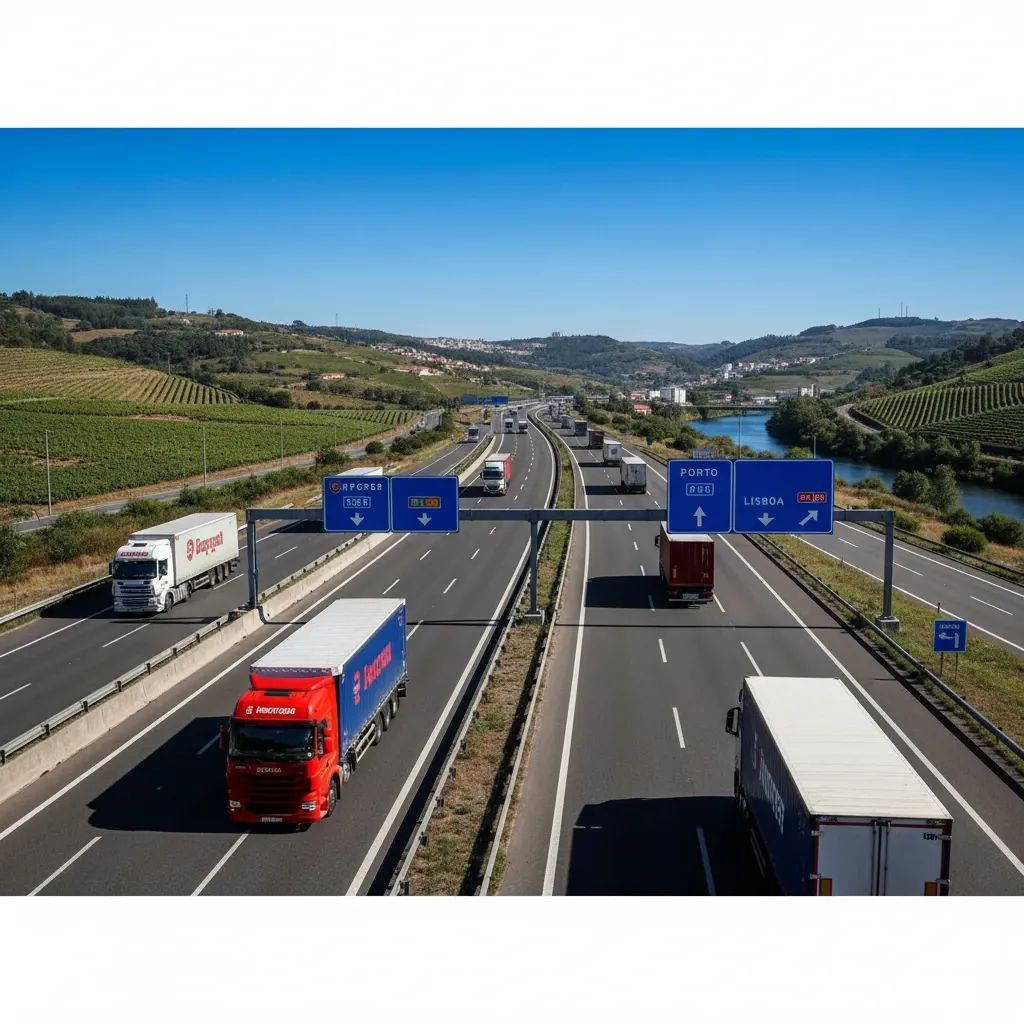
The Portugal Government has officially implemented a toll exemption for heavy goods vehicles on key highway stretches, a move that took effect on February 25, 2026, and will reduce operational costs for transport companies while reshaping traffic patterns in the Porto metropolitan area and central Portugal.
Why This Matters
• Heavy vehicles in classes 3 and 4 (trucks and trailers with height ≥1.10 meters at the first axle) no longer pay tolls on the A41, and sections of the A19 and A8, effective February 25, 2026.
• Retroactive refunds available: Companies can reclaim tolls paid since January 1, 2026, by requesting reimbursement from their toll service provider. If you operated these routes between January 1 and February 24, you're eligible to claim refunds now.
• Immediate cost relief: Transport operators in the Leiria district—home to major export industries including molds and glass—stand to gain significantly in competitiveness.
• Traffic redirection strategy: The exemption aims to divert heavy traffic from the congested VCI (Via de Cintura Interna), Porto's heavily congested inner ring road, onto the CREP (Circular Regional Exterior do Porto), the newer outer ring highway.
Legislative Clarity After Weeks of Standoff
The toll suspension entered force following the publication of clarifying legislation in the Diário da República on February 24, resolving a standoff between parliament and the Portugal Ministry of Infrastructure and Housing. The measure was originally included in Article 204 of the 2026 State Budget, but implementation stalled due to what the government described as technical barriers in distinguishing vehicle classes.
The Portugal toll system classifies vehicles into four categories based on height and number of axles. The ministry, led by Miguel Pinto Luz, initially argued that existing infrastructure could not differentiate between light and heavy vehicles within class 2 without additional specifications, making immediate application "operationally impossible."
The Socialist Party (PS) parliamentary group accused the government of "unprecedented disrespect" for parliamentary authority by failing to execute a budget provision already in force. PS/Leiria, led by Gonçalo Lopes, argued the district was being unfairly penalized and that the exemption was critical to support economic activity and reduce context costs for businesses heavily burdened by toll charges.
Three days after the ministry's January 6 statement, parliament approved a PS bill that removed ambiguity by defining the exemption as applying explicitly to classes 3 and 4 of the national toll system. The measure passed with broad support, with only the Liberal Initiative (IL) abstaining.
Geographic Scope of the Exemption
The toll suspension applies to three distinct highway segments:
A41 – Circular Regional Exterior do Porto (CREP): The entire loop around Porto is toll-free for heavy goods vehicles, designed to pull freight traffic away from the urban core and the congested VCI, Porto's inner ring road.
A19 – São Jorge to Leiria Sul: This section in the Leiria district serves as a key corridor for industrial traffic heading toward the capital and export hubs.
A8 – Leiria Sul to Pousos: Connecting central Portugal to the greater Lisbon area, this stretch is critical for freight movement and has long been a point of contention due to high toll burdens on regional exporters.
What This Means for Residents and Businesses
For transport operators, the exemption translates into immediate savings as of February 25, 2026. A single round trip by a class 4 vehicle on the affected A19 and A8 sections previously cost approximately €10 to €15 in tolls, adding up to thousands of euros monthly for companies running regular routes. With the suspension now in effect, these costs vanish entirely for the duration of the measure.
The Leiria district economy, anchored by export-driven industries like precision molds, glass production, and plastics, is expected to benefit from enhanced competitiveness. Local business groups have long argued that toll fees inflate logistics costs, making it harder to compete with firms in Spain, where roughly 85% of highways are now toll-free after the government opted not to renew concessions.
For Porto residents and commuters, the exemption is intended to reduce congestion on the VCI by offering freight carriers a free alternative route via the A41. Whether this achieves meaningful traffic relief will be monitored through government studies on metropolitan traffic flows, which are mandated to conclude by the end of 2026.
The exemption also ties into a separate study examining the negative impact of road traffic on the Batalha Monastery in Leiria district, a UNESCO World Heritage site. Heavy vehicle routing through the IC2 and EN242 national roads has contributed to congestion and vibration damage around the historic structure. The toll suspension on the A8 and A19 is designed to channel freight onto highways, sparing secondary roads and heritage zones.
How to Claim Retroactive Refunds
The law grants retroactive effect to January 1, 2026, meaning any tolls paid by class 3 and 4 vehicles on the exempted routes since the start of the year are eligible for reimbursement. The exemption is now active as of February 25, 2026.
To claim refunds, operators must file claims directly with their toll service provider:
• Via Verde: Contact their customer service at +351 217 230 400 or visit www.viaverde.pt to initiate a claim through their online portal or submit a written request with your toll receipts and vehicle registration documentation.
• Easytoll: Reach out at +351 213 606 060 or through their website to request retroactive refund processing.
• Other toll operators: Contact your provider directly—all concessionaires are legally obligated to process refunds for qualifying trips.
Transport companies should gather electronic toll receipts and vehicle registration documentation confirming class 3 or 4 status. Claims should be submitted promptly, as administrative backlogs could delay reimbursements. For official guidance, the Ministry of Infrastructure and Housing is expected to publish detailed instructions on its website (www.infraestruturas.pt) within the coming weeks.
Broader Context: Portugal's Toll Policy Shift
This exemption is part of a wider recalibration of Portugal's toll policy. On January 1, 2025, the government eliminated tolls entirely on the A22 (Algarve), A4 (northern corridor), and A25 (central east-west route), aiming to stimulate regional economies and reduce inequality in infrastructure access.
The 2026 budget continues this trend with targeted relief for freight operators, though tolls for passenger vehicles on most highways increased by approximately 2.3% due to inflation indexing. The divergence between passenger and freight toll policy reflects a strategic focus on industrial competitiveness rather than blanket toll abolition.
At the European level, the European Commission has proposed extending toll exemptions for zero-emission trucks and buses across the EU until mid-2031, incentivizing the transition to electric and hydrogen-powered fleets. Portugal has not yet adopted a CO2-based toll structure, unlike Germany and Austria, which now factor emissions into heavy vehicle toll rates.
Spain's aggressive toll elimination—covering routes like the AP-7 and AP-1—has set a competitive benchmark that Portuguese policymakers cannot ignore. Spanish freight operators enjoy significantly lower logistics costs, pressuring Portugal-based transport firms to lobby for similar relief.
Political and Economic Implications
The delay in implementing the toll suspension exposed friction between the Portugal Parliament and the executive branch. The PS seized on the government's hesitation to portray the administration as indifferent to the needs of export-heavy districts like Leiria, where toll costs are a persistent political grievance.
For the Portugal Cabinet, the episode underscored the operational complexities of administering selective toll exemptions within aging toll infrastructure. The ministry's claim of technical limitations was met with skepticism, particularly after the parliamentary clarification swiftly resolved the issue.
The exemption also reflects the influence of regional lobbying. The Intermunicipal Community of the Leiria Region (CIMRL) has been vocal in advocating for toll relief, even offering to subsidize temporary exemptions—at an estimated cost of €3.2M—following damage to alternative roads caused by Tempest Kristin earlier this year.
What Happens Next
The toll suspension remains in effect until the completion of government traffic studies, scheduled to conclude by December 31, 2026. These studies will assess whether the exemption successfully reduces congestion on the VCI, improves freight flow efficiency, and mitigates environmental and heritage impacts around the Batalha Monastery.
If the findings are favorable, the exemption could be extended or made permanent. Alternatively, the government may introduce a differentiated toll structure, potentially incorporating emissions-based pricing or dynamic congestion charges, aligning Portugal with broader European trends.
For now, transport operators should update route planning and billing systems to reflect the exemption effective February 25, while ensuring compliance documentation is in order for refund claims. Businesses that delayed shipments or avoided toll routes due to cost concerns may find this an opportune moment to reassess logistics strategies and capitalize on the temporary cost advantage.
The measure represents a tangible shift in how Portugal uses toll policy as an economic lever—prioritizing regional development and industrial support over revenue maximization. Whether this approach proves sustainable will depend on the balance between infrastructure maintenance costs and the economic gains realized by the freight sector.


