
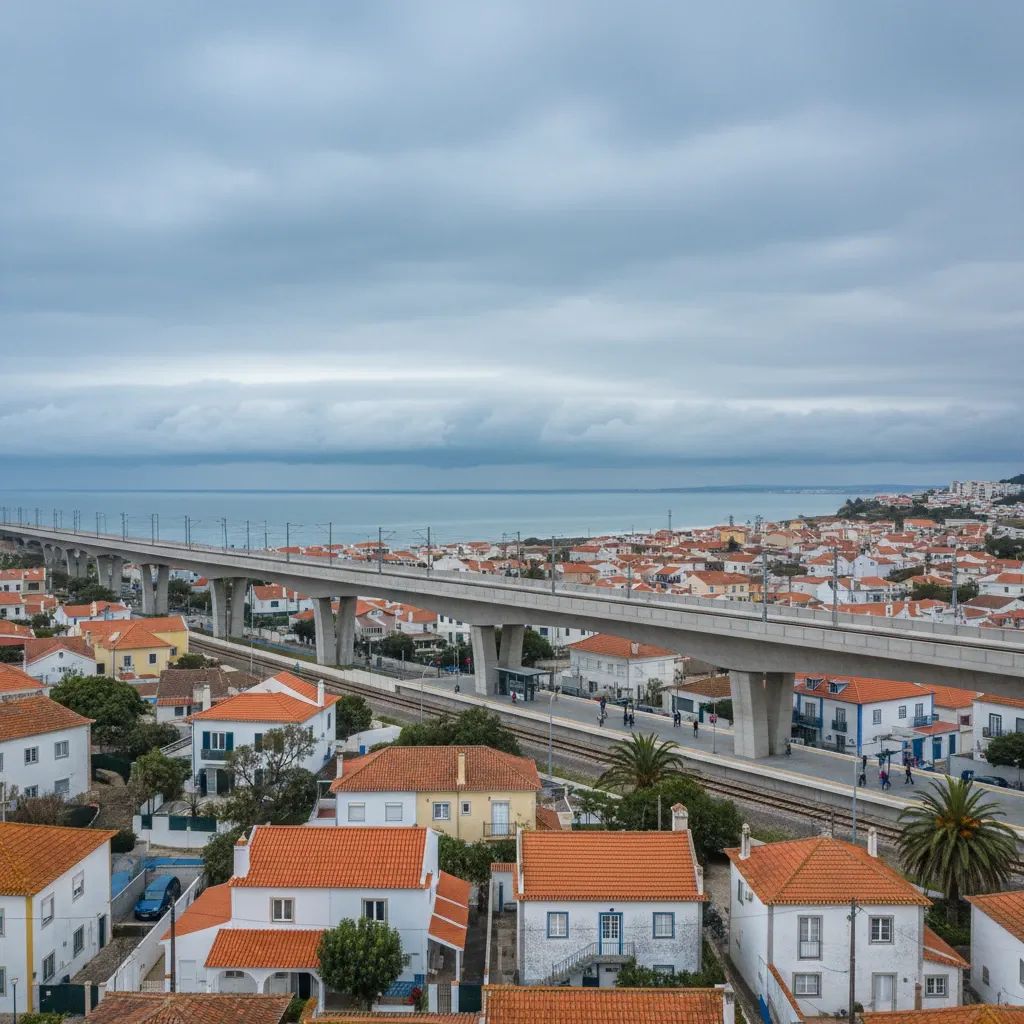
The Vila Nova de Gaia Municipal Council has declared the four-year delay in constructing underground pedestrian crossings along the Linha do Norte railway line "intolerable," escalating pressure on Infraestruturas de Portugal (IP) to honor commitments made to frustrated residents in the coastal neighborhoods of Aguda and Granja.
Why This Matters
• Broken promise: A 2022 protocol to replace unpopular elevated crossings with underground passages remains unfulfilled, with no construction project even drafted.
• Accessibility crisis: Frequent elevator breakdowns at the existing overhead walkways leave mobility-impaired residents stranded.
• Meeting imminent: Gaia officials will confront IP on Monday to demand action on the stalled infrastructure and inadequate station shelters across the municipality.
Protocol From 2022 Still Gathering Dust
Following requalification works on the Linha do Norte between Espinho and Vila Nova de Gaia, the state rail manager erected elevated pedestrian bridges in Aguda and Granja to maintain safety as trains now pass at higher speeds. Locals immediately protested the structures as "urban blight"—imposing metal-and-concrete frameworks that obstruct coastal views and force wheelchair users and elderly residents to navigate multi-story climbs even when elevators function.
In response, IP and the Gaia Municipal Council signed a cooperation agreement in July 2022 to study the feasibility of underground alternatives. Nearly four years later, the study itself remains unfinished. A first tender launched in November 2023 attracted zero bids; a revised procurement with a higher budget appeared in May 2025. As of early March 2026, the evaluation of proposals is ongoing, with the study phase alone projected to take an additional 180 days once a consultant is appointed.
Firmino Pereira, Gaia's vice-mayor for Public Facilities and Space (elected on the PSD/CDS-PP/IL coalition), told reporters the municipality will no longer tolerate excuses. "We consider the non-construction—indeed, the absence of even a project—intolerable and a breach of commitment to so many people who challenged the overhead crossings that were built," he said. Gaia has pledged to co-finance 20% of construction costs for any solution that emerges.
Elevator Failures Compound Accessibility Nightmare
Beyond the aesthetic and symbolic grievances, the existing overhead bridges suffer chronic mechanical failures. The lifts installed to meet accessibility standards break down with such regularity that residents in wheelchairs or pushing strollers frequently find themselves unable to cross the tracks for days at a time. Pereira argues that IP's maintenance regime is either inadequate or non-existent, turning a theoretical accessibility feature into a practical barrier.
"First, we will impress upon IP that regular maintenance of the elevators is essential," he explained. "But fundamentally, what matters to people—and to this council—is that the underground passages be built, precisely to eliminate this constant breakdown issue." The underground option would replace lifts with ramped or gently graded tunnels, sidestepping mechanical dependency altogether.
What This Means for Residents
For residents in the Aguda and Granja parishes, the delay translates into daily inconvenience and a sense of municipal neglect. Pedestrians heading to the beach, schools, or public transport must either gamble on elevator reliability or face lengthy detours. The dispute also illustrates a broader friction in Portuguese infrastructure projects: central state agencies often move at a pace that clashes with local political timelines, leaving citizens caught in bureaucratic limbo.
Gaia's insistence on underground passages—rather than accepting the completed overhead structures—reflects a strategic bet that long-term urban aesthetics and accessibility standards justify short-term pressure and delay. If IP concedes and funds the study and subsequent construction, other municipalities facing similar rail-modernization impacts may follow Gaia's blueprint of vocal opposition backed by financial co-investment.
Station Shelters "Undersized" Compared to Lisbon
The Monday meeting will also address what Pereira describes as a glaring disparity in passenger shelter quality between the Lisbon and Porto metropolitan rail networks. He singled out Devesas station in Gaia—soon to become the largest rail hub south of the Douro River once the Linha Rubi metro extension opens—as particularly ill-equipped.
"It is incomprehensible that there is a difference in the scale of shelters between Lisbon and Porto metropolitan stations," Pereira said. "Devesas is not adapted to the role of the metropolitan area's largest station south of the Douro." Current platform shelters cover only short sections, leaving commuters exposed to Atlantic rain and wind during peak hours when platforms fill with hundreds of passengers transferring between national rail and metro services.
The vice-mayor will demand that IP expand shelter coverage to span the full length of platforms at Devesas ahead of the Linha Rubi integration, expected to drive daily ridership into the tens of thousands. He framed the request as consistent with national policy: "If there is an appeal for people to use public transport—in this case, trains—we must provide conditions for them to use it."
Comparable stations in the Lisbon metropolitan area, such as Oriente and the renovated Santa Apolónia terminal, feature extensive weather protection and integrated commercial zones. By contrast, several Gaia stops along the Linha do Norte offer minimal canopies, a legacy of decades of underinvestment in northern rail infrastructure relative to the capital.
The Curious Case of the Missing 19th-Century Watchtower
Adding a cultural footnote to the technical disputes, Pereira revealed that the Mirante da Madalena—a revivalist-style watchtower erected in the 19th century specifically to watch trains pass below—has been disassembled and stored somewhere in Gaia, its location unclear even to municipal staff. The tower, a local landmark dismantled during the Linha do Norte works, was part of the 2022 protocol, with Gaia agreeing to fund reassembly.
"I had to ask council services where the pieces of the watchtower are," Pereira admitted. "They answered that they are possibly located. Clearly, if conditions exist, the council will proceed with reconstruction in the Madalena parish. I regret that this commitment was made and not fulfilled." According to IP records, the stone and metalwork were wrapped in protective casing and deposited on land owned by the Santa Casa da Misericórdia de Gaia, but no timeline exists for reconstruction.
Pereira declined to set a deadline, citing uncertainty over the complexity and cost of reassembly—whether it can be handled in-house or requires a specialist contractor. The tower, originally built after the railway line itself (which opened in 1864–65), symbolizes the historic relationship between Gaia's communities and the iron road that bisects them.
Broader Context: Linha do Norte Modernization
The Linha do Norte remains Portugal's busiest railway artery, carrying freight, commuter trains, intercity services, and international links between Lisbon, Porto, and onward to Galicia and France. Decades of deferred maintenance left the route slower and less reliable than European peers, and the Gaia bottleneck illustrates how local resistance and procedural complexity can stall infrastructure initiatives even when central funding is available.
The Countdown to Monday's Showdown
The scheduled meeting represents a test of leverage. Gaia controls land-use approvals and zoning decisions critical for ancillary rail projects, including parking facilities and commercial development around Devesas. IP, meanwhile, holds the purse strings for infrastructure spending and can delay projects until municipal co-financing materializes.
Observers in Portugal's transport sector will watch whether Pereira secures firm commitments—dates for study completion, budget allocations for tunnel construction, a maintenance schedule for elevators—or leaves with more promises that evaporate into administrative fog. For residents in Aguda and Granja, the answer will determine whether the next four years resemble the past four, or whether Portugal's rail modernization finally aligns with the lived experience of the people it is meant to serve.


