

Why This Matters
• Your compensation window: Delays beyond 3 hours or last-minute cancellations entitle you to €250–€600 under EU law, but you must claim within national timeframes or risk losing your right.
• Tourism's infrastructure test: When airports consistently strand passengers, Portugal risks surrendering market share to competitors—a threat worth substantial economic impact as 15% of the economy depends on visitor arrivals.
• New bottleneck in effect: The EU's Entry/Exit System (EES) biometric scanning, live since April 10, 2026, is creating 3-hour queues at border controls, compounding runway delays with administrative gridlock.
What Travelers Need to Know Now
If you're flying through Portugal, prioritize these three actions:
Morning departures are statistically more reliable than afternoon or evening flights, because delays accumulate throughout the day. International departures from Lisbon and Faro warrant a minimum 3-hour arrival window to account for both standard security processing and unpredictable EES biometric queues. Separate-ticket connections are especially risky; if your first flight delays, your second airline has no obligation to hold your seat.
EU Regulation 261/2004 guarantees:
• €250 for flights under 1,500 km
• €400 for EU flights over 1,500 km
• €600 for flights exceeding 3,500 km
These rights apply when delays exceed 3 hours at final destination or cancellations occur with fewer than 14 days' notice. Keep documentation: boarding pass photographs, delay notifications, receipts for meals and hotels, and written responses from the carrier. Travel insurance with flight disruption coverage has shifted from optional comfort to practical necessity given current airport volatility.
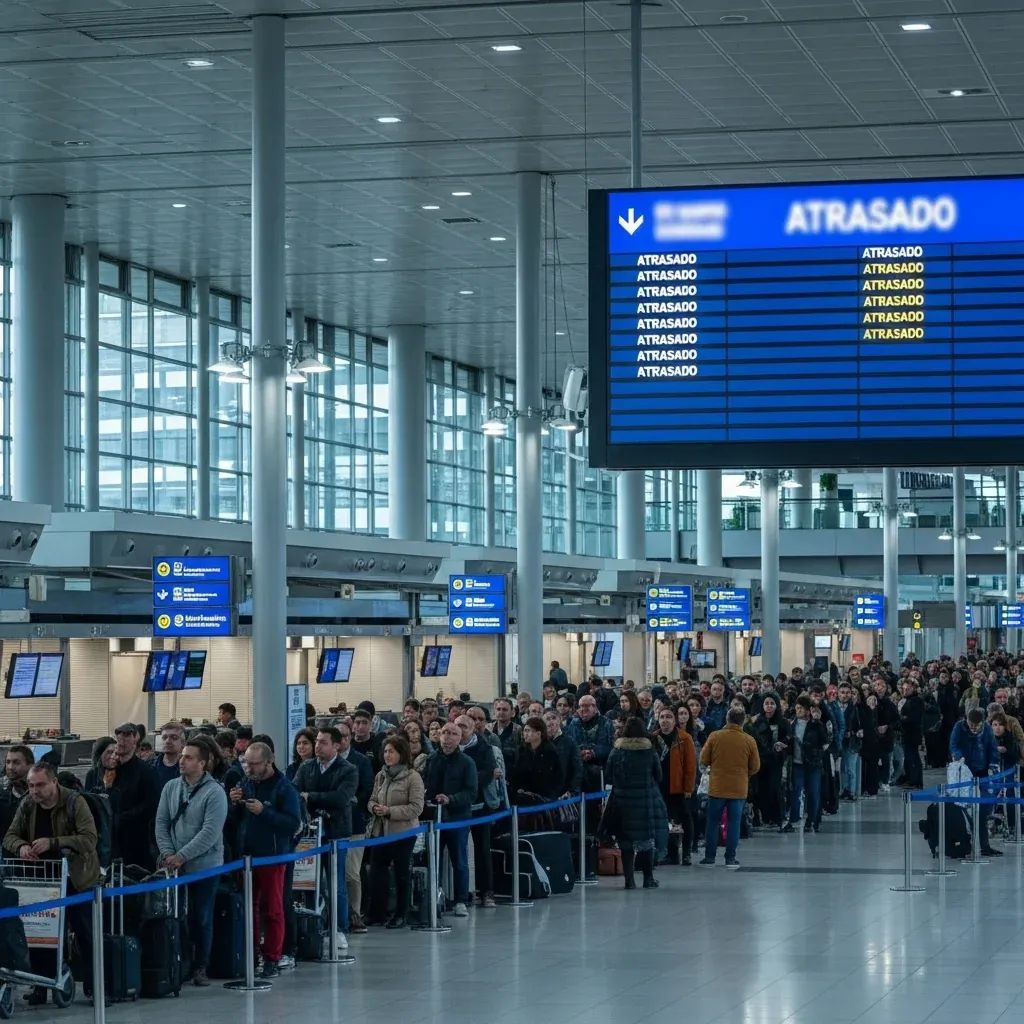
Over the past four months, Portuguese airports have experienced significant operational strain. Between January and March 2026, reports indicate disruption rates increased substantially compared to the same quarter in 2025, even as flight capacity expanded and passenger volumes climbed.
On April 19 alone, Lisbon's Humberto Delgado Airport registered 188 delayed departures and 2 cancellations. Simultaneously, Porto's Francisco Sá Carneiro Airport processed 45 delays and 4 cancellations. For most travelers, this translated to missed connections, forfeited hotel bookings, and the growing concern that Portugal's gateway infrastructure has become genuinely unstable.
The Anatomy of a System Under Stress
Lisbon Humberto Delgado operates under considerable pressure compared to other Portuguese hubs. The disparity reflects a fundamental asymmetry: Lisbon dominates national traffic but lacks the runway and slot flexibility to absorb operational surprises.
The specific causes converge rather than compete. On April 19, air traffic control protocols became overwhelmed, coinciding with adverse weather patterns and cumulative operational fatigue. Neither factor alone would have triggered the cascade; together, they exposed the system's razor-thin margin for error.
But beneath these acute episodes lies a chronic constraint: Lisbon operates above design capacity. Runway throughput, apron space for aircraft turnarounds, and available departure and arrival slots are all severely constrained. Airlines cannot add frequencies to new markets because slots don't exist. The airport cannot absorb a temporary surge—whether from weather delays, technical breakdowns, or security slowdowns—without systemic failure spreading backward through the day's schedule.
The New Friction: Biometrics and Border Chaos
On April 10, 2026, the EU Entry/Exit System (EES) transitioned to mandatory enforcement across all 15-nation European implementation zone, including Portugal. The system mandates fingerprinting and facial photography for every non-EU traveler entering or leaving European airspace. In theory, digitized biometric collection is more efficient than manual passport stamping. In practice, it has created significant bottlenecks.
Within days of full deployment, queues at Faro Airport—Portugal's third-largest hub and the main gateway for the Algarve—stretched to 3 hours during peak periods. This is not a security feature; it is administrative friction imposed by a new database system that airports and border agencies have struggled to fully staff or optimize. The Portugal Public Security Police (PSP) responded pragmatically, temporarily adjusting biometric data collection procedures at departure gates to prevent passengers from missing flights.
The economic stakes are concrete. The UK market accounts for substantial traffic to Faro during peak tourism season—precisely when the Algarve depends most heavily on visitor spending. If EES implementation becomes perceived as unreliable or time-consuming, tourists and tour operators may shift bookings to alternative destinations. For a region where hospitality and related services employ significant numbers of workers, such reallocation represents real economic impact.
Economic Vulnerability and Sector Exposure
Tourism and travel-related services represent roughly 15% of Portugal's annual economic output. Industry forecasters have cited infrastructure strain as a factor contributing to economic uncertainty, though causation remains complex and involves multiple variables.
Government and international institutions maintain varying growth projections for 2026, reflecting underlying uncertainty about the economy's trajectory. This variance is not merely academic. When international rating agencies and policy institutions diverge on growth outlooks, foreign investors notice and adjust capital allocation accordingly.
Infrastructure Constraints and Competitive Positioning
Portugal has deployed some operational improvements. Lisbon's new air traffic sequencing model has reduced arrival-related delays by better managing incoming aircraft flow. Terminal renovations and apron optimization at Faro have improved turnaround times and ground handling capacity. These are meaningful improvements within a constrained envelope.
They are insufficient to resolve the core problem: Lisbon Humberto Delgado has run out of runway capacity—literally and figuratively. Expanding the airport requires years of capital investment, environmental permitting, and infrastructure coordination that has been repeatedly deferred. Absent major expansion, the airport remains trapped in a no-win scenario: restrict passenger growth (economically painful, competitive disadvantage), or accommodate growth and accept recurring disruption (operationally painful, tourism reputation damage).
Porto and Faro have more headroom, but they too face capacity constraints if current growth trajectories persist.
The Competitive Reckoning Ahead
Portugal positioned itself over the past decade as a stable, culturally rich, weather-blessed destination for European leisure travelers and digital nomads. That positioning depends entirely on delivering a frictionless arrival experience. An airport plagued by delays, coupled with extended border queues, breaks that promise immediately. Competitors—Spain, Greece, Italy—are acutely aware that any operational stumble by Portugal creates an opening.
The Airports Council International Europe (ACI Europe) has urged national governments for regulatory flexibility on border processing during extreme congestion periods. Implementation remains inconsistent across the EU. Portugal's pragmatic response—temporary EES adjustments by the PSP—reflects the absence of centralized European coordination.
What comes next depends on political will and capital availability. Short term, passengers should expect continued operational challenges. Medium term, either Portugal invests substantially in airport expansion and optimizes EES processing through staffing and technology, or it gradually loses market share to competitors with smoother infrastructure. Long term, the tourism sector's contribution to Portugal's economy requires decisive action. The window to address these constraints remains open, but the operational pressures are already mounting.


