

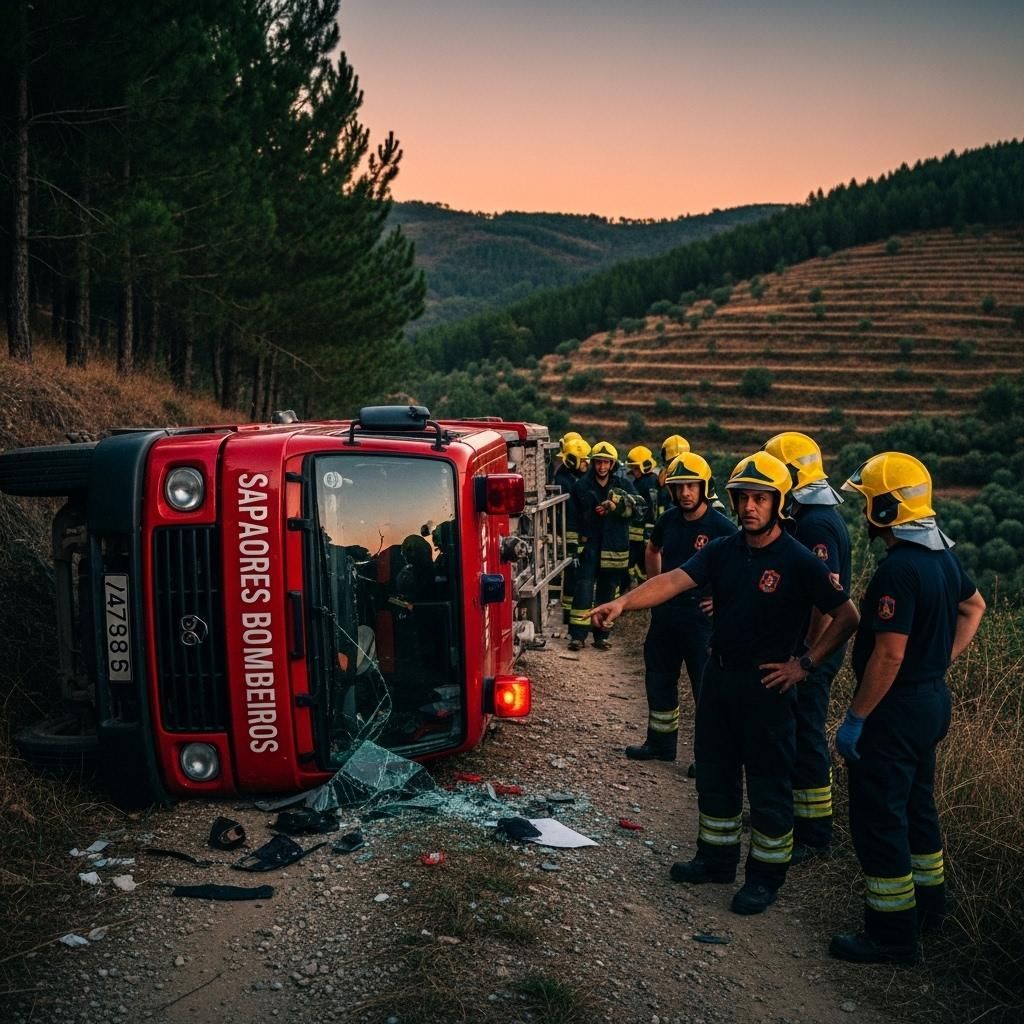
A single-vehicle crash on a national road in the Baixo Alentejo region on Sunday afternoon claimed the lives of two men—a 35-year-old Moldovan national and a 25-year-old Romanian—and left two other passengers with serious injuries. The accident, which occurred near the village of Peroguarda in Ferreira do Alentejo municipality, underscores ongoing concerns about road safety on secondary highways in Portugal's southern interior.
Why This Matters
• Two dead, two injured: A Moldovan man (35) and a Romanian man (25) died; a man and a minor girl were hospitalized in serious condition.
• EN387 temporarily closed: The national road was shut down in both directions until 5:20 PM for rescue and forensic operations.
• Cause under investigation: The Portugal Royal Police (GNR) Traffic Accident Investigation Unit is still determining what caused the vehicle to leave the road.
• Regional pattern: The Baixo Alentejo recorded 20 fatal accidents in 2025, with national roads accounting for over 36% of deadly crashes.
Emergency services received the alert at 2:31 PM on May 3, dispatching 33 personnel and 13 vehicles from fire brigades in Ferreira do Alentejo, Cuba, and Beja, along with the GNR and the Portugal National Institute of Medical Emergency (INEM). A medical helicopter from the Algarve was scrambled but ultimately did not transport any victims; all survivors and bodies were moved by ambulance to Beja Hospital, where the injured remain under care and the deceased were transferred to the legal medicine services.
What Investigators Know So Far
The crash took place at kilometer 2.2 of the EN387, a two-lane national road linking inland Alentejo towns. All four occupants—three Romanians and one Moldovan—were traveling in the same passenger vehicle when it veered off the roadway. None of the occupants were carrying identification documents at the time of the crash, which initially delayed the release of victim details.
The GNR's Traffic Accident Investigation Unit has opened a formal inquiry but has not yet released any preliminary findings. Authorities have not confirmed whether speed, driver distraction, mechanical failure, or road conditions played a role. No witness accounts have been made public.
Road traffic was restored around 5:20 PM once emergency crews completed their on-scene work and forensic teams finished documenting the wreckage.
The Broader Safety Picture
Portugal's national roads—designated EN followed by a number—carry a disproportionate share of fatal crashes. While they account for less than 20% of all accidents nationwide, they concentrate 36.8% of road deaths, according to 2024 data from the Portugal National Road Safety Authority (ANSR).
In the Alentejo region specifically, 36.5% of traffic fatalities occur on these secondary highways, which often lack the median barriers, lighting, and speed enforcement infrastructure found on motorways. The Baixo Alentejo recorded 20 fatal accidents in 2025, marking a slight decline from 21 in 2024. In the first half of 2025, the region logged 18 deaths, unchanged from the same period in 2024, despite a modest drop in total accident volume.
Beja district saw 1,017 crashes in the first six months of 2025, down from 1,031 in the same period of 2024. The May 3, 2026 tragedy on EN387 adds to the ongoing road safety concerns and raises fresh questions about whether current safety measures are adequate for rural highways.
What This Means for Residents
For those living in or traveling through rural Alentejo, the incident is a stark reminder of the risks posed by secondary roads that lack modern safety features. The EN387, like many rural routes, sees a mix of agricultural vehicles, local commuters, and long-distance traffic, often at higher speeds than urban roads permit.
Portugal's National Road Safety Plan 2023–2027 sets national targets for reducing casualties, but implementation at the municipal level varies. Municipal Road Safety Plans (PMSR) allow local councils to tailor interventions—such as improved signage, speed cameras, pedestrian crossings, and road surface repairs—to local accident data. However, no specific upgrades or scheduled roadworks for the EN387 have been announced by Ferreira do Alentejo authorities or the national road agency.
The European Union is rolling out new vehicle safety standards for cars registered after July 2026, which will mandate emergency braking systems with pedestrian and cyclist detection, lane-keeping assist, and speed limiters. These technologies may gradually reduce crash severity on rural roads, but the benefits depend on fleet turnover and enforcement.
Emergency Response and Helicopter Deployment
Sunday's mobilization highlighted the logistical challenges of emergency medicine in Portugal's sparsely populated interior. INEM dispatched a Medical Emergency and Resuscitation Vehicle (VMER) from Beja Hospital and an Advanced Life Support (SIV) ambulance from Castro Verde, along with the Algarve-based helicopter.
The helicopter accompanied the ambulance convoy but did not airlift any patients, suggesting that the victims' conditions—while critical—did not require the speed advantage of aerial transport, or that weather and terrain made road transfer safer. The decision underscores the protocol-driven nature of triage in multi-casualty incidents, where ground ambulances often provide more stable environments for severely injured patients.
Legal and Investigative Next Steps
The GNR Traffic Accident Investigation Unit will analyze tire marks, vehicle telemetry if available, road surface conditions, and autopsy results to reconstruct the sequence of events. If speed, alcohol, or driver fatigue are implicated, criminal charges could follow. If the road itself—poor signage, defective barriers, or inadequate drainage—is found to be a contributing factor, liability may extend to the Portugal Infrastructure and Housing Agency (Infraestruturas de Portugal) or local authorities.
Families of foreign nationals killed in Portugal are entitled to consular support and can pursue civil claims for damages, though the process often involves navigating both Portuguese tort law and bilateral agreements on legal aid.
A Preventable Tragedy?
Sunday's crash is the latest data point in a decades-long debate over Portugal's rural road network. While motorways like the A2 and A6 have seen steady declines in fatalities thanks to central barriers, lighting, and enforcement, the thousands of kilometers of national and municipal roads remain under-resourced.
Advocacy groups have long called for systematic road audits, lower speed limits on high-risk stretches, and mandatory electronic stability control retrofits for older vehicles. The National Road Safety Plan acknowledges these gaps but faces budget constraints and competing infrastructure priorities.
For now, the investigation into the Peroguarda crash continues, and two families mourn preventable losses on a quiet Sunday afternoon in the Alentejo countryside.


