
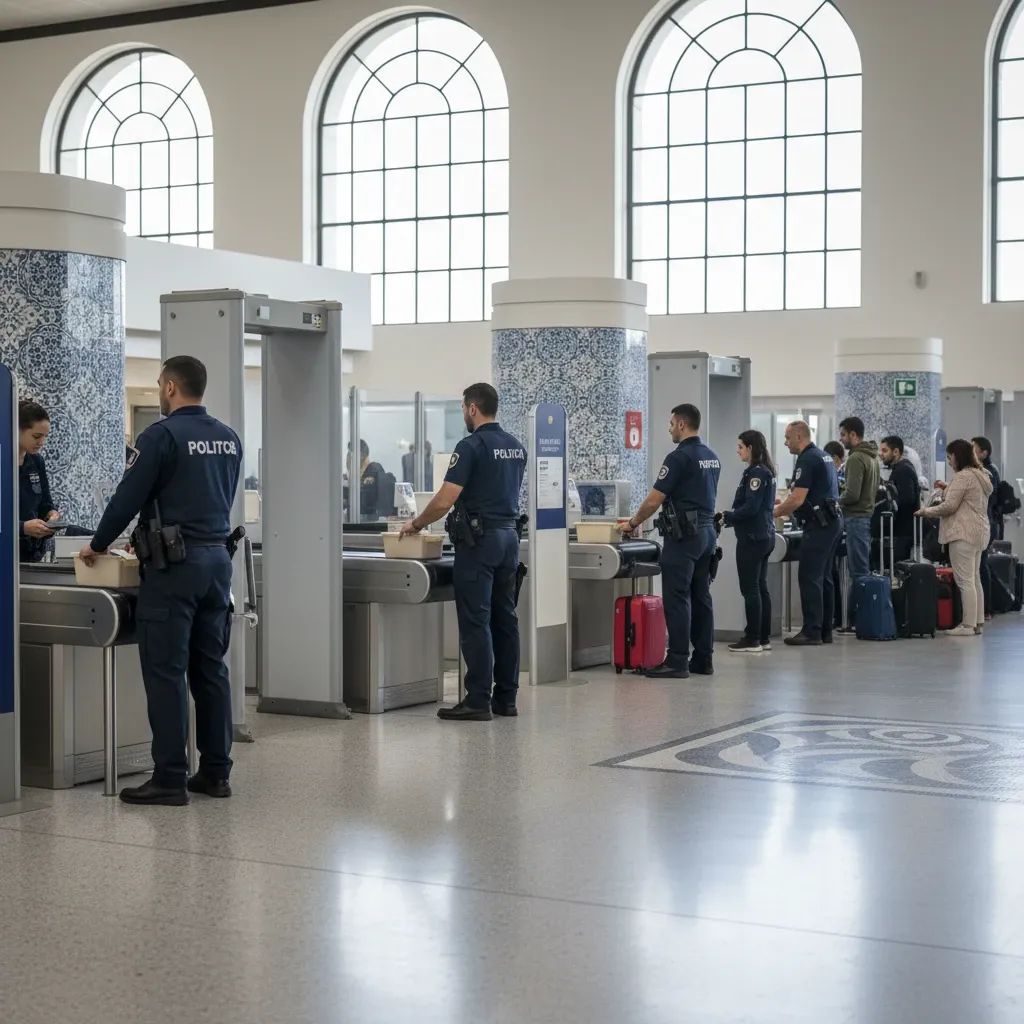
The Polícia Judiciária has apprehended a 28-year-old suspected drug trafficker in Lisbon who allegedly coordinated a Telegram-based narcotics operation spanning Estonia over an eight-month period. The arrest, executed under a European Arrest Warrant (EAW) issued by Estonian judicial authorities, illustrates both the increasing sophistication of encrypted-app trafficking networks and the cross-border police cooperation that underpins European enforcement efforts.
Why This Matters
• Telegram trafficking is surging: Portuguese authorities have dismantled multiple networks using encrypted messaging apps to sell drugs delivered by fake Uber Eats couriers and CTT postal services—this case proves the model operates continent-wide.
• EAW speed: The arrest occurred today, demonstrating that Portugal's judicial system processes European warrants swiftly for serious organized crime, reducing extradition delays from months to days.
• Sentencing exposure: If convicted in Estonia, the suspect faces up to 15 years in prison for crimes committed between mid-2025 and February 2026.
• International operations: The arrest confirms that international crime syndicates view Portuguese cities as viable operational bases, a reality relevant to ongoing EU enforcement coordination.
The Operation: Eight Substances, One App
Estonian investigators allege the detained man held leadership and coordination responsibilities within a trafficking ring that moved wholesale volumes of eight distinct controlled substances: amphetamines, cannabis, hashish, ketamine, cocaine, MDMA, LSD, and hallucinogenic mushrooms. The inventory mirrors Europe's polysubstance market, where consumer demand has diversified beyond traditional cocaine and heroin into club drugs, psychedelics, and synthetic stimulants.
Crucially, the network did not rely on street-level dealers or physical storefronts. Instead, the suspect allegedly issued instructions through Telegram for handling, packaging, and sale—a command-and-control structure that insulates bosses from product handling while maintaining operational authority. Telegram's end-to-end encryption and weak identity verification make it harder for law enforcement to intercept communications or link accounts to physical devices, a structural advantage that has turned the platform into a preferred marketplace for European drug syndicates.
The Polícia Judiciária statement confirms the crimes spanned roughly eight months, ending in February 2026—suggesting Estonian authorities needed an additional two months to trace the suspect's movements to Portugal before transmitting the EAW that triggered today's arrest.
How Telegram Networks Bypass Traditional Policing
The suspect's alleged business model is part of a broader European trend that has accelerated sharply in 2025–2026. In December 2025, Portuguese police dismantled a separate ring that branded itself as a "grocery store" on Telegram, shipping narcotics nationwide via CTT postal services—16 individuals were charged in that case. Earlier that same month, Lisbon authorities broke up a more elaborate operation employing fake Uber Eats couriers who concealed drugs inside gummy candies, chocolates, and vape cartridges, managed through a custom-built app designed by the syndicate's own programmers.
These networks share common features that challenge conventional law enforcement:
Payment flexibility: Traffickers now accept debit and credit cards, cryptocurrency wallets, and digital transfers—moving beyond cash to exploit the same fintech infrastructure that powers legitimate e-commerce.
Discreet delivery: Beyond postal services, syndicates recruit "estafetas" (couriers) who mimic food-delivery drivers, reducing the visual signature that might alert police patrols.
Encrypted coordination: Telegram groups function as both catalog and dispatch center, with product photos, strain reviews, and order confirmations circulating in channels that can be deleted or migrated in seconds if compromised.
The European Union Agency for Drugs (EUDA) flagged these dynamics in its June 2025 European Drug Report, warning that organized crime groups are exploiting digital platforms and the dark web to expand market reach faster than regulators can adapt. In January 2026, Europol noted that cocaine trafficking into Europe had reached "unprecedented levels," with criminal networks fragmenting routes and adopting "increasingly complex methods"—including online recruitment of couriers via social media, promising easy money to economically vulnerable young adults.
European Cooperation and Enforcement
For residents and policymakers across the EU, this arrest confirms the effectiveness of the Polícia Judiciária's cooperation with Baltic and European partners under the EAW framework. The mechanism, in force since 2004, eliminates the bureaucratic sluggishness of traditional extradition by allowing one EU member state's judicial warrant to trigger immediate action in another. For crimes such as drug trafficking—which qualify for EAW without requiring "dual criminality" checks (i.e., proof that the act is illegal in both jurisdictions)—the turnaround can be measured in days rather than months.
This coordination speed is particularly relevant as cross-border organized crime increasingly uses Portugal as a logistical hub for the European market, exploiting Atlantic port access and favorable real estate prices for operatives. The suspect's apprehension underscores the importance of sustained investment in Polícia Judiciária resources, cross-border intelligence sharing, and Telegram monitoring capabilities to counter such operations.
The Tribunal da Relação de Lisboa (Lisbon Court of Appeal) will now decide on coercive measures—typically either pre-trial detention or electronic monitoring—before the suspect is extradited to Estonia to face formal charges. Portuguese law allows courts to refuse EAW execution only under narrow circumstances (risk of inhuman treatment, minor offenses, or nationality concerns in some cases), so extradition is highly probable.
The Bigger Picture: Europe's Encryption Dilemma
The case arrives as the European Commission pursues a renewed anti-drug trafficking action plan launched in December 2025. That strategy includes a platform to counter recruitment of minors by trafficking networks via social media and messaging apps—a recognition that Telegram and similar services are not merely communication tools but recruitment and logistics infrastructure for organized crime.
Yet law enforcement faces a structural puzzle. Telegram's architecture—decentralized servers, optional two-factor authentication unlinked to real identities, self-destructing messages—was designed to resist state surveillance. While that appeals to privacy advocates and dissidents, it equally benefits criminals. The EUDA's 2025 report highlighted this tension, noting that encrypted platforms complicate "fiscalization" (regulatory oversight) and tracing of synthetic cannabinoids and novel psychoactive substances entering the EU market.
Portugal itself has struggled with full EAW compliance. In December 2021, the European Commission opened an infringement procedure against Portugal (alongside Latvia and other member states) for incorrectly transposing EAW deadlines and optional refusal grounds—suggesting bureaucratic friction persists even within the streamlined framework. The July 2025 EU Mutual Evaluation Round, which assessed Portuguese judicial, police, and customs cooperation on drug trafficking, aimed to identify procedural bottlenecks and best practices, though its findings have not yet been publicly released in full.
What Happens Next
The detained suspect will appear before the Tribunal da Relação de Lisboa in the coming days. If extradited—an outcome Estonian prosecutors will almost certainly seek—he will stand trial in Estonia, where a conviction for organized drug trafficking leadership could yield the maximum 15-year prison term referenced by the Polícia Judiciária.
This arrest serves as a reminder that Portugal's integration into European policing mechanisms underpins effective cross-border cooperation against organized crime. The same legal infrastructure that expedites the capture of foreign fugitives helps ensure that international criminal networks face swift accountability. As digital trafficking methods continue to evolve, sustained coordination among EU member states remains essential to combating these threats.


