

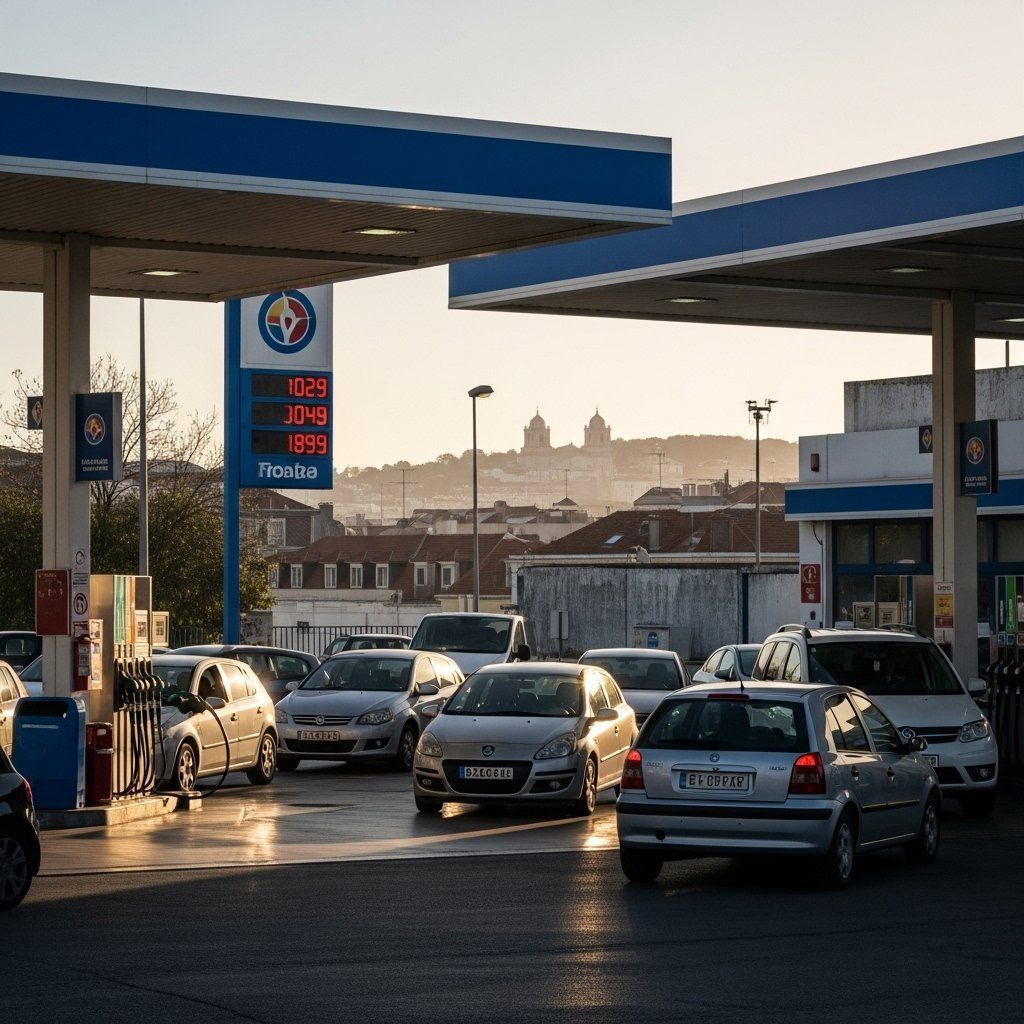
Diesel Price Drop Takes Effect Monday Across Portugal
Motorists will see meaningful relief at the pump starting next week, with diesel prices set to drop 13 cents per liter and petrol falling by 3 cents, according to projections from the National Association of Fuel Retailers (ANAREC). The decline follows global crude oil price movements related to Middle Eastern developments.
Why This Matters
• Diesel relief: The drop brings diesel to approximately €1.95 per liter, down from €2.08 last week—a 13-cent reduction that translates to roughly €6.50 in savings per 50-liter tank.
• Madeira advantage: The autonomous region will maintain its 13.3-cent price advantage over the mainland on petrol and a 5-cent edge on diesel.
• Aviation fuel concerns: Portugal's government is monitoring jet fuel supply conditions closely given global market pressures during the peak summer season.
Global Energy Markets Drive Price Changes
The price decline reflects broader volatility in global energy markets linked to geopolitical developments in the Middle East. Global benchmark crude prices influence fuel costs across Europe and Portugal, regardless of the country's direct energy sources.
Portugal sources crude oil from Brazil, Nigeria, Angola, and the United States rather than the Middle East. However, global benchmark prices such as Brent crude determine import costs across European markets, including Portugal.
What This Means for Residents
For households and businesses across Portugal, the diesel drop is significant. The country's road freight sector and rural communities rely heavily on diesel, and the 13-cent reduction offers meaningful savings. Petrol's 3-cent fall also provides marginal savings for private motorists.
At current projections, diesel will settle around €1.95 per liter, down from an average of €2.08 recorded by the Directorate-General for Energy and Geology (DGEG) before the price adjustment. Petrol should land near €1.90 per liter, compared to the previous €1.91 average.
In the Madeira Autonomous Region, the local government announced its own price cuts effective immediately: petrol (IO95) falls 2.7 cents to €1.78 per liter, while diesel drops 4.7 cents to €1.93. Marked and colored diesel for agricultural use declines 4.4 cents to €1.50. The regional administration emphasized that Madeira retains a structural price advantage over the mainland due to regulated pricing and lower distribution costs.
Aviation Fuel: Government Monitoring Supply
Portugal's aviation sector remains a focus for government attention. The Minister of the Presidency confirmed during a Cabinet briefing that the government is working to ensure aviation fuel supply remains adequate through the peak summer season. Officials are coordinating with energy suppliers and evaluating options at both national and European Union levels.
The European Commission is preparing support measures for sectors exposed to energy price shocks, and Portugal is engaged in these discussions.
LPG Bottled Gas: Sector Seeks Relief
Bottled liquefied petroleum gas (LPG) users are lobbying for relief on fuel costs. João Durão, president of ANAREC, testified before Portugal's Budget, Finance, and Public Administration Committee this week, arguing that LPG cylinders serve as the primary energy source for families, particularly in rural and interior regions where electricity and natural gas networks don't reach.
Durão called for the value-added tax (VAT) on LPG cylinders to be reduced from 23% to 6%, aligning it with essential goods. He noted that the sector has shrunk over the past decade and that without fiscal relief, bottled gas distributors could face challenges in serving their customer base.
The Madeira regional government has already taken action, increasing its "Solidarity Gas" subsidy for vulnerable families. The measure covers more than 3,300 households and provides additional support to offset energy costs during peak periods.
Energy Dependence and Economic Context
Portugal's exposure to global oil price movements underscores a structural reality: the country imports 100% of its fossil fuels and still derives roughly half of its primary energy consumption from oil. While Portugal no longer sources crude directly from the Middle East, global crude prices drive costs throughout the economy.
The Brent crude reference is priced in dollars, adding a currency dimension: fluctuations in the euro-dollar exchange rate influence import costs independent of barrel prices. Energy price volatility affects inflation, household budgets, and operational costs for freight and logistics firms.
For the tourism sector, which employs hundreds of thousands across the country, energy stability is important given the sector's reliance on air connectivity and the global nature of travel logistics.
What Comes Next
The Portugal Cabinet continues to assess energy policy and may adjust measures as conditions evolve. Options reportedly under discussion include temporary reductions in the Petroleum Products Tax (ISP) to minimum European Union thresholds, targeted fuel support for transport and agriculture, and coordination with Brussels on strategic initiatives.
For now, motorists can expect relief at the pump starting Monday. Energy markets remain subject to various global pressures, and Portugal's government is monitoring developments to ensure stable supply for both consumers and critical sectors such as transportation and tourism.


