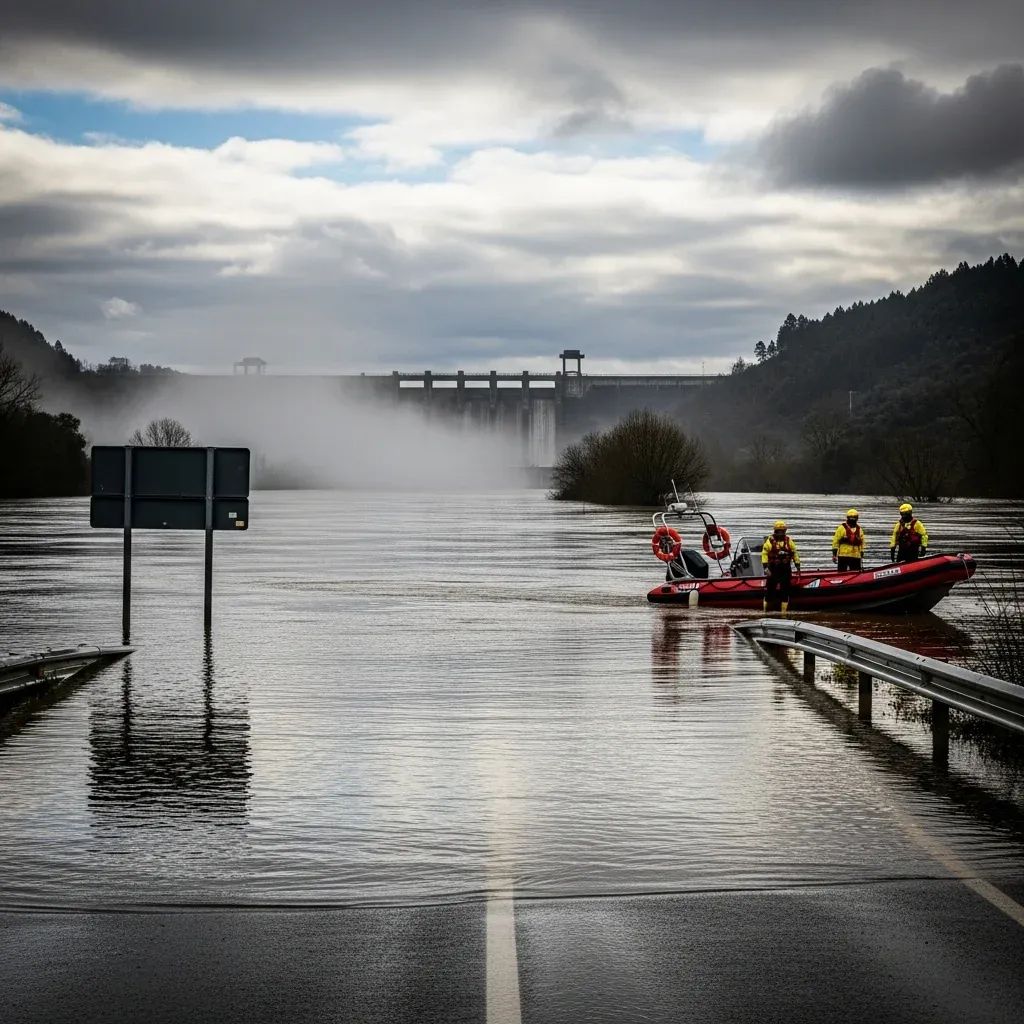
When late January's torrential rains overwhelmed aging infrastructure across central Portugal, the Portuguese Environment Agency (APA) executed a high-stakes race against floodwaters that revealed both the fragility of 1970s-era systems and the urgent need for climate-adapted alternatives. The extreme precipitation from storms Joseph and Kristin on January 26-27, 2026, triggered cascading infrastructure failures in February, with the critical dike rupture near Casais on February 11. By late February, temporary sealing of critical ruptures along the Mondego and Lis Rivers has bought some breathing room—but behind these provisional fixes lies a far larger reckoning with obsolete flood protection.
Why This Matters
• Temporary repairs buy time, not security: Provisional dike seals at Coimbra and Leiria prevent further water discharge but do not eliminate future rupture risk; the underlying infrastructure remains outdated
• Agricultural recovery hinges on drainage timing: Approximately 12,000 hectares of submerged farmland around Coimbra will require weeks of sustained dewatering before spring planting becomes possible
• Economic exposure extends beyond immediate damage: National agricultural and forestry losses may approach €1 billion, with permanent infrastructure solutions remaining years away
A River System Under Siege
The Mondego basin experienced its most serious infrastructure failure in a generation when the right-bank dike near Casais gave way on February 11, days after the extreme precipitation from storm systems Joseph and Kristin on January 26-27. The cascade of destruction—including partial collapse of the A1 motorway—forced evacuation of roughly 3,000 residents and pushed regional authorities into contingency planning for potential city-center evacuation as the Aguieira Dam approached dangerous capacity levels. The APA deployed approximately 7,000 tonnes of clay-based aggregate to create a provisional seal, reinforced with an additional 4,000 tonnes, allowing engineers to halt the water's progression into adjacent agricultural zones.
This intervention represented not a solution but an emergency stabilization—indispensable for drainage operations to commence but entirely inadequate for long-term protection. The provisional repair prevents river flow from spilling into fields, yet the dike structure itself remains fundamentally compromised.
Parallel structural failures along the Lis River in Leiria underscore how comprehensively the infrastructure failures in February exposed systemic weaknesses that had developed over decades. A breach beneath the A17 viaduct in Amor parish initially diverted substantial river flow onto surrounding farmland. As accumulated floodwaters mounted over subsequent days, two additional ruptures appeared two kilometers downstream, while the Amor collector tributary developed a significant breach. The cascading failures reached their nadir when the Aroeira collector collapsed across an 80-meter stretch, creating sweeping inundation of Monte Real agricultural lands. The APA expects completion of temporary repairs along the Lis within approximately three weeks, though definitive reconstruction timelines remain entirely undefined.
The Economic Toll Reshaping Regional Agriculture
The immediate financial devastation concentrates heavily in agricultural production. Two ornamental plant nurseries in Coimbra's flood zone—Flora Atlantic Plants and Viveiros Alfredo Moreira da Silva—project combined losses exceeding €5 million as floodwaters destroyed infrastructure and wiped out standing inventory. The Cooperativa Agrícola de Coimbra documented approximately 2,000 tonnes of stored corn ruined by water infiltration, representing months of accumulated harvest in a single facility.
Horticulture losses in Coimbra district surpass €500,000, encompassing warehouse roof destruction, dozens of collapsed greenhouses, and thousands of uprooted trees and olive groves—generational cultivation erased in days. The rupture of the Casais dike destroyed much of the irrigation infrastructure serving approximately 10,000 hectares between Coimbra and Figueira da Foz, leaving farmers without functional systems regardless of whether fields eventually dry.
The damage pattern in Leiria reveals a livestock sector in acute distress. The pig farming industry across 285 operations faces €280 million in documented losses, while the poultry sector experienced approximately 80,000 laying hens lost, disrupting egg supply chains through 2026. A single agricultural operation near Caldas da Rainha lost complete greenhouse infrastructure and standing crops—€4.5 million in losses representing years of accumulated investment and livelihood security.
Nationwide assessment suggests total agricultural and forestry damage may approach €1 billion, though the Ministry of Agriculture had formally logged only €303 million in damage declarations from 4,208 separate incidents through mid-February. Recovery declarations continue arriving as floodwaters recede and damage assessment progresses.
Infrastructure Designed for Yesterday's Weather
The core vulnerability animating this crisis stems from an uncomfortable reality: the Mondego dike system, constructed between the late 1970s and mid-1980s, was engineered for meteorological patterns that no longer exist. Design parameters reflected historical rainfall intensity and river discharge patterns that climate change has rendered obsolete. Contemporary storm systems routinely exceed design thresholds that seemed conservative when these barriers were planned.
Maintenance protocols and monitoring procedures that functioned adequately for decades proved insufficient when circumstances shifted fundamentally. Budget constraints and bureaucratic inertia historically delayed critical upkeep—vegetation control, seepage point inspection, embankment reinforcement—until deterioration forced emergency intervention. The January storms, combined with aging infrastructure, exposed how comprehensively these deferred maintenance practices left systems vulnerable.
The Mondego employs overflow channels, fusible dikes, and siphon systems on its right bank designed to relieve pressure and prevent overtopping. Yet even these engineered safety valves proved inadequate when precipitation loads from Joseph and Kristin on January 26-27 exceeded accumulated water management capacity. The system operated at design limits and then beyond, revealing the harsh mathematics of infrastructure overstressed by contemporary weather realities.
The National Laboratory of Civil Engineering (LNEC) conducted technical inspections and recommended installing filtration barriers using sandbags at vulnerable seepage points as a precautionary measure during future high-water periods. This tactical approach addresses localized vulnerabilities while larger systemic solutions develop, but represents incremental adjustment rather than fundamental redesign.
Historical Echoes and Recurring Patterns
Portuguese water management history demonstrates consistent, recurring vulnerabilities across centuries. Documentary evidence places the Douro River floods as far back as 1526, with subsequent major events in 1585, 1596, and 1644. The catastrophic 1967 Lisbon flooding killed approximately 700 people and destroyed 20,000 homes, exposing fatal gaps in urban planning and drainage system capacity. The 1948 Mondego flood remains the largest recorded event in that basin.
More recent failures include the 2000-2001 dike rupture displacing 400 Mondego families and the 1983 and 1989 Tagus basin floods, which demonstrated conclusively that even major dam systems cannot fully control catastrophic events when upstream precipitation exceeds design parameters. The pattern reveals consistent themes: construction encroaching on natural floodplains, deferred maintenance of protective systems, and infrastructure capacity fundamentally mismatched to actual hydrological behavior.
The governmental response to the February 2026 emergency—triggered by the January extreme precipitation events—has initiated meaningful institutional acknowledgment of systemic inadequacy. The Portuguese Government requested an urgent technical report evaluating flood impacts on the Mondego basin and assessing whether existing risk management models remain viable for contemporary climate conditions. This review may catalyze significant infrastructure investment in coming years, though property owners should anticipate protracted timelines rather than expedited solutions.
What This Means for Property Owners and Residents
Farmers and landowners in affected zones confront a narrow window of opportunity. Spring planting season approaches, and every week of prolonged waterlogging represents lost income and potentially fallow fields through the entire 2026 growing season. Agricultural experts privately advise some clients to write off 2026 production entirely and redirect resources toward soil remediation for 2027 planting, acknowledging that extended submersion may degrade soil structure and nutrient chemistry.
Insurance companies will likely reassess risk profiles for identified flood zones, potentially increasing premiums or restricting coverage availability. Some underwriters may invoke force majeure clauses, creating protracted disputes over damage claims. Real estate values in vulnerable areas face downward pressure as buyers factor flood risk into purchase decisions.
Municipalities will probably update zoning regulations and building codes to reflect current flood risk maps, potentially restricting future development in areas previously considered safe. These regulatory changes, prudent from safety perspectives, impose additional costs on property owners seeking to rebuild or improve structures.
The Portuguese Government extended the state of calamity declaration to 68 municipalities through February 15. Property owners, farmers, and businesses in affected areas should prepare for a protracted restoration process extending well beyond emergency response phases.
Institutional Response and Prevention Frameworks
The temporary restoration of dike integrity enables drainage operations while engineers design permanent solutions—a process typically requiring extensive geological surveys, environmental impact assessments, and funding allocations spanning years rather than months. The APA has committed to a comprehensive hydraulic system review of the Lower Mondego, with plans to implement rehabilitation measures, improve monitoring networks, and undertake interventions providing greater infrastructure resilience.
Some engineering specialists have proposed constructing new dams to enhance flow control and flood prevention, though such projects require extensive environmental review and funding authorization before implementation begins. Dam management presents inherent complexities: while reservoirs moderate smaller flood events, they can amplify peak flows during major flooding if operators must release stored water to protect dam integrity. Winter reservoir management protocols may evolve, with operators potentially lowering water levels to increase surge capacity for extreme precipitation events—a trade-off sacrificing hydroelectric generation capacity for enhanced flood prevention capability.
The Aguieira Dam's approach to capacity limits during the February crisis illustrates this dilemma. Engineers must continuously balance downstream flood risk against catastrophic failure risk from overtopping, a calculation that becomes increasingly precarious as climate patterns shift toward greater precipitation intensity.
Effective flood management requires multi-institutional coordination bridging technical agencies, emergency services, and local authorities. The February infrastructure failures tested existing coordination mechanisms, revealing both strengths and gaps in early warning systems and evacuation planning. Municipalities are now developing evacuation protocols and emergency communication systems specifically designed for rapid-onset flood scenarios, recognizing that climate change may produce increasingly frequent extreme events with minimal response windows.
The Lengthy Road to Permanent Solutions
While Lis River repairs target completion within three weeks, no specific timeline exists for definitive reconstruction of the Mondego system. Provisional repairs provide breathing room for design work, but implementation of contemporary climate-adapted solutions typically requires protracted development and approval processes.
For agricultural land in affected valleys, forecasts suggest fields may remain waterlogged for considerable periods even after active drainage begins. Soil saturation levels, groundwater table elevations, and continued spring rainfall will all influence actual recovery timelines. Some consultants work with clients on contingency scenarios extending recovery timelines into summer months, and multiple seasons may elapse before soil conditions permit full production resumption.
The recognition that existing infrastructure suffers from fundamental obsolescence represents perhaps the most significant institutional shift emerging from the January storms and February infrastructure crisis. For decades, policy operated on assumptions that design parameters remained valid despite changing climate realities. Contemporary events have shattered that assumption, forcing acknowledgment that protection of communities and agricultural economies may require not incremental repairs but wholesale system redesign.
European Union climate adaptation funds and disaster recovery mechanisms may provide partial financing for infrastructure upgrades, but matching requirements and administrative processes typically slow capital deployment. Property owners and agricultural operators facing immediate recovery needs cannot postpone decisions while waiting for multi-year funding authorization cycles—a tension between urgent individual needs and methodical systemic solutions that will characterize Portugal's recovery trajectory through 2026 and beyond.