

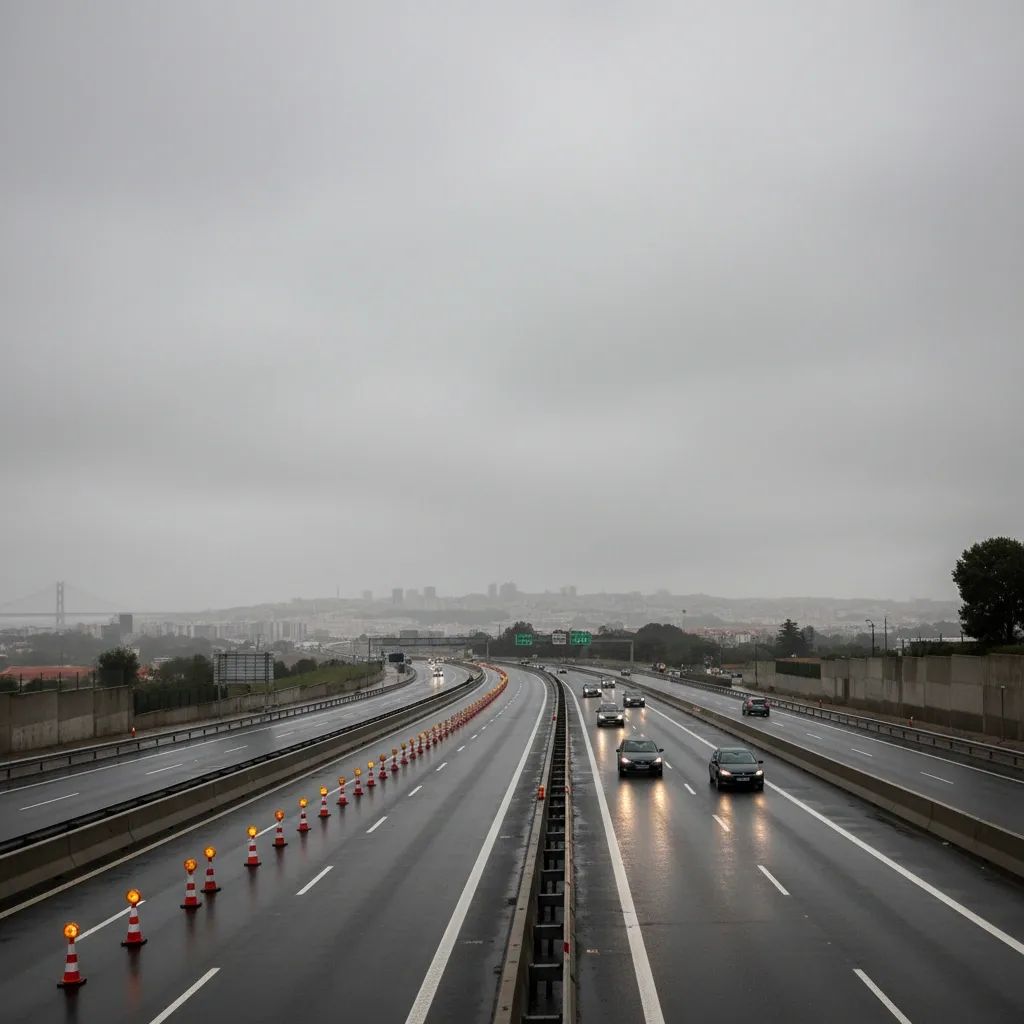
The Portugal concessionaire Brisa has reopened two of the four lanes on the A5 toward Cascais, a partial fix that will still funnel peak-hour traffic into a tight bottleneck and add minutes—or even an hour—onto many daily commutes.
Why This Matters
• Two-lane squeeze: only half the capacity is available on the Lisbon-to-Cascais side.
• No deadline given for full reopening—engineers first have to stabilise the hillside.
• Access from the 25 de Abril Bridge remains closed, forcing bridge users to detour.
• Heavy rain is due again this weekend, raising the risk of fresh debris on the road.
The Situation on the Ground
Traffic police from the Portugal National Republican Guard (GNR) confirmed that vehicles began flowing again at km 1 around 06:30 after crews scraped away mud, tree roots and broken rock. Drive-through footage posted by commuters shows a narrow corridor hemmed in by temporary concrete barriers, orange beacons and a 40 km/h limit.
By midday, sensors mounted on overhead gantries were already logging 20 % slower travel times compared with an ordinary February weekday. The pinch-point sits on the Monsanto climb, a section notorious for water run-off; two successive landslides on 12 February sent soil cascading across three lanes, forcing an overnight closure that paralysed homebound traffic.
Why the Hill Keeps Slipping
Geologists from the Portugal Civil Protection Authority blame a cocktail of record-breaking rainfall, thin surface vegetation and the steep cut made when the motorway was built in the 1990s. When clay becomes saturated, it turns slick, and gravity does the rest. The same weather system—storms Kristin, Leonardo and Marta—has already been linked to 16 fatalities, flooded basements from Leiria to Évora and a patchwork of rail delays.
Engineers on site are now inserting self-drilling soil nails, laying betão projetado (sprayed concrete) and carving extra drainage channels so water can escape rather than push the slope forward. That work must cure before the final two lanes can reopen.
Repairs, Budget and Timeline
Brisa’s preliminary cost estimate runs to €4 M–€6 M, covering slope anchoring, new retaining mesh and upgraded stormwater piping. Funding will be split between Brisa’s concession budget and the €2.5 B disaster-relief envelope the Portuguese Cabinet unlocked last week for infrastructure damaged by the winter storms.
Officials insist safety trumps speed. A spokesman told our newsroom there is “no reliable date” for letting full traffic back until independent inspectors certify the slope. Similar repairs on the A9 at Bucelas in 2024 took five weeks.
What This Means for Residents
• Commuters from Oeiras, Carcavelos and Cascais should expect longer door-to-door times, especially during the 07:30–10:00 and 17:00–19:00 peaks.• Navigation apps currently show a 15- to 40-minute penalty if you stay on the A5. Plan meetings with slack in your calendar.• For toll-road subscribers, Via-Verde has confirmed that full tolls still apply despite the lane closure; only a legislative decree could change that.• Property owners near the motorway may face heavier noise as engines rev to climb the narrower incline. Check whether your double-glazing or external shutters qualify for the €1 200 acoustic-insulation tax credit introduced in 2025.
How to Cross the Lisbon-Cascais Corridor in the Meantime
Avenida Marginal (EN6): scenic but slow. Expect average speeds of 30-40 km/h and traffic lights every few kilometres. Good for off-peak trips.
N117 through Carnaxide and Linda-a-Velha: useful if you live on the north side of Monsanto Park; lanes are narrow and bus traffic heavy.
Park-and-Ride plus CP suburban rail: Leave the car at Cacém or Agualva; a monthly rail pass costs €40 and avoids the bottleneck entirely.
Teleworking: The Labour Ministry still allows companies in the Lisbon Metro Area to trigger the “adverse-weather remote-work clause” for up to five consecutive days without extra paperwork.
Expert View: Making Highways Landslide-Proof
Portuguese geotechnical engineer Luís Antunes notes that “climate volatility is turning 50-year slopes into five-year slopes.” His prescription:• Real-time tilt sensors that ping maintenance crews before soil moves.• Vegetated terracing rather than bare cuttings, so roots knit the soil.• Mandatory drainage audits every 3 years for all concessionaires.The extra spending, he argues, costs far less than the GDP lost to repeated closures on arteries such as the A5.
The Bigger Picture: Climate and Infrastructure
The A5 incident is another reminder that Portugal’s coastal ring road network was designed for mid-20th-century weather patterns, not the modern era of “atmospheric rivers.” Since 2020, the Public Works Ministry has logged a 45 % jump in slope-failure incidents on national highways. Parliament is now debating a bill that would require concessionaires to set aside 1 % of annual toll revenue for climate-resilience upgrades.
For now, drivers will have to put up with orange cones and clogged ramps. But the debate about how to future-proof the country’s most travelled roads has finally shifted from PowerPoint slides to the muddy reality lining the A5.


