

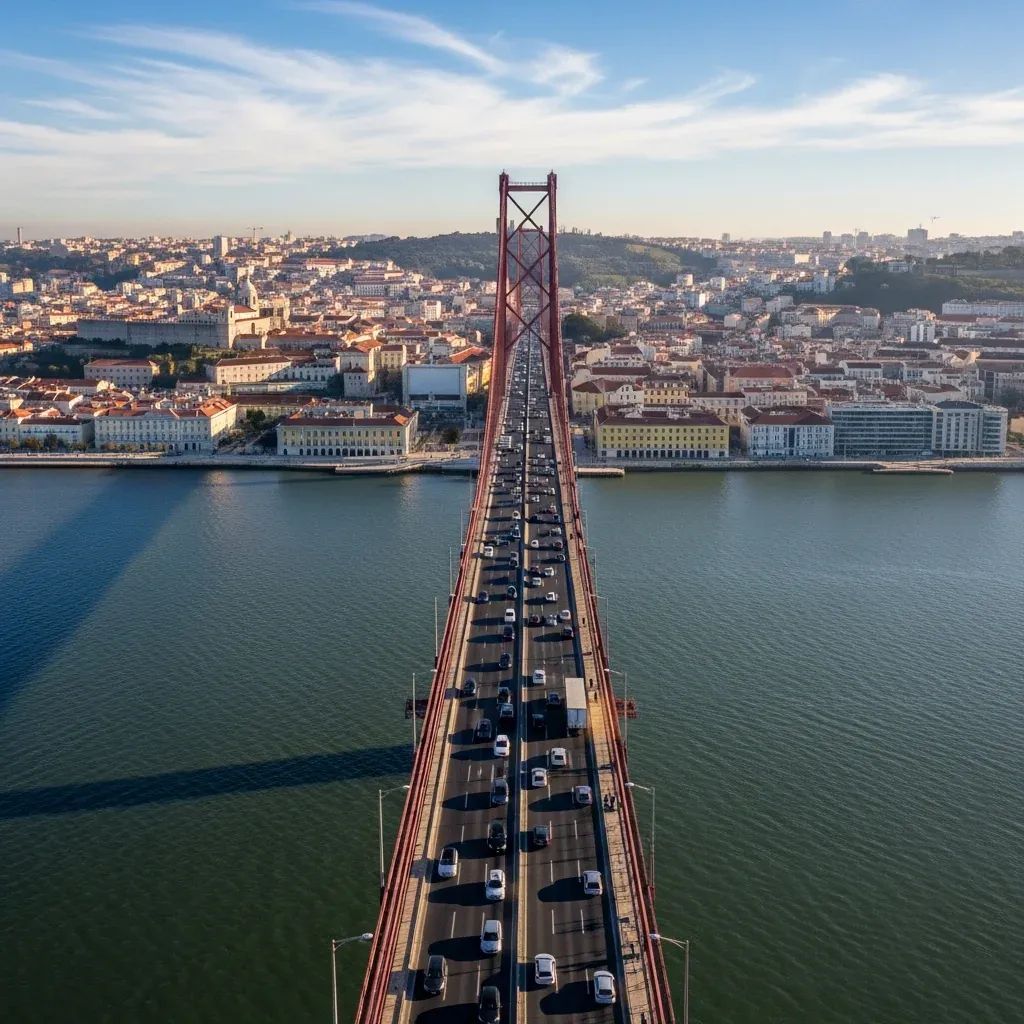
The arteries that bind Lisbon’s daily rhythms run not through veins but across steel and concrete. Every morning, tens of thousands of drivers and train passengers weave their way over two flagship crossings that span the Tejo – vital yet increasingly strained links that carry the city’s life force.
Key Takeaways
• 212,000 vehicles use the two bridges each weekday
• Toll rates rose by 2.38% on 1 January 2026
• Night closures and a full shutdown impacted traffic in late 2025
• A Third Tagus Crossing (TTT) is slated to open around 2034
• Sustainability measures have shaped both past and future works
Vital Links for Lisbon’s Commuters
Lisbon’s social and economic activity hinges on two structures: the Ponte 25 de Abril and the Ponte Vasco da Gama. Together they facilitate over 150 Fertagus trains daily and an average of 212,000 vehicles, funneling workers, tourists and freight between north and south. Any disruption ripples through metropolitan life – from suburban dormitories to downtown offices – underscoring why these spans are both treasured icons and growing bottlenecks.
Anatomy of Two Spans
From Suspension to Cable-Stay
The Ponte 25 de Abril was born amid the 1960s boom, its suspension design echoing San Francisco’s skyline. Construction began in 1962 and by August 1966 cars glided across its upper deck while trains rumbled underneath. Originally dubbed the Salazar Bridge, it was swiftly renamed after the Carnation Revolution of 25 April 1974 – a bold symbol of Portugal’s democratic rebirth.
A generation later, the Ponte Vasco da Gama emerged eastward to relieve pressure. Inaugurated for Expo 98, its cable-stayed spans stretch nearly 17 km, with foundation piles driven 95 m below sea level and engineered to endure 250 km/h winds and seismic shocks well above Lisbon’s standards. Designed for a 120-year lifespan, it skirts protected marshes and tilts every lamppost inward to avoid disturbing the estuary’s nocturnal wildlife.
2026 Traffic and Toll Adjustments
As of 1 January, commuters saw their bills climb by 2.38% – a mechanism tied to inflation set in 2022:
• Ponte 25 de Abril: Class 1 vehicles now pay €2.25 (up €0.10)
• Ponte Vasco da Gama: Class 1 vehicles now pay €3.40 (up €0.15)
Late in 2025, maintenance works reshuffled the deck:
• Between 9 October and 5 November, the 25 de Abril underwent nightly resurfacing, nudging motorists toward the Vasco da Gama.
• In the predawn hours of 16 September, the Vasco da Gama closed entirely for structural checks, with hazardous-load restrictions shifted to the older span.
Operators urged motorists to stagger their commutes, but critics argue only a third corridor can end the perpetual jams.
Charting the Third Crossing
Plans for the Terceira Travessia do Tejo (TTT) have solidified around a 15 km road–rail hybrid linking Chelas to Barreiro:
• Four railway lines (two high-speed, two conventional) plus six to eight lanes for cars
• Towers soaring 198 m, visible from Lisbon’s eastern skyline
• Cost estimates range between €2.2 B and €3.9 B, under a public–private partnership
Infraestruturas de Portugal (IP) is set to deliver a unified management model for all three bridges within days, paving the way for an international tender by March 2030 and an opening projected in 2034. This rodoferroviária span also dovetails with the Lisbon–Madrid high-speed link, aiming to cut travel times and shift freight off overloaded roadways.
Balancing Infrastructure with Nature
Environmental scrutiny has marked every stage of Lisbon’s crossings. The Vasco da Gama’s CEMA monitoring centre tracks air, noise and avian patterns within the Tagus Estuary Nature Reserve. Meanwhile, LED retrofits on the 25 de Abril have slashed energy consumption by over 70%. Activists from ZERO and Quercus press for a comprehensive noise-action plan, stricter water-quality controls upstream, and stronger ferry services to reduce car reliance.
As IP prepares its environmental impact studies for the TTT, a critically endangered plant recently spotted along the proposed route highlights the stakes. Public consultations in mid-2026 will shape mitigation measures that could define a new era of green mobility for Greater Lisbon.
Everyday Impacts and Forward Vision
For those living in Portugal, these crossings are more than feats of engineering – they determine the pulse of daily life. Rising tolls pinch household budgets, night works test patience, and the promise of a third bridge offers hope for smoother commutes. Yet as the city expands, the challenge will be to weave new infrastructure into an ecological and social tapestry without fraying the connections that bind communities along the Tejo. Only then can Lisbon’s iconic spans continue to carry not just cars and trains, but the ambitions of a resilient, sustainable capital.


