

Lisbon – In the wake of a string of drone sightings that have repeatedly shut down major European airports and raised fears of Russian hybrid warfare, Portugal is testing the waters with Israel over a possible purchase of the “Iron Beam” laser air-defence system for protecting its airports and critical infrastructure, according to people familiar with the contacts.
The exploratory talks come just weeks after Russian President Vladimir Putin publicly mocked European concerns, saying Russia had “no drones capable of reaching Lisbon” and dismissing the recent airport shutdowns as Western “hysteria” – a quip that nonetheless placed Portugal squarely in the rhetorical crosshairs of the Kremlin.
Across Europe, unexplained drones over airports and military sites have already forced temporary closures in Denmark, Norway and other NATO states, affecting tens of thousands of passengers and triggering urgent consultations in Brussels over airspace security. While Portugal has so far avoided a major incident on its own soil, officials in Lisbon are acutely aware that Humberto Delgado (Lisbon), Sá Carneiro (Porto) and Faro airports are soft targets in an era of cheap, commercially available drones and loitering munitions.
Against that backdrop, defence sources say Portugal has begun “discreet, early-stage discussions” with Israel about what it would take to deploy the Iron Beam system to shield its main aviation hubs and possibly other strategic locations. There is no formal negotiation or tender yet, and neither government has publicly confirmed any talks.
What makes Iron Beam interesting to Lisbon is not just the technology, but the fact that – unlike rival systems in the UK and China – Israel’s laser has already been tested under real combat conditions.
From Gaza to the global market: Iron Beam’s head start
Iron Beam is a high-energy, ground-based laser air-defence system developed by Rafael Advanced Defense Systems with Elbit Systems as the laser supplier. Designed to intercept short-range rockets, mortars, artillery shells and drones, it uses a 100-kilowatt-class laser to heat a target until it fails structurally or its sensors are destroyed.
After more than a decade of development, Israel’s Defence Ministry announced in September that Iron Beam had completed final testing and reached full operational maturity, with delivery to the Israel Defense Forces due by the end of 2025. Lower-powered prototypes were already deployed in late 2024 during the “Sword of Iron” war and used to shoot down drones and loitering munitions over northern Israel, giving the system the distinction of being the first high-power laser weapon with documented operational use in combat.
In other words, when Portuguese officials look at the global market, Iron Beam is currently the only laser air-defence system that is both declared operational and has real battlefield experience – a critical differentiator for a country that cannot afford to be a test range.
How Iron Beam works – and why airports care
At its core, Iron Beam combines three elements:
- Sensors and tracking
A radar and electro-optical / infrared (EO/IR) suite detect and track incoming threats – from small quad-copters up to rockets and mortars. The system then classifies targets and decides whether to engage them with the laser or leave them to traditional missile-based systems. - Beam director
A fast-slewing turret mounts the high-energy laser and precision optics. Adaptive optics compensate for atmospheric turbulence, keeping the beam tightly focused on the target over several kilometres. - High-energy laser
The laser itself delivers continuous energy on the target for a few seconds, burning through structural elements or blinding/destroying sensors. Because it’s powered by electricity, as long as there is power and cooling, there is effectively “infinite ammunition”.
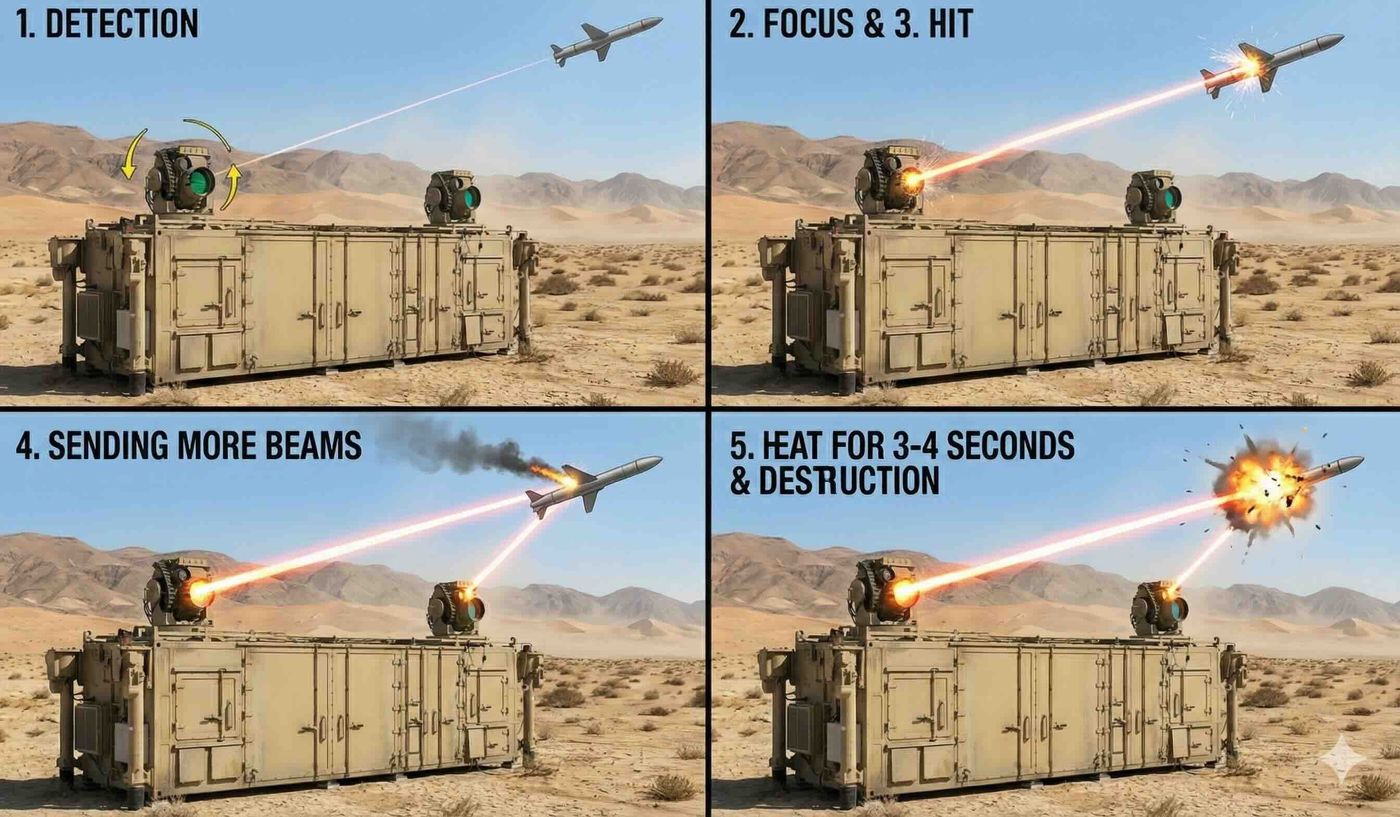
For an airport, the appeal is clear:
- Ideal for drones and small projectiles: Many of the recent European incidents have involved small, slow, low-flying drones – exactly the kind of targets Iron Beam is optimised to handle.
- Minimal debris: A laser strike can disable a drone without creating large fragments falling onto runways or terminal buildings, a key safety concern in dense civilian environments.
- Scalable coverage: Multiple beam units can be networked around an airfield, creating overlapping “bubbles” of protection that can be expanded or repositioned as needed.
Israel itself does not intend Iron Beam to replace systems like Iron Dome, David’s Sling or Arrow, but to sit as a short-range, low-cost layer that frees missile batteries from having to waste expensive interceptors on cheap threats. A Portuguese deployment around airports would likely follow a similar “last line of defence” philosophy: radars and jammers to detect and disrupt, Iron Beam to physically neutralise what gets through.
Why Iron Beam is different from British and Chinese lasers
Portugal is not the only country studying directed-energy weapons. The UK and China are both racing to field their own systems – but they are at a different stage of maturity and optimised for different missions.
UK: DragonFire and the naval focus
Britain’s DragonFire programme, a partnership between MBDA, Leonardo and QinetiQ, has recently made headlines after successfully shooting down high-speed drones during live trials in the Hebrides. London has now signed a £316 million contract to accelerate deployment of DragonFire on Royal Navy warships from 2027, part of a broader, nearly £1 billion push into directed-energy and radio-frequency weapons.
Technically, DragonFire and Iron Beam share several features: both are high-energy laser systems designed to intercept drones and missiles at short range. But there are key differences that matter for a country like Portugal:
- Domain: DragonFire is being optimised first for naval platforms, where cooling and power are less constrained and the primary mission is ship self-defence. Iron Beam is already designed as a ground-based, trailer-mounted system suitable for protecting fixed sites like airports.
- Maturity: DragonFire has achieved impressive test results but has not yet been declared fully operational, nor has it seen combat. Iron Beam has completed its test campaign and has already been used in real conflict scenarios.
- Export pathways: While UK officials talk openly about future export potential, DragonFire is not yet a catalogue product. Rafael, by contrast, has been marketing Iron Beam internationally and courting early adopters as part of Israel’s broader missile-defence export strategy.
China: Parade lasers, not airport shields – yet
China has unveiled several laser air-defence concepts in rapid succession, including the LY-1 shipborne laser showcased at a major military parade in Beijing, and the OW5-A50 mobile anti-drone system designed to protect air-defence batteries from swarms of UAVs.
These systems underline how seriously Beijing takes the drone threat, but they also highlight why Lisbon is looking elsewhere:
- Strategic alignment: As an EU and NATO member, Portugal is highly unlikely to source core air-defence technology from China.
- Transparency and testing: Much of what is known about Chinese lasers comes from parades and state media, with little independently verifiable data on performance or reliability, and no confirmed combat use.
- Mission set: Chinese designs are oriented toward protecting warships and long-range SAM sites, not civilian hubs like airports.
For now, Iron Beam’s combination of NATO-friendly politics, documented test results and operational experience gives it a unique position in the market Lisbon is examining.
The “pennies-per-kill” argument
Beyond the technology, cost is the single biggest factor driving interest in lasers – especially for a medium-sized defence budget like Portugal’s.
Traditional air-defence systems rely on interceptor missiles that can cost tens or even hundreds of thousands of euros per shot. In Israel’s layered defence, an Iron Dome Tamir interceptor is often cited at around $50,000 per missile. Using such missiles to shoot down $500 commercial drones is a losing economic game.
Iron Beam flips that equation:
- Direct energy cost: Sources estimate the pure energy cost of an Iron Beam shot at just a few dollars.
- All-in operational cost: When you factor in maintenance, crew, and amortised system costs, independent analyses still put each interception in the low thousands of dollars – one to two orders of magnitude cheaper than using a missile.
For a country defending a handful of airports from sporadic drone incursions, that “pennies-per-kill” model is attractive. Rather than stockpiling vast numbers of interceptors, you invest heavily up-front in the laser batteries and then pay primarily for electricity and maintenance.
Portuguese officials also view the low per-shot cost as an insurance policy against escalation. If Europe truly enters an era of sustained drone harassment – whether by state actors or non-state proxies – the ability to engage large numbers of small threats without bankrupting the defence budget becomes a strategic asset in itself.
Weather, politics and what comes next
Lasers are not a magic shield. Iron Beam’s own developers acknowledge that performance can degrade in heavy rain, fog or dust, all of which scatter or absorb the beam. For an Atlantic country like Portugal, with frequent low cloud and coastal haze, that is a non-trivial planning factor.
Engineers in Tel Aviv and Lisbon would also have to address regulatory and safety issues: how to ensure that invisible, high-energy beams cannot endanger civilian aircraft, satellites or people on the ground, especially in the complex airspace around major airports.
For now, officials in Lisbon stress that they are “studying a range of options” as part of a broader review of anti-drone and air-defence capabilities. But the fact that Iron Beam is on the table at all shows how far the conversation has shifted in just a few months: from dismissive jokes about drones over Lisbon to serious discussions about defending Portuguese skies with beams of light.
Whether Portugal ultimately buys the Israeli system or not, the direction of travel is clear. In Europe’s new era of airport closures, mysterious UAVs and hybrid threats, lasers are no longer science fiction – they are entering procurement spreadsheets.


