

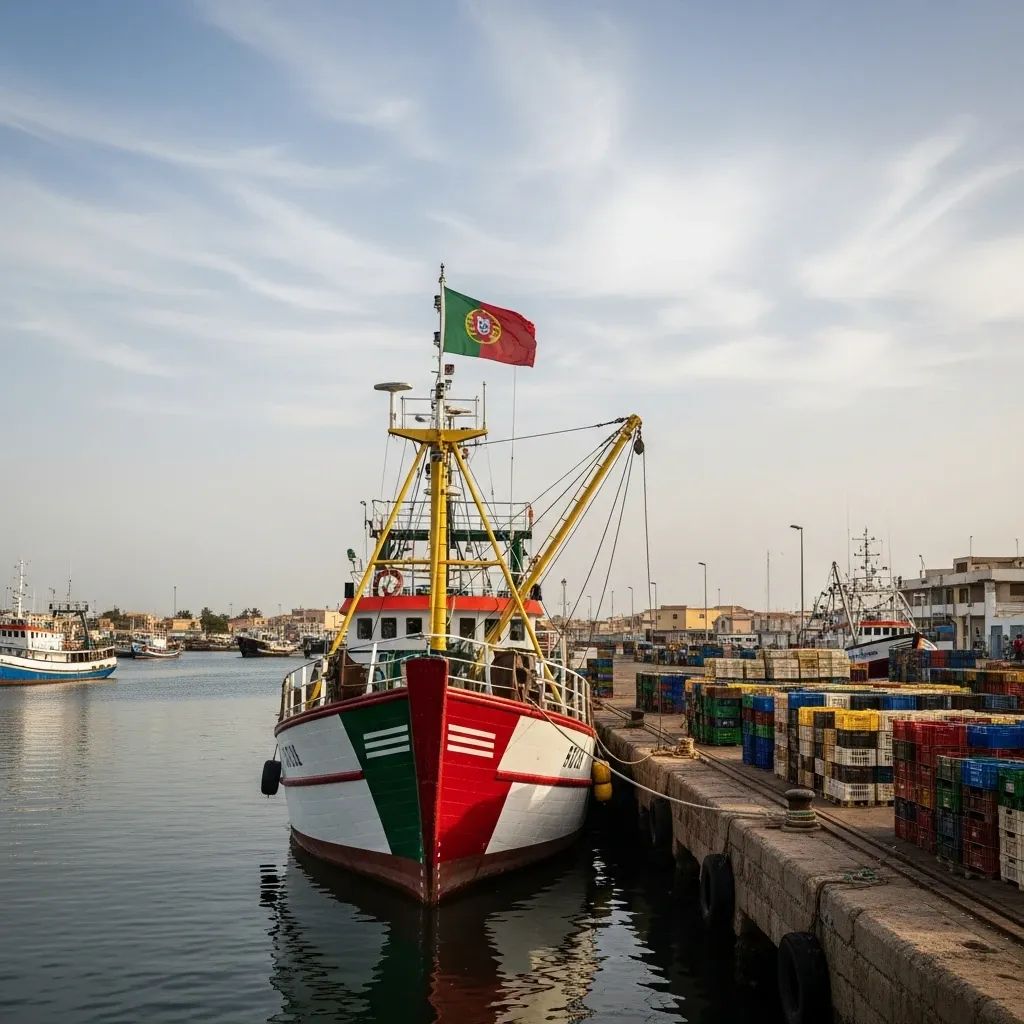
A Portuguese-flagged trawler has been stuck in Mindelo’s outer harbour since early December, leaving 12 crew members from Angola and Indonesia in legal limbo and eight months without pay. Their shipowner is back in Portugal, creditors circle the vessel, and the men’s only certainty is that a judge will not release the boat until the wage bill is settled.
At a Glance
• 12 foreign seafarers – 9 Angolans, 3 Indonesians – remain aboard the "Novo Ruivo".
• Ship was judicially seized in Cabo Verde on 11 December 2025 over unpaid debts.
• Crew’s basic supplies are provided by port authorities, but wages – some €45,000 in total – are outstanding.
• Indonesian diplomats have requested repatriation; Angolan officials have yet to file a formal note.
• The owner, a Lisbon-registered company, says it is negotiating a bridge loan to clear arrears.
• Case exposes a gap in Portugal’s maritime oversight and the risks faced by CPLP workers.
Stranded in Mindelo: Why Portugal Should Care
For Lisbon, the episode is more than a distant labour dispute. The "Novo Ruivo" sails under a Portuguese flag, which means that, under international law, Portugal bears ultimate responsibility for ensuring the vessel complies with the Maritime Labour Convention. A failure to act could undermine Lisbon’s credibility just as the government is pushing the concept of a “blue economy” and courting investment in fisheries. Moreover, half of the stranded seafarers come from Angola, a country with deep historical and commercial ties to Portugal; the other half from Indonesia, an increasingly important supplier of migrant labour to European fleets.
How the Arrest Happened
Mindelo’s maritime court ordered the arrest after the owner fell behind on port fees, insurance premiums and crew wages. Port captain Aguinaldo Lima confirmed that officials boarded the vessel on 11 December and instructed the master to remain alongside until further notice. Such arrests are common in West Africa when creditors fear a ship will sail away before bills are paid, but the three-month stalemate has now become a test of maritime debt enforcement between a Portuguese flag and a Cape-Verdean dock.
Life on Board: Food but No Pay
Daily life revolves around routine maintenance, WhatsApp calls home and an uncertain pay-day. Authorities deliver rice, bottled water and diesel every few days, and a local clinic treated one fisherman for a tooth infection. “We are not prisoners,” one sailor told the International Transport Workers’ Federation, “yet we cannot afford a plane ticket to Luanda or Jakarta without the money owed.” The ITF describes conditions as “socially unsustainable,” stressing that psychological stress grows when months pass without income or news.
Diplomatic Moves and Missed Steps
Jakarta’s embassy in Dakar filed a formal repatriation request in mid-January, citing humanitarian grounds. Luanda, by contrast, has limited itself to phone conversations with Cabo Verde’s foreign ministry, according to port officials. Analysts note that Angola’s seafarer protection framework remains patchy, leaving private unions to fill the gap. Meanwhile Portugal’s consulate in Mindelo insists its jurisdiction ends at the gangway, though Lisbon quietly acknowledges reputational risk if the saga drags on.
Legal and Financial Knots
Under the “privileged maritime lien” principle, crew wages outrank virtually all other claims on a vessel. Yet lawyers representing the shipowner argue that the arrest also froze company accounts, making it harder to secure a loan. The contradiction is typical of West African ports where creditor hierarchies clash with practical realities: nobody wants to release a ship before they are paid, but a ship stuck in port cannot earn the money required to pay anyone. An expedited auction is possible, although insiders warn that a distressed trawler may fetch far below the €1.2 M market value estimated by creditors.
What This Means for Portugal’s Blue Economy
Lisbon has spent years promoting Portuguese flagging to attract tonnage, citing flexible labour rules and EU-level safety standards. Cases such as the "Novo Ruivo" illustrate the downside: reputational damage when owners default and foreign crews suffer. Labour experts suggest that Portugal could emulate Spain’s practice of mandatory wage-insurance bonds to ensure crew are paid even if a company collapses. The incident also renews calls from NGOs for a CPLP-wide protocol guaranteeing the rapid repatriation of crews caught in judicial seizures.
The Road Ahead
Cabo Verde’s court has given the owner until mid-February to deposit the outstanding wages. If the money arrives, the crew could be flown home within days. Failure would likely trigger a judicial sale of the vessel, a process that can last months. Either way, the episode serves as a reminder that in the global fishing industry, the weakest link often stands on deck, waiting for a pay cheque that may never come.


