
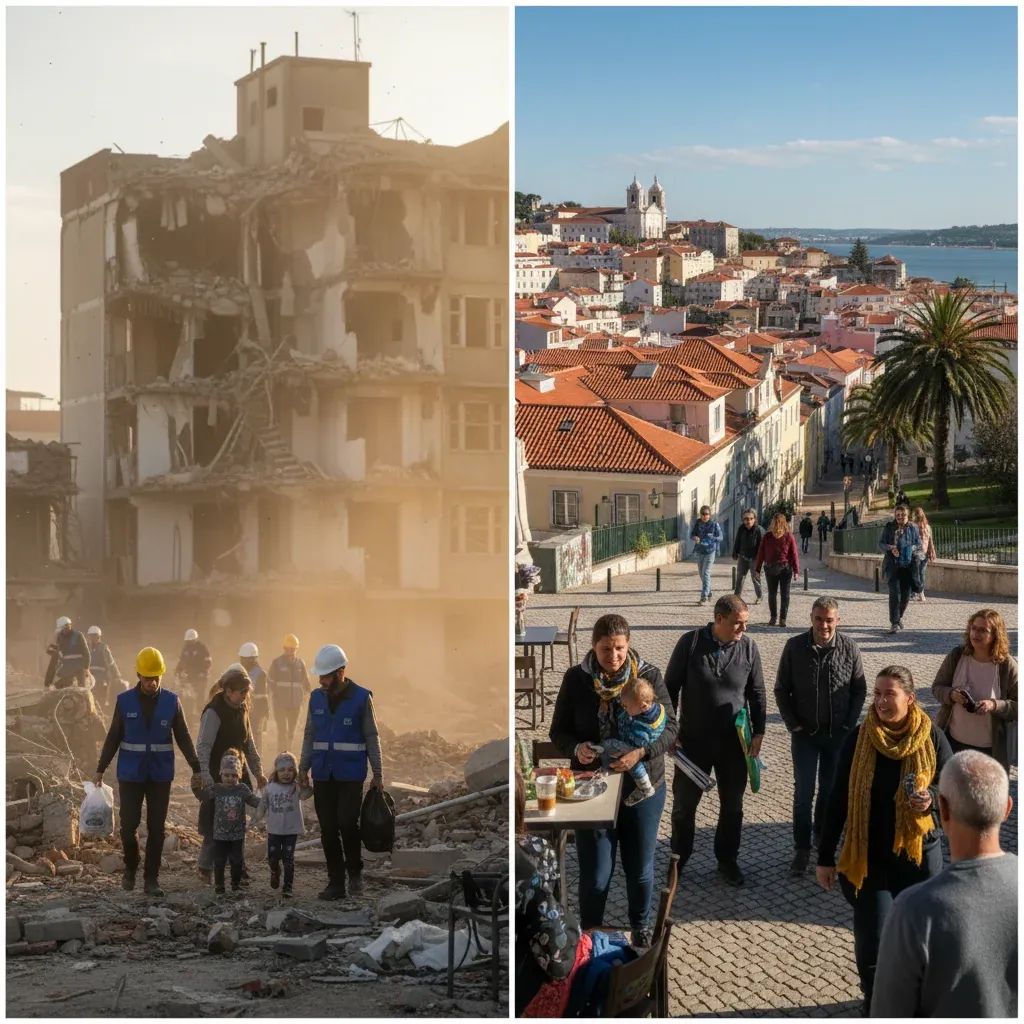
Portugal has reaffirmed its unwavering support for Ukraine as the country marks four years since the Russian invasion began on February 24, 2022, now entering its fifth year of conflict. President Marcelo Rebelo de Sousa and Foreign Minister Paulo Rangel both emphasized the country's commitment to political, military, humanitarian, and financial assistance "for as long as necessary." The war has evolved into a grinding battle of attrition, with diplomatic efforts showing little concrete progress and mounting humanitarian costs.
Why This Matters for Portugal Residents:
The anniversary carries direct implications for people living in Portugal. Portuguese taxpayer funds flow to Ukraine through EU channels and bilateral aid, affecting national fiscal priorities. Over 50,000 Ukrainian refugees have settled in Portugal since 2022, with significant populations in Lisbon, Porto, and other cities, integrating into local schools, workforces, and communities. Energy costs and supply chain disruptions linked to the war continue to affect Portuguese households and businesses. European stability, in which Portugal has a direct security interest through NATO membership, remains tied to how this conflict unfolds.
Portuguese Leadership Voices Solidarity
In a statement released through the Presidency of the Portuguese Republic, Marcelo Rebelo de Sousa praised the "admirable courage" of Ukrainians enduring four years of what he termed "illegal aggression and enormous brutality" by Russia. The Portuguese head of state emphasized that Ukraine is entering the fifth year of war with "stronger determination than ever," underscoring the country's resilience.
The statement, published on the official government website, made clear that Portugal's support within the European Union framework remains unshakeable. Marcelo committed the country to continue providing assistance alongside European and international partners, both to sustain Ukraine's resistance and to support its eventual accession to the European Union.
Paulo Rangel, Portugal's Minister of State and Foreign Affairs, marked the fourth anniversary by acknowledging "four years of suffering for the entire Ukrainian people," including military and civilian casualties. He characterized the war as creating "a new phase in international life," citing violations of international law and the UN Charter. Despite the grim assessment, Rangel expressed cautious hope that 2026 might bring a sustainable, lasting, and just peace agreement, grounded in the belief that sanctions are gradually affecting Russia's economic capacity to sustain the war.
The Military Situation and Humanitarian Cost
As of early 2026, the battlefield remains largely deadlocked. Between January and February 2026, Russian forces captured approximately 471 km² of Ukrainian territory, their fastest monthly gains in over a year, though this represents less than 1% of Ukraine's total land area. Russia currently controls roughly 19-20% of Ukrainian territory, including the Crimean Peninsula and substantial portions of eastern regions.
Ukraine has mounted counteroffensives as well. In mid-February, Ukrainian forces retook 201 km² of territory in their fastest advance since mid-2023. Military analysts describe the situation as a war of attrition with neither side capable of decisive victory without a significant change in circumstances.
The human cost is severe. Both sides have suffered approximately 1.8-2 million combined casualties by March 2026, including killed, wounded, and missing. The United Nations Office for Human Rights has documented over 15,000 civilian deaths and 41,000 injuries since February 2022, with 2025 marking the deadliest year for civilians to date.
For Ukraine's displaced populations, the scale is staggering: approximately 3.7 million internally displaced and 5.9 million refugees registered across Europe, including over 2.5 million children. Infrastructure damage has been catastrophic, with over 2.5 million homes damaged or destroyed and more than 4,300 schools hit, disrupting education for millions of Ukrainian children.
Impact on Portugal's Ukrainian Community
Portugal hosts a significant Ukrainian refugee population, with Ukrainian children now attending Portuguese schools and Ukrainian workers employed across various sectors. Cities like Lisbon and Porto have established support services, though resource pressures remain. The integration of these families into Portuguese society represents both a humanitarian response and a long-term challenge, with outcomes directly dependent on how and when the conflict ends.
Many Ukrainian residents maintain close ties with family members still in Ukraine, either displaced or living under ongoing bombardment. For them, the fourth anniversary and entry into the fifth year carries deep personal significance.
Diplomatic Obstacles and European Complications
Peace negotiations remain mired in fundamental disagreements. Talks resumed in Geneva in February 2026 under U.S. mediation, yet territorial questions remain the core obstacle: Russia refuses to surrender territories it has declared annexed, while Ukraine maintains that ceding territory is unacceptable.
For Portugal and other EU member states, unity has faced challenges. Hungary blocked the 20th sanctions package against Russia scheduled for the anniversary and has threatened to block a proposed €90 billion loan to Ukraine, potentially affecting Kyiv's ability to sustain operations into spring.
European leaders visited Kyiv for the anniversary, including European Council President António Costa and Commission President Ursula von der Leyen, who inspected damaged energy infrastructure before meeting with President Zelensky. Unlike the previous year, this visit carried fewer tangible financial commitments, reflecting fiscal pressures across Europe and political fatigue with the prolonged conflict.
Portugal's Economic and Strategic Stakes
For Portuguese residents, the war's continuation has concrete effects. Energy markets remain volatile, with natural gas and electricity prices in Portugal elevated compared to pre-war levels due to Europe's restructured supply chains after reducing Russian imports. Food prices—particularly grains and sunflower oil from Ukraine—have been affected by shipping disruptions, though recent agreements have partially restored export corridors.
Portuguese defense spending has also been affected, as NATO members face pressure to increase defense budgets in response to the demonstrated Russian threat, a factor that competes with domestic priorities in Portuguese budget debates.
Looking Ahead
Military analysts project the war will continue as a slow-burn conflict with neither side capable of decisive victory in 2026, absent a diplomatic breakthrough. Russia's war economy shows strain from sanctions, though remains functional. Ukraine remains almost entirely dependent on external financing to maintain government operations and military resistance.
The political calendar adds pressure to resolve the conflict. U.S. officials have reportedly pushed for an agreement by June 2026, though the basis for optimism about that timeline remains unclear.
For now, Ukraine has preserved its resistance despite Russian expectations of swift victory. Whether that defiance, backed by European and transatlantic support including from Portugal, can eventually translate into a stable peace remains the central question affecting millions across Europe—including the Ukrainian families who have made Portugal their home during these four years of war and as Ukraine enters its fifth year of conflict.


