

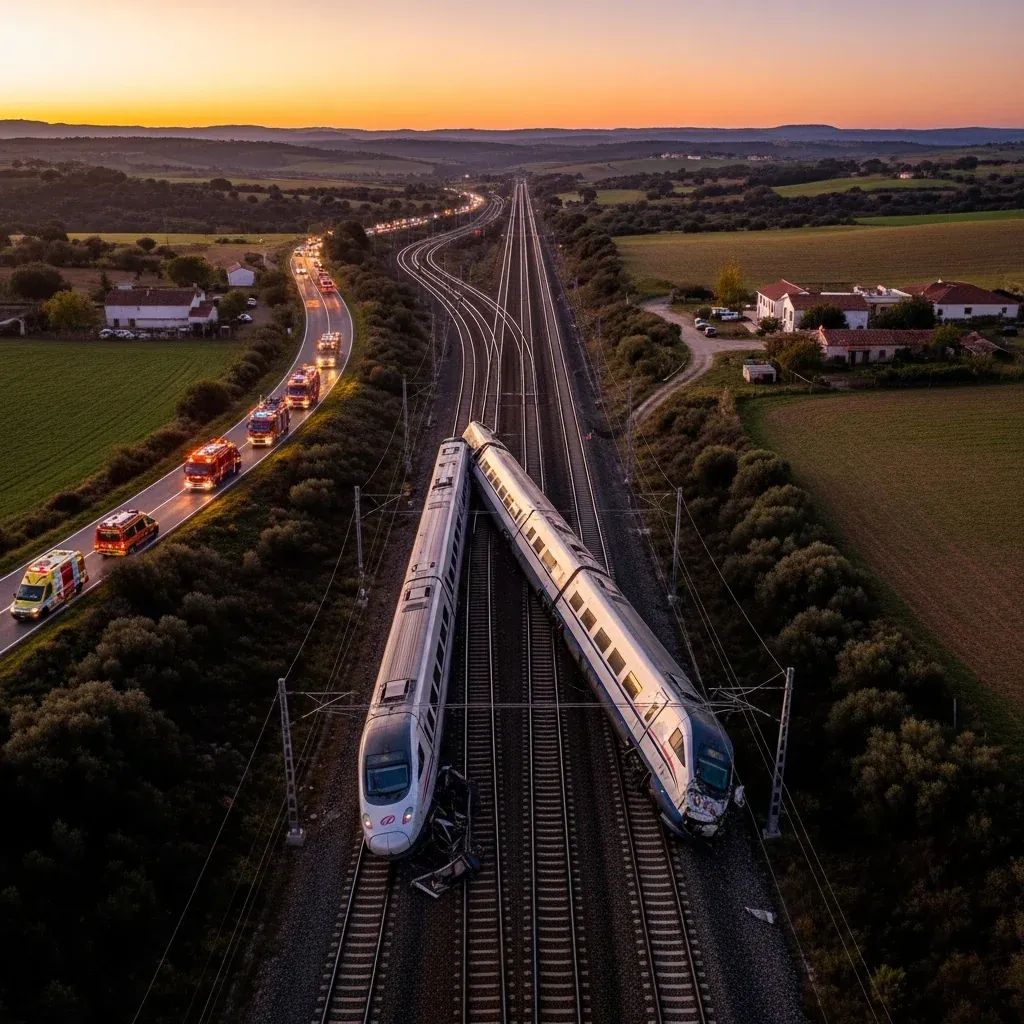
Few news alerts cut through a Portuguese Sunday evening faster than word that two compatriots were caught in a deadly rail crash just across the border. While both citizens are now safe, the accident near Córdoba has reignited questions about cross-border transport safety and what Lisbon can do when tragedy strikes abroad.
At a glance
• 2 Portuguese passengers identified; no life-threatening injuries
• ≥43 fatalities and more than 120 wounded in Spain’s worst rail disaster in a decade
• Collision involved Iryo and Renfe high-speed trains at the apeadeiro of Adamuz
• Initial probe points to track failure rather than driver error or speeding
• Three days of national mourning declared in Spain; Portugal offers technical and consular help
Portuguese passengers: bruised but alive
For families in Porto and Santarém, the long wait for news ended with relief. One Portuguese woman was able to return home the same night, while Santiago Salvador—the second national—suffered fractures of the tibia and fibula. Treated at Hospital Reina Sofía, he left on crutches but called his escape “um milagre”, describing being hurled around a carriage “as if on a merry-go-round”. Portugal’s embassy in Madrid confirmed that no further nationals were on either train.
Anatomy of a catastrophic evening
Shortly after 19:45, an Iryo train heading north from Málaga lost its last three carriages. Those wagons slid onto the opposite track and slammed into an on-coming Renfe service bound for Huelva. The first two Renfe coaches were thrown four metres down an embankment, trapping dozens. About 500 passengers in total were spread across both trains, many standing in the aisles for the late-weekend run.
Investigators eye the track, not the drivers
Early data recorders show the Iryo and Renfe units travelling at 205 km/h and 210 km/h, comfortably below the 250 km/h limit. Investigators from Spain’s accident bureau are focusing on a suspected break in a rail joint near a switching mechanism that had undergone recent maintenance. Transport minister Óscar Puente called the chain of events “extremely strange” for a straight, freshly renewed section of the Córdoba-Seville high-speed corridor.
Lisbon’s diplomatic machinery in action
Inside an hour, the Gabinete de Emergência Consular activated its 24-hour lines, cross-checking hospital admissions and passenger manifests. Prime Minister Luís Montenegro telephoned Pedro Sánchez to express solidarity and to offer Portuguese forensic engineers if Spain needs independent expertise. Meanwhile, Portugal’s Ministry of Infrastructure circulated guidance on how citizens should register travel plans using the "Registo Viajante" app—a tool that proved invaluable in locating the two passengers.
Should Portuguese travellers worry?
Spain remains one of the safest rail networks in Europe, and cross-border high-speed services between Lisbon, Porto and Madrid are central to forthcoming Iberian mobility plans. Still, the Adamuz crash is a reminder to: keep passports handy, store emergency numbers (+351 217 929 714), verify health-insurance coverage, and register journeys digitally. Consular officials stress that such steps accelerate rescue efforts when minutes count.
The bigger picture: Spain’s rail record under scrutiny
Until Sunday, the last comparable tragedy was Santiago de Compostela (2013), where 80 people died. Since then, Spain has invested billions in ERTMS signalling, yet accident analysts note that infrastructure fatigue—rather than driver error—has featured in several minor incidents. With the EU’s TEN-T corridors poised to pour fresh funds into Iberian lines, the results of this month-long probe could shape budget priorities and maintenance protocols from Badajoz to Barcelona.
Spain will eventually reopen the Córdoba stretch, but for now the Adamuz embankment stands as a stark reminder: even on the continent’s fastest tracks, a single broken joint can derail hundreds of lives—and send shivers across the border in Portugal.


