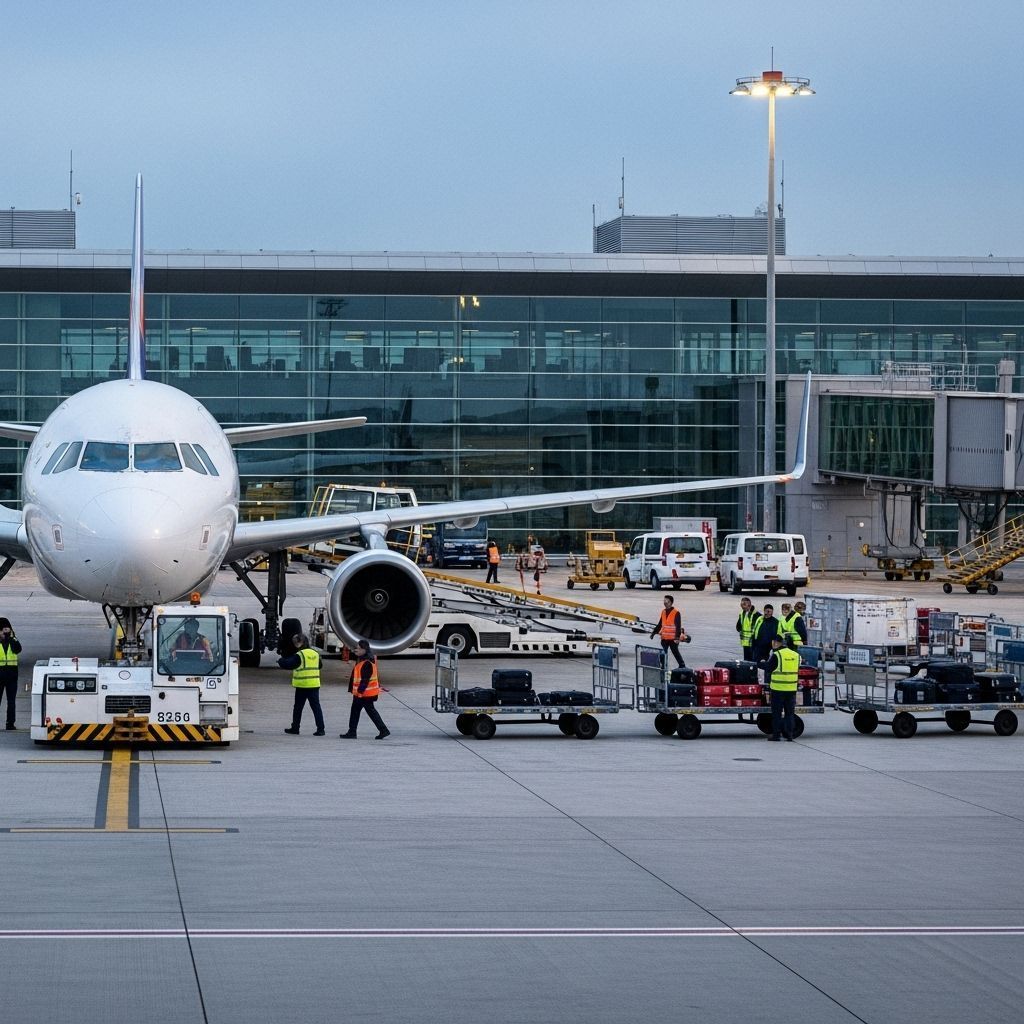
Portugal's aviation sector faces potential summer-season disruption as Menzies Aviation filed a legal challenge on March 17, 2026, with the Lisbon Administrative and Fiscal Court, seeking to overturn the Portugal National Civil Aviation Authority's (ANAC) recent ground handling tender decision. The move raises the prospect of delayed flights, baggage chaos, and job uncertainty for thousands across the country's busiest airports just as tourist traffic prepares to surge.
Why This Matters
• Airport chaos risk: A poorly managed operator transition could trigger delays, baggage mishandling, and longer queues at Lisbon, Porto, and Faro airports during peak season.
• Job security in jeopardy: Roughly 3,500 to 4,000 specialized ground handling jobs hang in the balance as the incumbent operator contests the tender outcome.
• Legal limbo: Current Menzies licenses expire May 19, 2026, meaning the court has two months to resolve the dispute or risk operational paralysis.
The High-Stakes Legal Battle
Menzies Aviation—the current ground handling operator at Portugal's three main airports since acquiring majority control of Groundforce (SPdH) in 2024—has formally requested an injunction to suspend ANAC's January 2026 decision to award 7-year licenses to the Clece/South consortium. The Spanish-led partnership unites Clece, a subsidiary of the ACS Group, with South Europe Ground Services, Iberia's handling arm under the IAG umbrella (which also owns British Airways).
In a statement released Tuesday, Menzies attacked the tender structure and evaluation methodology, arguing the process failed to capture the operational complexity and safety requirements inherent to high-traffic Portuguese airports. The company contends ANAC's assessment leaned heavily on formal document verification rather than rigorous technical vetting of staffing levels, equipment inventories, and peak-hour resource allocation plans.
The crux of Menzies' complaint centers on questions about whether the winning proposal can function when dozens of flights overlap during summer peaks. According to the company, the selected bid "raises doubts about its viability under real operational conditions, particularly during periods of heightened traffic intensity." Menzies claims the Clece/South plan lacks clarity on how equipment and personnel would be deployed when simultaneous turnarounds strain the system, making it difficult to verify whether proposed aircraft rotation times are achievable in practice.
What This Means for Travelers and Workers
For passengers, the stakes are immediate. Ground handling encompasses everything from baggage loading and aircraft marshaling to refueling and cabin cleaning—services that, when mismanaged, cascade into flight delays, lost luggage, and extended boarding waits. Menzies warns that any shortfall in the new operator's commitments could result in delays and service deterioration.
The timing carries particular risk. Portugal's airports are approaching the summer high season, when passenger volumes swell and even minor operational hiccups can spiral into systemic gridlock. The legal action highlights concerns about the country's reputation during peak travel demand.
For the workforce, the uncertainty is significant. The Sindicato dos Trabalhadores dos Transportes de Portugal (STTAMP) announced its own separate legal challenge in December 2025, demanding ANAC adhere strictly to labor transfer provisions under Portuguese employment law. Menzies echoes this concern, asserting the tender lacked "a realistic and sufficiently robust transition framework between operators, including adequate provisions for the transmission of workers, operational knowledge, and critical resources."
Union representatives have questioned whether Clece/South's relative inexperience in the Portuguese market translates to institutional knowledge needed to manage Lisbon Airport's structural constraints—a facility known for tight apron space and congested taxiways. A poorly executed handover could generate uncertainty around employment for the specialized workforce.
Previous Ground Handling Disputes in Portugal
This is not Portugal's first ground handling collision. The country's aviation services market has experienced successive tender disputes since European liberalization began in the late 1990s. The European Directive 96/67/EC mandated that major airports accommodate multiple competing ground handlers.
A significant precedent occurred in 2016, when Menzies was initially awarded licenses for Lisbon and Faro, only for Groundforce to successfully appeal on grounds that Menzies could not absorb over 2,800 specialized workers. That legal wrangle preserved the status quo, but operational quality suffered. In late 2025, the Associação dos Transitários de Portugal (APAT) reported disruption in air cargo handling, citing chronic understaffing that forced freight diversions to Madrid.
New EU Safety Standards Add Complexity
The transition unfolds against sweeping regulatory change. The European Union Aviation Safety Agency (EASA) published its first-ever EU-wide ground handling safety regulations in March 2025, which mandate full compliance by March 27, 2028. These rules introduce stringent requirements for Safety Management Systems, staff training, equipment maintenance, and cybersecurity, shifting formal safety responsibility from airlines to ground handling organizations.
Any new operator entering the Portuguese market must simultaneously master local operational requirements while building EASA-compliant management systems. Menzies argues that Clece/South requires particularly rigorous technical scrutiny given the demands at Lisbon, where structural limitations present some of Europe's most challenging ground handling conditions.
What Should Travelers Do?
For residents planning summer travel through Portuguese airports, several practical steps can help:
• Monitor updates: Check with your airline and airport websites regularly for any announcements about service changes or delays.
• Review travel insurance: If you're traveling between now and May 19, consider insurance that covers delay-related costs in case disruptions occur.
• Plan buffer time: Allow extra time for airport procedures during peak summer weeks when staff transitions may cause congestion.
• Contact your airline: If you're concerned about a specific flight, reach out to your airline for reassurance about their ground handling arrangements.
There is no indication that current flight operations will be disrupted immediately, but the legal uncertainty means conditions could change with little notice.
The Clock Is Ticking
ANAC's provisional extension of Menzies' operating licenses expires May 19. If the Lisbon Administrative and Fiscal Court grants the injunction, the tender could be suspended indefinitely, prolonging the incumbent's tenure but leaving the long-term future unresolved. If the court declines or delays a ruling, Clece/South must demonstrate it possesses the necessary workforce and equipment to commence operations within roughly eight weeks.
The IAG-backed consortium has launched recruitment drives and publicly committed to absorbing current SPdH employees. Menzies contends that promises of continuity require transparent resource allocation plans and proven operational capacity under stress conditions.
For the 4,000 ground handlers whose livelihoods depend on the outcome, the next two months will determine whether they face job security under a new employer or prolonged uncertainty should the legal battle extend into the peak season. For Portugal's aviation sector, the episode underscores a recurring vulnerability: a ground handling market that remains contested and prone to the very disruptions regulators sought to eliminate decades ago.