

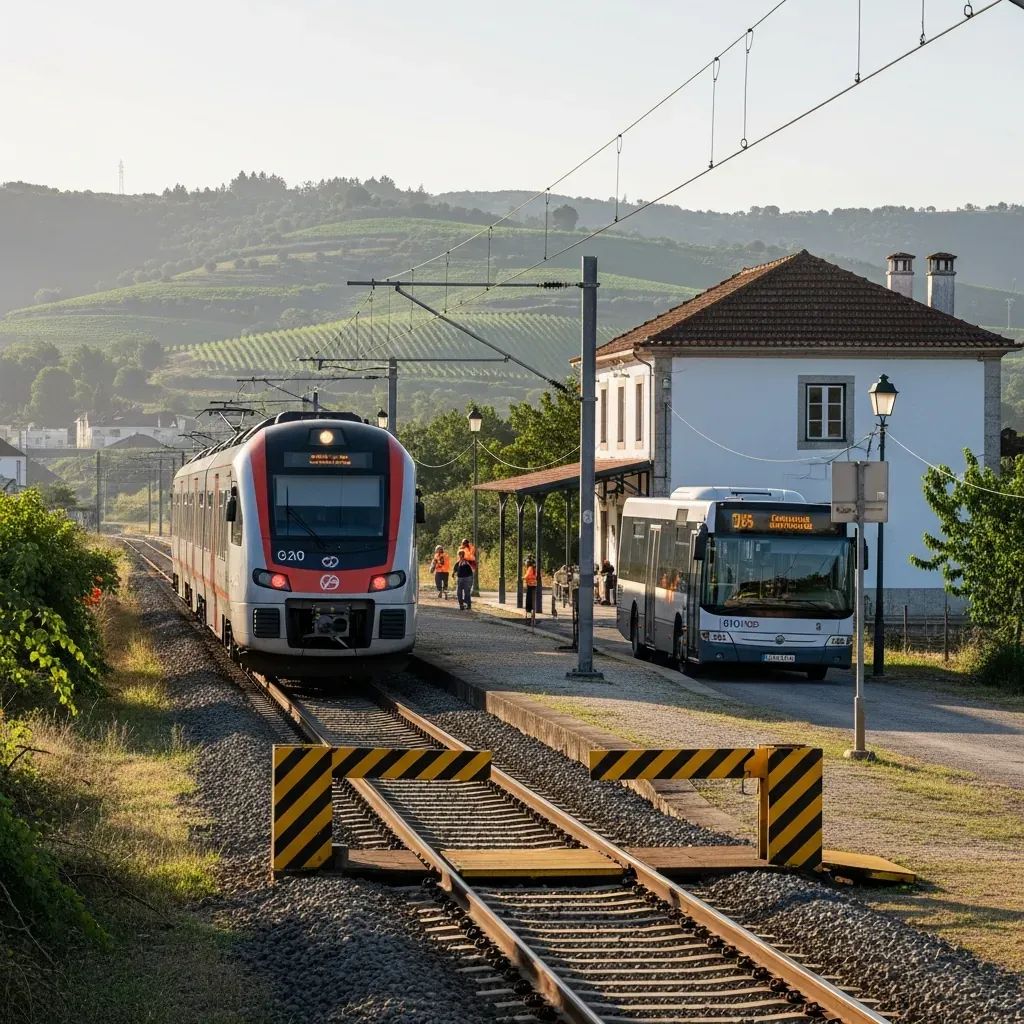
Commuters heading to Portugal’s hinterland, weekend tourists chasing vineyard views and exporters moving goods toward Spain are all running into the same obstacle: trains have ground to a halt on three of the country’s most important interior rail corridors.
At a glance
• Douro services between Marco de Canaveses and Peso da Régua remain suspended for heavy‐duty electrification works, with an optimistic reopening target in early April.
• Beira Alta is technically open end-to-end, yet storm damage near Oliveirinha has forced a fresh, short stretch closure and has freight operators scrambling for alternative lanes.
• Beira Baixa trains are operating, but localised blockades between Ródão and Guarda—also weather related—mean passengers face bus transfers.
• Replacement road coaches are in place, but journey times are swelling by 40-70 minutes.
• The goal of the overlapping works is a faster, fully electrified spine that links the Atlantic ports to central Europe. Until then, expect disruptions to linger in winter windows through 2027.
Three routes, three different headaches
Modernisation, weather and history are colliding. On the Linha do Douro, a five-month blackout that began in November tackles tunnel re-profiling, track renewal, platform standardisation, and above all electrification between Marco de Canaveses and Régua. The project requires lowering the track bed in six century-old tunnels, a high-risk engineering exercise that simply cannot occur with trains passing overhead.
The Linha da Beira Alta only reopened fully last September after a three-year overhaul of its 193 km freight artery. Yet the recent depressão Kristin knocked down catenary and trees near Oliveirinha, forcing Infraestruturas de Portugal (IP) to impose a temporary safety cordon.
Further south-east, the Linha da Beira Baixa is under lighter pressure. Services continue, but a storm-hit section between Ródão and Guarda is restricted to buses for several days while crews replace damaged signalling and clear debris.
From vineyards to factories: who feels the pinch?
For the Douro, the loss is cultural as much as logistical. Wine estates, riverside hotels and the iconic comboio histórico a vapor rely on rail-borne tourists. The high-season pause was deliberately set for winter, yet locals fear April could slip if tunnel work overruns, slicing into spring bookings.
On the Beira Alta corridor, the cost is counted in euros per pallet. It is the fastest rail gateway to Salamanca and the rest of Europe, handling thousands of containers from Leixões and Aveiro ports each month. With wagons rerouted via the longer Beira Baixa or, worse, the road network, freight forwarders cite operating surcharges of 15-30 %.
For small towns such as Pampilhosa, Mortágua or Belmonte, rail closures translate into missed hospital appointments, longer school runs and higher fuel bills for families suddenly dependent on cars or replacement buses.
Behind the closures: engineering and red tape
The Douro programme alone involves €165 M of investment, funded by a mix of EU Recovery Plan grants and national coffers. IP’s strategy is to cluster the most disruptive tasks into the low-demand November–March window, even if that means shutting the line completely for two successive winters.
On Beira Alta, delays were less technical than bureaucratic. Successive contract addenda, late expropriations and a supplier insolvency stretched an announced nine-month job into 38 months. The silver lining: the route now supports 750-metre freight trains, European Train Control System (ETCS) Level 2 and speeds up to 160 km/h for passenger expresses.
Beira Baixa’s current works are smaller—chiefly a €2.2 M grade-separated underpass near kilometre 2.528 and slope stabilisations worth half a million—but IP warns that any unforeseen geotechnical issue can still halt traffic at short notice.
When will normal service return?
• Douro (Marco–Régua): reopening target early April, followed by a second winter shutdown Nov 2026–Mar 2027.• Beira Alta: full timetable already back; storm repairs near Oliveirinha expected to finish within days, weather permitting.• Beira Baixa: intermittent blocks through 2026 as the new road underpass and talus reinforcement progress; train-and-bus hybrids will remain common between Abrantes and Guarda.
IP tentatively forecasts a fully electrified interior network by 2028, contingent on budget approvals in Lisbon and Brussels.
How to travel in the meantime
CP is running substitute coaches that honour existing rail tickets, albeit with no seat reservations and limited luggage space. Allow an extra hour if your journey crosses the Douro works site, 40 minutes for Beira Baixa detours.
Passengers with tight air or international train connections may find it faster to transfer to the Linha do Norte at Porto-Campanhã or Entroncamento. For freight, the Viana–Nine–Soure detour via the Minho coast is emerging as the preferred workaround, though capacity is tight.
Beyond the nuisance: a greener, faster backbone
Once the dust settles, travellers could see Porto-Régua journeys cut to 65 minutes, while Lisbon–Vilar Formoso freight trains should shave 30 minutes and burn 30 % less diesel. The bigger prize is strategic: an interior rail spine that can anchor Iberian high-speed links and funnel cargo from Atlantic ports deeper into the continent.
Until then, patience—and a charged mobile for those replacement-bus QR codes—remains the best travel companion.


