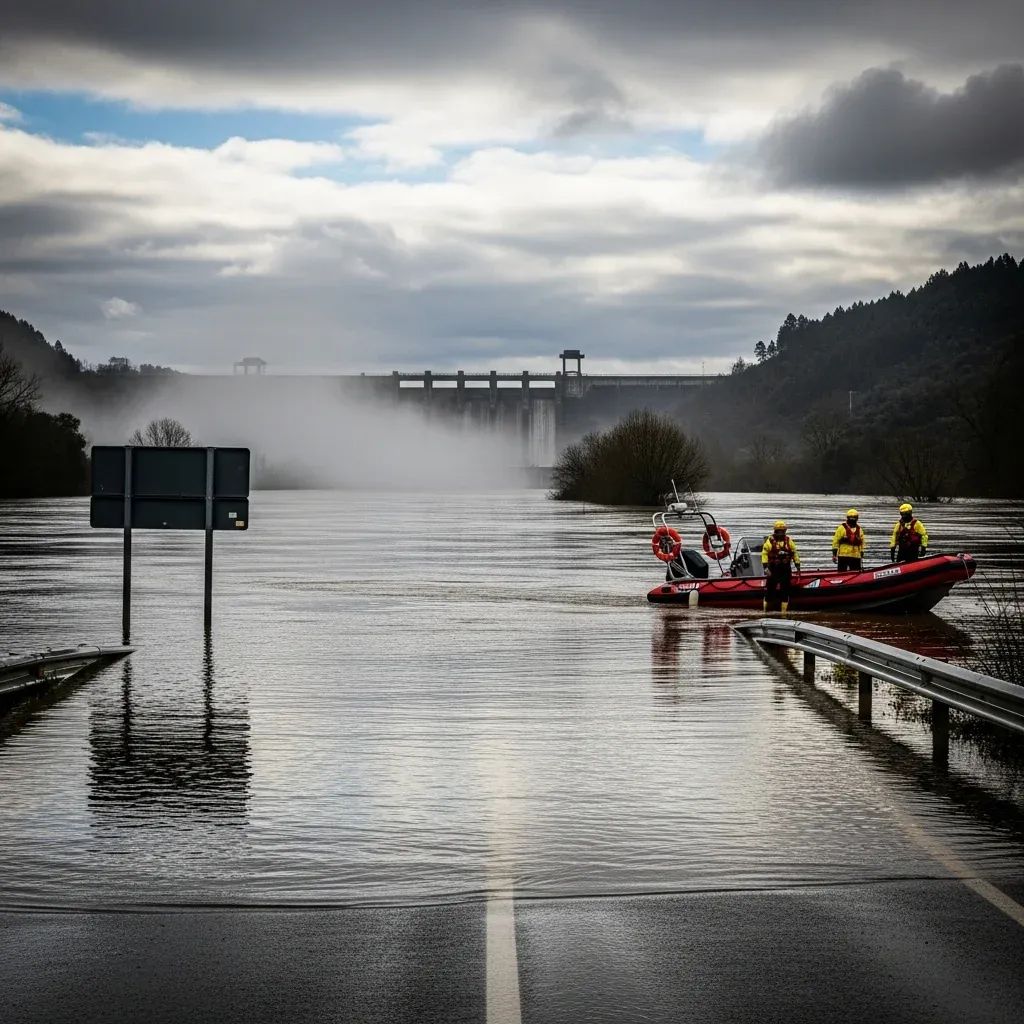
The Portugal National Authority for Civil Protection (ANEPC) has confirmed the death of firefighter José Valter Canastreiro during Storm Marta, a loss that highlights how the third major weather system in as many weeks is pushing emergency services, budgets and infrastructure to breaking point.
Why This Matters
• First storm-related fatality in Portugal: The death in Campo Maior brings the Iberian storm sequence’s toll to 16.
• Orange alerts in 13 districts: Winds up to 120 km/h and persistent downpours continue through the weekend.
• Water releases equal to a year’s national consumption: Reservoirs on the Tejo and Sado are dumping record volumes, raising downstream flood risk.
• €2.5 B support package on the table: Lisbon is weighing fresh aid while several municipalities lobby to postpone Sunday’s presidential vote.
Mapping the Danger
Ground already saturated by Storms Kristin and Leonardo offered little absorption capacity when Marta barreled in from the Atlantic. From Alcácer do Sal’s submerged stilt pier to the rice paddies of Benavente, floodwaters have swallowed roads and railway embankments. Gale-force gusts near 110 km/h uprooted cork oaks in Alentejo while snowfall above 900 m blanketed the Serra da Estrela, complicating relief logistics.
Hydrologists at the Portugal Environment Agency point out that dams on the Tejo, Mondego and Sorraia basins are discharging "full-spate volumes"—roughly 7 billion m³ since Thursday, the same amount domestic households use in an entire year. Every cubic metre released upstream travels toward Lisbon within 48 hours, prompting riverine villages such as Valada and Salvaterra de Magos to erect sandbag walls overnight.
Emergency Response & Friction
A nationwide deployment of 26,500 responders—firefighters, GNR units and military engineers—remains in the field. The Portugal Navy, using 47 inflatable craft and drones fitted with thermal cameras, ferried stranded residents from Cartaxo’s islets and airlifted medicine to cut-off hamlets in the Vouga valley.
Yet the speed of official reaction has drawn criticism. The governor of Banco de Portugal publicly questioned why flood-risk mapping approved after the 2010 winter storms is still awaiting local implementation. Municipal leaders from Golegã to Arruda dos Vinhos counter that national funding has not kept pace with climate-driven weather volatility.
Agricultural & Economic Toll
Orchards in Ribatejo and greenhouses along the western coast resemble inland lagoons. Early estimates from CAP, Portugal’s largest farmers’ confederation, put crop losses at €230 M for Marta alone, adding to a projected €750 M hit from the broader "storm train."
Across the border, Andalusian officials count an additional €500 M in damage—an important metric because cross-border river management agreements could unlock EU Solidarity Funds for both nations. Meanwhile, Lisbon’s minority government is drafting a €2.5 B multi-year resilience plan that blends direct aid, low-interest credit and accelerated insurance payouts. Fiscal hawks warn the package could nudge the 2026 deficit above the Stability Programme target, though the Finance Ministry maintains that Brussels allows leeway for extreme-weather contingencies.
What This Means for Residents
• Travel: Expect intermittent closures on A1, A23 and regional rail lines north of Coimbra. Consult Infraestruturas de Portugal’s live map before setting out.
• Utilities: Roughly 25,000 households—mostly in Santarém and Aveiro districts—may face rolling outages until crews can safely access downed lines. Keep mobile power banks charged.
• Insurance claims: Policies covering "fenómenos sísmicos e atmosféricos" waive the standard 7-day waiting period when the government declares a state of calamity; start documentation now to jump the queue.
• Elections: If you vote in the flooded parishes of Bidoeira de Cima, Alcácer do Sal or Golegã, monitor municipal websites. Some polling stations are being relocated or, in rare cases, balloting postponed under emergency statutes.
Human Cost Behind the Numbers
José Valter Canastreiro, 46, a veteran of both the Campo Maior Volunteer Fire Brigade and the GNR, slipped beneath a deceptively calm sheet of water on the EN-373 while attempting to gauge current depth on foot. Colleagues retrieved him within minutes and performed CPR, but medical staff pronounced him dead at the scene. His passing triggered a minute of silence in fire stations nationwide and renewed calls for better high-water gear—most brigades still rely on equipment procured after the 2017 wildfire season, not optimized for floods.
Looking Ahead
Meteorologists at IPMA predict another Atlantic depression could skirt northern Portugal mid-next week, though early models suggest lower intensity. In the medium term, the Environment Ministry will fast-track a task force on "100-year floods"—a designation whose frequency appears to be collapsing under climate pressure.
For now, the best defence remains vigilance: register for ANEPC’s SMS alerts, keep a "grab bag" with essentials by the door, and avoid sightseeing near swollen rivers. The storms will pass, but the policy debates—funding priorities, land-use planning and climate adaptation—are only gathering strength.