
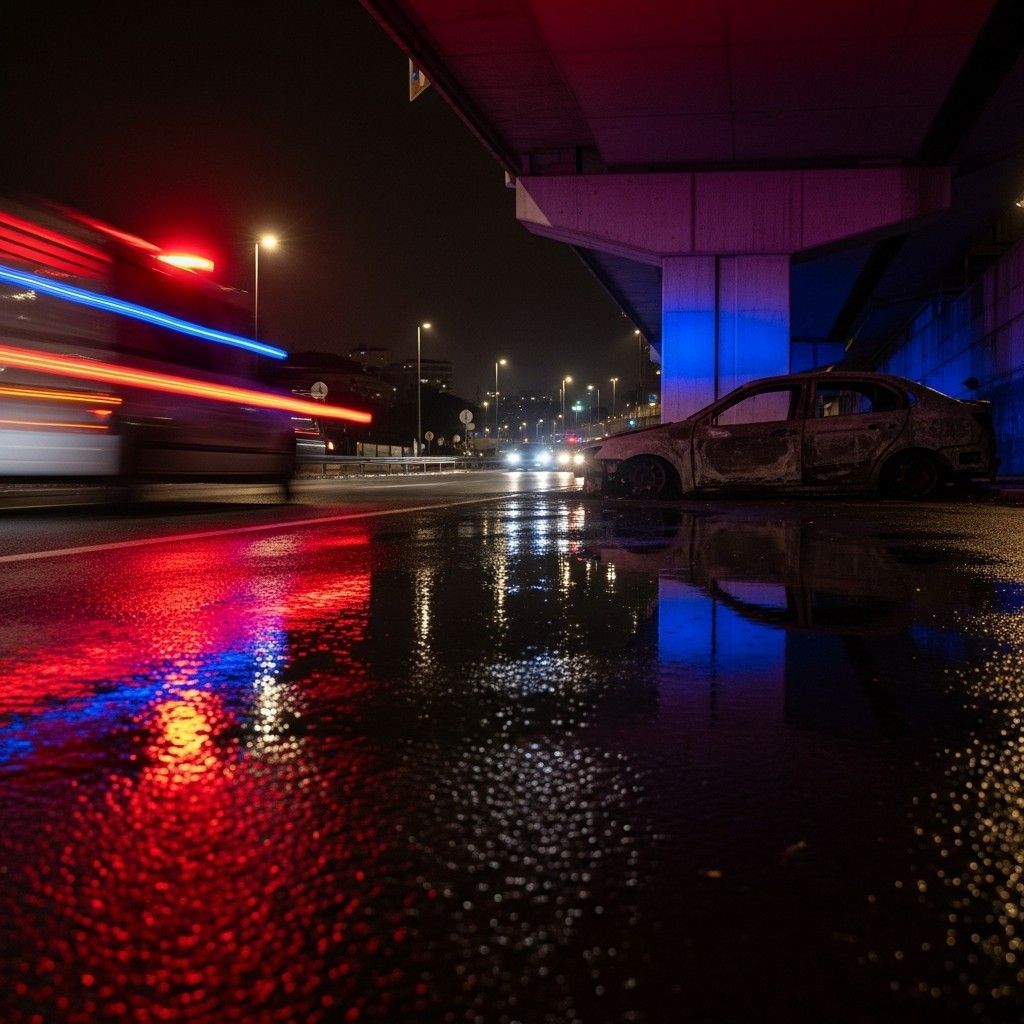
A chorus of sirens before dawn on Lisbon’s Avenida das Forças Armadas has left the city reckoning with the deaths of six university-age passengers, the vehicle reduced to twisted metal and ash. While forensic teams race to put names to the final four victims, the accident has reignited debate on youth road safety, speed limits and the effectiveness of urban policing in Portugal’s busiest district.
What investigators know so far
The crash sequence, reconstructed from nearby surveillance recordings, began at 03:40 when a dark-coloured BMW 3-series left the southbound lane, struck a concrete kerb, ricocheted against a support pillar and burst into flames beneath the elevated Eixo Norte-Sul. An officer from the Polícia de Segurança Pública (PSP), posted at the neighbouring United States embassy, sounded the alarm within seconds, but the blaze consumed the cabin before firefighters arrived. Initial site analysis points to excessive speed, a possible loss of control on a damp road surface and the complication of a sixth passenger squeezed onto five seats. Investigators have confirmed that at least one rear occupant was not wearing a seat belt.
Who the victims were
Two identities were established almost immediately: Bruno Balça, 19, the man believed to be behind the wheel, and Luís Garrido, 20, seated in front. Authorities later received dental records and DNA samples that match four Angolan nationals studying in Lisbon—sisters Flora and Tomasia Moreira, economics student Daniela Morais and engineering freshman Nelson Ferreira. Angola’s ambassador, Maria de Lurdes Bernardo, issued a statement of “profunda consternação”, praising the young adults’ “vontade de vencer” and offering consular support to grieving relatives. All six victims were between 18 and 21.
The unresolved questions
The Brigada de Investigação de Acidentes de Viação is testing whether the BMW’s electronic control unit registered a final travelling speed north of 120 km/h—well above the 70 km/h limit signed for that avenue. Officers are also checking whether Balça, who carried only his Cartão de Cidadão, ever obtained a valid driving licence. Toxicology will clarify if alcohol or recreational substances factored into the loss of control, while tyre fragments retrieved from the site are being examined for tread depth and possible under-inflation. Prosecutors from the Ministério Público say criminal proceedings are unlikely because every occupant perished, yet insist the technical report is essential for future policy decisions.
A wider pattern on Lisbon’s roads
Data compiled by the Autoridade Nacional de Segurança Rodoviária (ANSR) show that, between January and late November 2025, the district of Lisboa recorded 22 568 road crashes, more than any other in Portugal, with 44 fatalities. Among national victims, an average of 70 young people aged 15-25 die each year; nearly one-third of those deaths involve single-vehicle accidents where the car leaves its lane—often at night, often with peers on board, and frequently in densely populated corridors such as the Second Circular or the Eixo Norte-Sul. Despistes alone accounted for 33,6 % of all Portuguese crashes in 2024 but caused 45,4 % of deaths, underlining how hazardous an out-of-control slide can be.
Families demand answers, authorities promise action
Outside the Instituto de Medicina Legal, parents and siblings have voiced frustration at how long identification has taken, yet pathologists defend the need for DNA confirmation in burn cases “to an accuracy above 99,9 %.” City councillor for mobility Ângelo Pereira argues that enforcement cameras on the avenue have curbed previous speeding episodes but says the municipality will now consider rumble strips, fresh anti-skid surfacing and a review of night-time policing patrols. In Parliament, opposition MPs called for mandatory black-box recorders in cars driven by motorists under 24 years, a proposal the government will study during the next overhaul of the highway code.
How tragedies like this can be prevented
Traffic-safety specialists stress that modern cars offer remarkable protection only when occupants respect seat belts, abide by posted limits and keep vehicle maintenance up to date. On wet asphalt, they recommend trimming speed by roughly 30 %, allowing for longer braking distances and easing through curves to prevent aquaplaning. Equally critical is curbing in-car distraction, which studies rank as a leading trigger for nighttime crashes among young Portuguese drivers. National road-safety champion Diana Ramos notes that no single measure suffices: “It’s the daily discipline of checking tyre pressure, refusing to drive drowsy, and never squeezing an extra friend into a seatless space that saves lives.”
While police laboratories finalise their report and families prepare funerals, Lisbon confronts a familiar dilemma: how to reconcile the freedom of a late-night drive with the stark statistics of risk on Portugal’s capital roads. The six students who left a campus party early Sunday never made it home; their memory now fuels a renewed call for smarter enforcement, better driver education and a culture that treats every cockpit decision as potentially life-or-death.


