
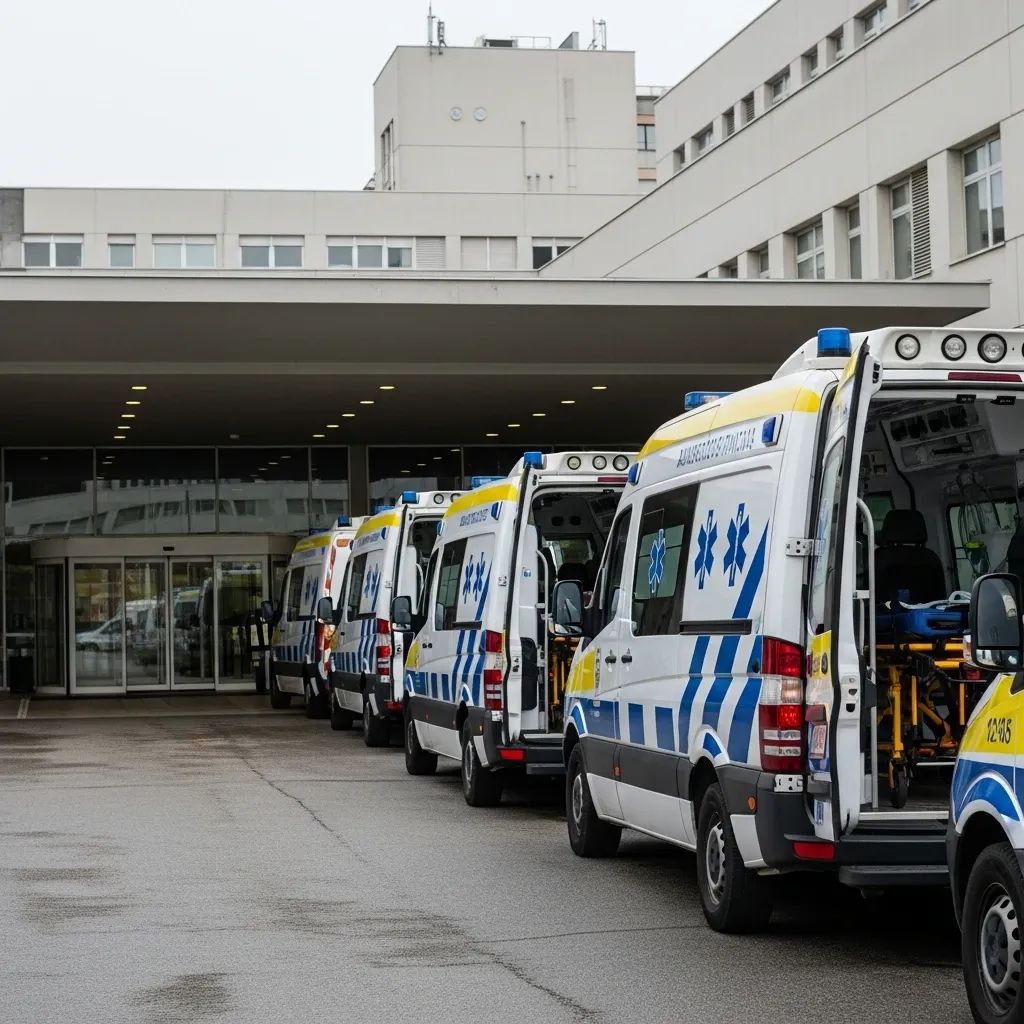
A 78-year-old resident of Paio Pires waited nearly three hours for an ambulance that was supposed to arrive in one. By the time help reached his door, he had died. Public prosecutors now want to know why a routine call on the south bank of the Tagus became a fatal lesson in system overload.
At a Glance
• Public prosecution service opens criminal inquiry
• Autopsy ordered to clarify medical cause of death
• INEM blames ambulance bottlenecks caused by stretcher block at hospitals
• Health inspectorate (IGAS) begins its own probe into response quality
• New five-level triage algorithm under scrutiny for widening permissible delays
Why It Matters to People in Portugal’s Industrial Belt
Commuters who live in Seixal, Almada or Barreiro already know the cost of crossing the river for a hospital bed. The case shines a light on fragile emergency cover, the chronic shortage of ambulances and the pressure on local fire brigades that Portugal’s most densely populated peninsula has faced for years. For families who rely on elderly relatives, the question is simple: can an emergency line still guarantee a life-saving arrival within the time printed on the brochure?
The Lost Minutes — A Reconstructed Timeline
Witness statements compiled by prosecutors point to the following sequence:11:20 — First distress call logged at the Lisbon coordination centre.11:35 — Operators flag the incident as priority level 3 (“urgent” meaning up to 60 minutes acceptable delay).12:00-13:59 — No ambulance free in the district; crews queue outside hospitals waiting to unload patients.14:09 — A medical rapid-response vehicle finally leaves Almada.14:28 — Patient found in cardio-respiratory arrest; resuscitation unsuccessful.
What Investigators Must Untangle
Prosecutors are gathering radio logs, vehicle GPS tracks, hospital handover times and the new triage software protocols. They will ask whether:• The priority tag was correct for a 78-year-old with potential head trauma.• Control-room supervisors escalated the call when no ambulance became free.• Hospital emergency departments breached Ministry rules by holding on to pre-hospital stretchers longer than the permitted 30 minutes.• Any individual or organisation negligently contributed to the fatal delay.
New Triage, Old Doubts
Introduced on 1 January, the algorithm splits cases into five coloured tiers instead of the previous three. Operators can now legally wait up to 120 minutes for “pouco urgente” calls and 60 minutes for “urgente”. Unions and firefighters say the wider windows are tempting managers to stall in the hope that a crew eventually frees up. INEM counters that the Seixal call would have carried exactly the same label under the old rules, insisting “software made no difference.”
Ambulances Parked, Stretchers Locked
The broader problem involves stretcher gridlock at hospitals such as Garcia de Orta. When emergency wards run out of beds, incoming patients stay on the ambulance cot, effectively freezing that vehicle in place. Last year 18 % of shifts in Setúbal district were logged as understaffed. Fire commanders estimate that on a busy winter morning half of their fleet can be trapped outside emergency departments, leaving the region with fewer than three mobile units at certain hours.
Voices From the Front Line
"We are not talking about rare glitches, we are talking about a daily pattern," says Rui Lázaro, head of the pre-hospital technicians’ union. Intensive-care physician Ana Serrano argues for mandatory medical oversight of all priority downgrades. Local mayor Paulo Silva wants funding for a promised hospital on the Seixal side, warning that "the river is an extra 15 minutes a patient may not have."
Proposals on the Table
Retrieve stretchers within 30 minutes or bill hospitals that exceed the limit.
Contract additional ambulance hours with volunteer fire brigades, paid at parity rates.
Deploy Support Immediate Life (SIV) units in Almada and Seixal to shorten critical care drive times.
Introduce real-time public dashboards showing average ambulance wait so the system can be held to account.
What Happens Next
The criminal inquiry could lead to charges of manslaughter by negligence if prosecutors see proof of avoidable delay. Separately, IGAS will publish an administrative report that may recommend disciplinary action or service redesign. Meanwhile, INEM’s internal audit must explain how a 60-minute promise morphed into 169 minutes. For now, residents across the Setúbal peninsula are left to hope the next emergency call finds an empty stretcher, a free crew and a clear lane across the bridge before the clock runs out.


