

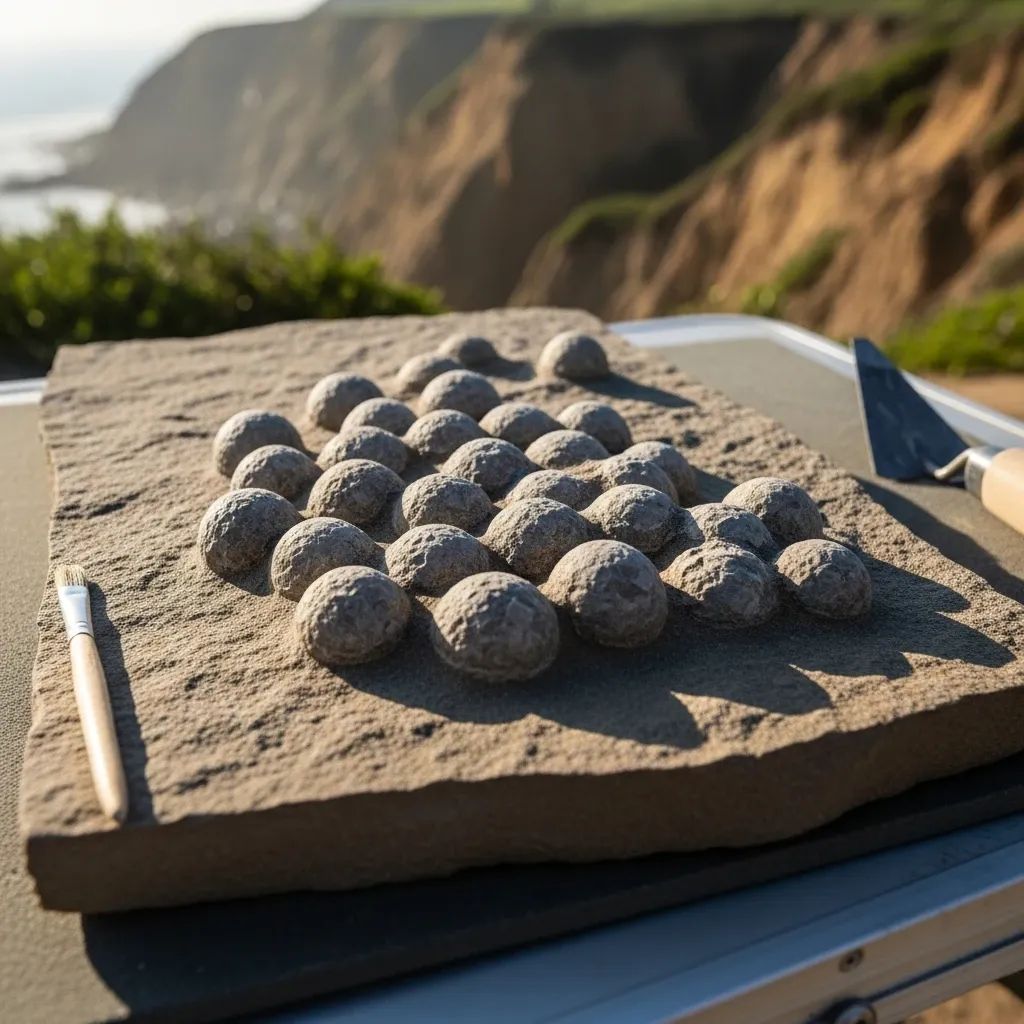
An unexpected discovery on the windswept cliffs north of Lisbon is reshaping how scientists — and local residents — picture Portugal’s Jurassic past. A cluster of fossilised eggs, tiny compared with most dinosaur finds yet astonishingly well-preserved, has been lifted from the sandstone of Santa Cruz beach in Torres Vedras. Early tests suggest a small carnivorous dinosaur left its mark here roughly 150 million years ago, making the site one of Europe’s richest windows onto life long before the Atlantic touched Portuguese shores.
Why the find matters to Portugal
• Only a handful of Upper Jurassic nests had ever been confirmed on the Iberian Peninsula
• The eggs sit just 55 km from Lisbon — an easy day-trip for schools and tourists
• CT scans could reveal embryonic tissue, something rarely preserved in sandstone
• Local authorities see a chance to expand the so-called “Dino-Rota” that already links Lourinhã, Peniche and Torres Vedras
• The discovery revives debate over how to balance coastal erosion control with heritage protection
A cliff-side surprise
The breakthrough belongs to Carlos Natário, a field researcher with the Society of Natural History of Torres Vedras. While inspecting erosion scars after a winter storm, Natário spotted a rounded outline in the beige cliff face. What looked like an isolated concretion revealed, after careful clearing, a tight circle of about ten eggs pressed into granulose sandstone — a sediment more typical of ancient riverbanks than beach dunes.
Palaeontologists note that such river-margin deposits tended to bury nests rapidly, shielding them from scavengers and, crucially for modern science, from oxygen-driven decay. That may explain why the shells still display a delicate micro-porosity pattern associated with small theropods — the two-legged hunters often seen as kin to today’s birds.
Small in size, big in science
Where most known dinosaur eggs from Portugal measure eight to ten centimetres across, these rarely exceed five. The compact diameter, coupled with dense clustering, hints at a species that invested in tight nesting to retain heat. Equally intriguing is the near-perfect arrangement: shell fragments remain inside each egg, implying hatchlings broke upward and then walked away, leaving their first home almost undisturbed.
Those clues may settle a long-running question about how Jurassic predators reared their young along what is now the Oeste coastline. “We finally have data to compare with the famous nests of China’s Gobi Desert and Argentina’s Neuquén Basin,” says Bruno Camilo, director of SHNTV. “Portugal can now enter that dialogue with hard evidence, not just isolated bones.”
From cliffs to CT scanners
The fossil block has reached a climate-controlled lab in Torres Vedras, where technicians are coating the exterior with reversible resin before subjecting it to high-resolution CT. Three-dimensional modelling will allow researchers to peer inside each egg without opening it — a tactic that has already revealed veins, skull plates and even yolk residues in comparable finds abroad.
If embryonic bones emerge, they could anchor the nest to a specific genus. Current bets lean toward a small allosauroid or perhaps Eustreptospondylus, a predator known from Portugal’s Lourinhã Formation. Either match would extend the documented range of those dinosaurs and strengthen the nation’s claim to a continuous fossil corridor along 60 km of Atlantic coast.
Heritage, tourism and a fragile coastline
Torres Vedras council has fast-tracked protective fencing and signage around the dig, mindful that word travels quickly on social media. Officials insist visitors remain at a safe distance while geologists assess cliff stability — part of a broader plan to merge geo-tourism with rising concerns about sea-level rise.
Local businesses already benefit from Portugal’s “silver coast” surf culture; now they are preparing dinosaur-themed walking tours and augmented-reality apps that overlay ancient ecosystems onto present-day landscapes. Regional planners hope this layered story — surfing waves above, theropod footprints below — will lengthen off-season stays and spread tourist revenue beyond marquee destinations like Lisbon and Sintra.
Portugal’s growing Jurassic trail
Santa Cruz joins an expanding list of fossil hotspots that includes Vale Frades, Praia da Corva and the Lourinhã Museum’s open-air digs. Taken together, they position Portugal as one of the few places globally where visitors can track 150 million years of evolution across a short coastal drive. The government’s latest cultural-heritage plan sets aside funds for new signage, replica casts in local schools and a travelling exhibition scheduled to begin in Évora next spring.
What happens next
Palaeontologists expect preliminary CT results within months. If viable embryonic material is present, researchers will apply for European Research Council backing to run isotopic analyses, micro-wear studies and perhaps even molecular assays. Each step, they stress, will proceed under Portugal’s strict património guardianship laws, which require public ownership and curated storage.
For now, the eggs remain hidden behind laboratory walls, but their story is already rippling outward, inviting residents and visitors alike to imagine the Santa Cruz shoreline as it once was: not a retreat for swimmers and sun-seekers, but a nursery for sharp-toothed hatchlings testing their claws in the soft sand of a vanished riverbank.


