
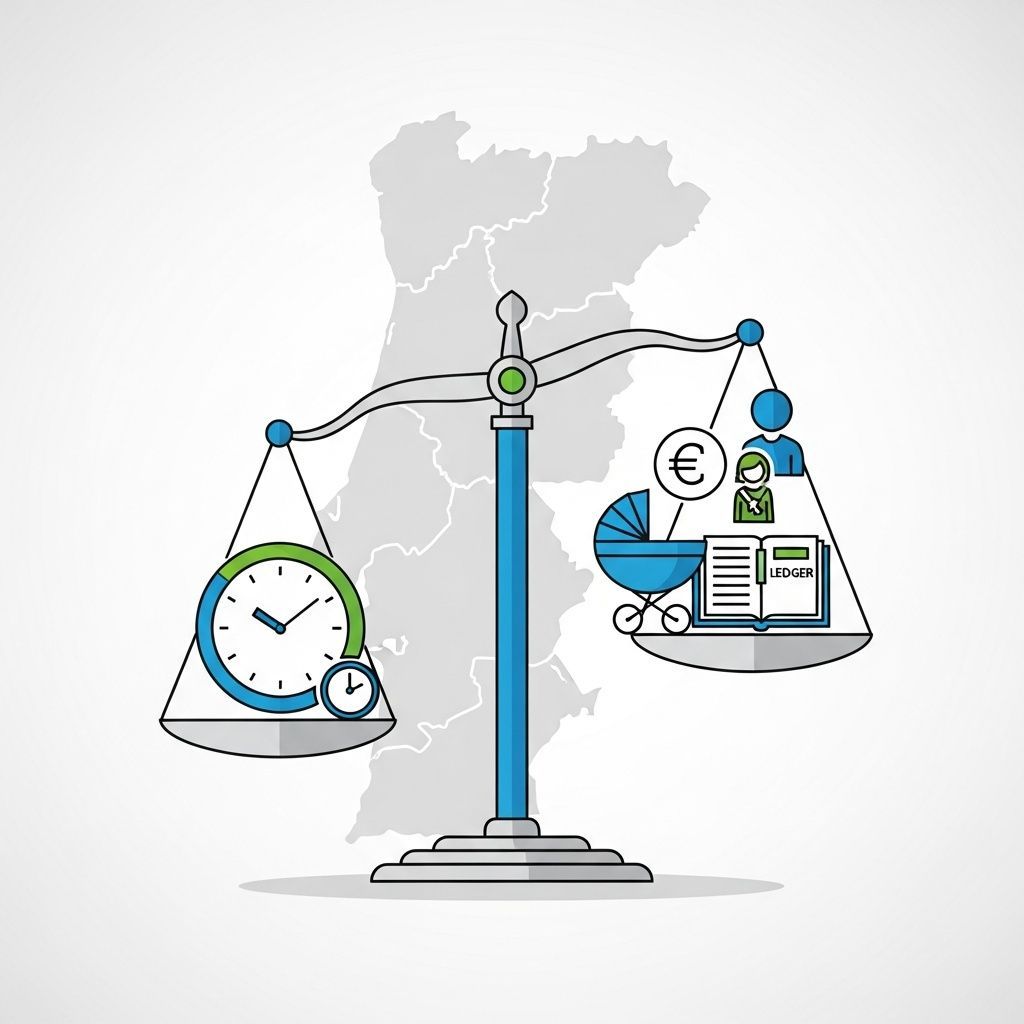
Portugal is poised to overhaul its labour rulebook again, and the political temperature is rising almost as quickly as expectations. The Government’s draft package, branded Trabalho XXI, promises to modernise work relations for a digital age, yet unions insist it threatens hard-won protections. Employers, meanwhile, see a chance to put flexibility on par with European competitors. The coming weeks will reveal whether the country can square these circles through the consensus, transparency and balance so often invoked but rarely achieved.
The road to Trabalho XXI – what is really at stake?
Legislation from the last two decades still anchors Portugal’s workplaces, even though cloud computing, hybrid schedules and algorithmic management have rewritten everyday routines. Supporters of the new code argue that a more agile system is essential if Portugal wants to keep attracting investment and stop its skilled workers from decamping abroad. The draft text rewrites more than one hundred articles, touching everything from bank of hours arrangements to guardrails on digital-platform labour. For the Government, these revisions are not ideological experiments but a bid to align with European directives on pay transparency and strengthened worker consultation. Critics counter that the package smuggles in precarity under the banner of competitiveness.
How households could feel the changes
The reform reaches into living-room budgets as well as factory floors. An anticipated rise in the minimum wage to €870 will nudge up low incomes, while a higher meal allowance could offset inflation at the supermarket checkout. Yet extended fixed-term contracts—lengthened from two to three years—and a restored bank of hours capable of stretching weekly work to fifty hours may complicate family planning. Parents also face a revamped parental-leave regime that obliges one hundred and twenty days at home but caps breastfeeding dispensation at two years. In tourism-heavy regions such as the Algarve, small operators welcome seasonal leeway; teachers’ unions warn that parents of young children will pay the price.
The bargaining table – consent, clarity, symmetry
Social-dialogue sessions have become marathon affairs in which every comma is scrutinised. The Confederation of Tourism of Portugal insists that only a reform built on consensus, transparency and equilibrium can succeed. That mantra conceals deep rifts. Employer lobbies applaud changes that lift the moratorium on outsourcing after collective layoffs, claiming it keeps firms alive during downturns. Union confederations CGTP and UGT label the same article a licence to swap permanent staff for cheaper subcontractors. Both sides, however, agree that algorithmic recruitment tools must carry explicit audit trails to avoid hidden bias, a nod to Brussels’ push for responsible artificial-intelligence deployment.
The most disputed points
Few proposals inflame passions like the resurrected individual bank of hours. Bosses celebrate the option to shift peaks in demand without overtime bills, yet labour lawyers recall past abuses where extra hours were banked but never paid. Equally polarising is the expansion of services-minimum obligations during strikes, now slated to cover food distribution, private security and childcare. Government officials frame this as a safeguard for public welfare; union leaders see it as a muzzle on industrial action. Tensions have already produced an unusual joint strike call by CGTP and UGT for mid-December, underscoring how fragile the negotiation climate has become.
Expert voices: flexibility or fragility?
Academics split along familiar lines. Employment-law professor Gonçalo Pinto Ferreira contends that greater contractual elasticity will anchor Portugal in global value chains and foster productivity gains. Veteran jurist António Garcia Pereira blasts the draft as a “declaration of war on workers”, warning of an uptick in litigation once looser rules meet on-the-ground inequalities. Economists add a fiscal note: without heftier spending on active labour-market programmes, any new freedom to hire and fire could widen skill gaps rather than close them. Portugal currently channels less than 0.5 % of GDP into re-skilling, well below the Nordic average.
European snapshots: why consensus matters
From Copenhagen’s celebrated flexicurity to Rome’s recent clamp-down on serial temporary contracts, neighbouring capitals provide cautionary tales. Where reforms progressed smoothly—Denmark, the Netherlands—broad parliamentary coalitions paired flexibility with robust safety nets. Where they stumbled—Spain’s earlier liberalisation waves—precarity surged and productivity stalled. Brussels is now doubling down on dialogue, revising the directive on European Works Councils and pressing member states, Portugal included, to embed gender-pay reporting. Lisbon’s reformers cite these cues to justify faster change; opponents reply that real consensus, not selective benchmarking, is the lesson to import.
What happens next for workers and employers?
Parliament is expected to start article-by-article scrutiny early in the new year. Observers expect amendments around telework expenses, the definition of an economically-dependent contractor and safeguards for collective bargaining. If the schedule holds, the updated Code may enter force before next summer’s tourist rush, a calendar welcomed by hotels desperate for staffing clarity. Should talks collapse, the spectre of prolonged industrial unrest—and potentially a return to the Constitutional Court—could delay any benefits until 2026. Either scenario will test whether Portugal can marry flexibility, security and fairness in time to keep pace with a labour market already racing ahead.


