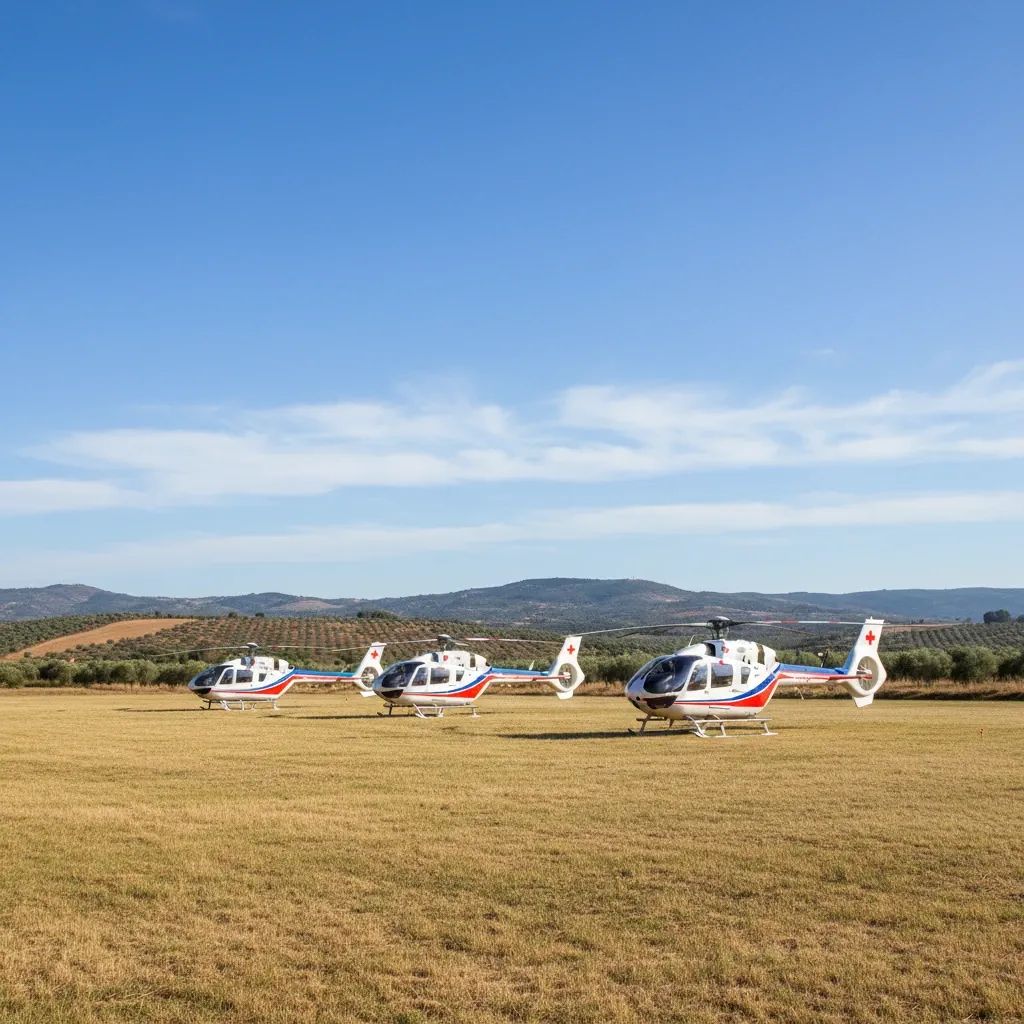
Portugal's emergency helicopter services operated at reduced capacity for over a year—not because of budget shortfalls, but because health officials hesitated over a 60% cost spike. The revelation came when former Health Minister Manuel Pizarro told a parliamentary inquiry on April 15 that the Portugal National Emergency Medical Institute (INEM) delayed launching its emergency helicopter tender due to internal caution over expenses that would have jumped from €7.5 M to €12 M annually. This procurement saga ultimately left Portugal's aerial medical response operating under rushed stopgap contracts, tribunal scrutiny, and penalty disputes totaling nearly €1 M.
Why This Matters
• Cost vs. Speed: The tender delay stemmed from bureaucratic caution over rising expenses, not lack of funds—INEM maintained positive balances throughout.
• Service Disruption: The failed 2024 tender forced INEM into a direct-award contract (a procurement method allowing INEM to negotiate with a single supplier without competitive bidding) that the Portugal Court of Auditors (the tribunal responsible for overseeing public spending) initially blocked, leaving two helicopters operating only 12 hours daily for months.
• Penalty Battle: INEM is pursuing €926,600 in fines against Gulf Med Aviation Services for delays and operational gaps during the July–October 2025 interim period; the contractor is appealing.
• Operational Status: Four new helicopters have been fully operational 24/7 since November 2, 2025, stationed in Macedo de Cavaleiros, Viseu, Évora, and Loulé. The four bases provide coverage across Portugal's north (Macedo de Cavaleiros, Viseu), south-central (Évora), and Algarve (Loulé) regions, ensuring nationwide emergency response capability.
The 60% Question
Pizarro, who served as Portugal Minister of Health from September 2022 to March 2024, faced lawmakers on the inquiry commission examining INEM's performance during a fatal late-2024 strike by pre-hospital emergency technicians. Twelve deaths occurred during the industrial action, three linked to delayed response according to the Portugal Health Activities Inspectorate.
He clarified that when the existing four-aircraft contract expired in 2023, the government debated whether to absorb a €4.5 M annual increase—a figure representing a full 60% jump over the previous five-year deal. "Naturally, weighing whether to raise spending by 60% was difficult," Pizarro said, "and as it turned out, that tender with the increased price came back empty." The January 2024 tender attracted two bids, both priced well above the €12 M base, leaving INEM with no acceptable offers and no contract in place for the start of 2024.
The inquiry revealed that the Portugal Court of Auditors and INEM management had flagged the urgency of launching a new procurement by August 2024, with the deadline set for September 30. The tender was not published until late November, nearly two months overdue.
Why INEM Cannot Own Its Fleet
Responding to questions from the Portuguese Communist Party (PCP), Pizarro rejected outright any notion that INEM should purchase and operate its own helicopters. "It is completely impossible for an institution like INEM to own a fleet" of emergency aircraft, he argued, citing the complexity of maintenance, pilot training, and technical support. "There is no capacity to resolve the technological problems of helicopter upkeep or the formation and availability of pilots for those helicopters."
His position aligns with the model used across much of Europe, where emergency medical aviation is typically contracted to specialized private operators or delivered through public-private partnerships rather than held in-house by health ministries. Portugal's reliance on external providers mirrors arrangements in British Columbia, Canada, and Croatia, where long-term contracts with commercial operators balance public oversight with private-sector agility.
From Desert Tender to Direct Award
Timeline recap: The original contract expired in 2023, a January 2024 tender failed, INEM used an interim direct award from July-October 2025, and full service resumed November 2025.
With the 2024 tender yielding no viable bids, INEM turned to a direct-award contract with Gulf Med Aviation Services—a Malta-based firm—to maintain three helicopters at a daily cost of €11,300 per aircraft for 12-hour shifts. That interim arrangement, worth up to €4.01 M over four months (July to October 2025), faced immediate legal trouble when the Portugal Court of Auditors ruled it null. The tribunal reversed its decision in February 2026, validating the contract retroactively but opening the door to penalty enforcement.
Meanwhile, the full tender—launched in April 2024 under the authority of Council of Ministers Resolution 133/2023 from October 25, 2023—was finally awarded to Gulf Med on March 27, 2025. The five-year deal, valued at €77.47 M plus VAT, covers four medium helicopters operating around the clock until June 30, 2030. At over €42,000 per day, the contract represents one of the largest single-line items in Portugal's pre-hospital emergency budget.
Penalties, Appeals, and Air Force Backup
INEM is now seeking €926,600 in penalties from Gulf Med for delays and availability shortfalls during the direct-award period. On March 18, 2026, Gulf Med announced it would contest the fines, calling them unjustified. The dispute underscores the fragility of Portugal's emergency aviation procurement: even after contracts are signed, operational hiccups trigger financial and legal friction.
To bridge gaps in service, the Portuguese Air Force stepped in with its own helicopters, charging €30,000 per flight hour—nearly triple the per-hour equivalent of the Gulf Med contract. The government also announced in early 2026 the acquisition of four Black Hawk helicopters for approximately €32 M (about €8 M each), due for delivery by August 2026. While primarily destined for Air Force duties, these aircraft will be available to reinforce medical emergency response when INEM capacity is strained.
Fleet Deterioration and Vehicle Shortages
Beyond aviation, Pizarro acknowledged that INEM's ground ambulance fleet suffered "absolutely factual deterioration" during his tenure. Post-pandemic supply-chain disruptions made vehicle procurement exceptionally difficult: a tender for 89 ambulances launched in April 2023 also came back empty. A subsequent Council of Ministers resolution authorized the purchase of 312 vehicles across 2024, 2025, and 2026, though delivery timelines remain uncertain.
The former minister emphasized that financial constraints were never the root cause. "INEM always had positive results," he told lawmakers, adding that the real challenge was ensuring public spending was "well done" rather than simply abundant.
What This Means for Residents
For anyone living in Portugal—whether citizen, expat, or long-term resident—the helicopter procurement saga has direct implications:
• Response Times: Reduced helicopter availability during 2024 and early 2025 meant longer waits for air ambulance assistance in rural and island regions, particularly in the Alentejo and Algarve, where road access can be slow.
• Service Reliability: With four helicopters now operational 24/7 as of November 2025, the system is back to its intended capacity, though financial and contractual disputes continue in the background.
• Taxpayer Cost: The jump from €7.5 M to over €15 M annually (including interim contracts and Air Force support) represents a significant increase in public health spending—one that Pizarro justified as unavoidable given market conditions.
• Future Vulnerability: The pattern of failed tenders and emergency direct awards suggests systemic issues in Portugal's public procurement framework for specialized services, raising questions about resilience if Gulf Med or future contractors face operational difficulties.
• How to Access Emergency Helicopter Services: If you need emergency medical assistance and believe helicopter transport is necessary, call 112 (Portugal's emergency number). INEM dispatchers assess whether air ambulance transport is appropriate based on your location and medical condition. Current service availability is nationwide, with 24/7 coverage from the four helicopter bases.
Broader Context: Portugal's Procurement Puzzle
The helicopter debacle is part of a wider story about Portugal's struggle to modernize emergency health infrastructure in a post-pandemic, high-inflation environment. Market conditions since 2020 have made procurement unpredictable: vehicle shortages, pilot labor disputes, and rising fuel costs have all contributed to tender failures. The Portugal Court of Auditors has taken an increasingly assertive stance on oversight, blocking contracts it deems insufficiently justified—a stance that, while ensuring accountability, can also delay critical services.
Internationally, Portugal's reliance on private contractors for emergency aviation places it in a middle tier: more market-driven than fully public models in Scandinavia, but more state-directed than the for-profit U.S. system. The five-year contract model—standard in Spain and Portugal—offers budget predictability but can discourage bidders if initial pricing is too tight, as the 2024 tender demonstrated.
Former INEM President Luís Meira told the inquiry in late March 2026 that the ministry had been aware of the tender impasse during the final phase of his mandate but provided no clear guidance, leaving INEM management to navigate procurement, legal, and operational pressures simultaneously.
The Inquiry's Scope
The parliamentary commission is examining not only the helicopter delays but also INEM's broader handling of the October–November 2024 strike, during which emergency response times stretched and three deaths were officially attributed to delayed assistance. The inquiry's mandate extends back to 2019, covering the tenure of multiple health ministers and INEM presidents, and is expected to produce recommendations on procurement reform, labor relations, and crisis management protocols.
Pizarro's testimony—focused on budget discipline and market realities—contrasts with earlier criticism that the government failed to act decisively when tender problems first emerged in 2023. The dispute over whether financial caution or bureaucratic inertia drove the delay remains unresolved, but the operational consequences are undeniable: Portugal's emergency aviation network spent over a year in a state of partial readiness, relying on stopgap measures that cost more and delivered less than a functioning contract would have provided.
As the inquiry continues, attention will turn to whether the current Gulf Med contract can deliver sustained performance, whether penalty enforcement will deter future delays, and whether Portugal's procurement rules need fundamental reform to prevent a repeat of the 2024 tender failure.