

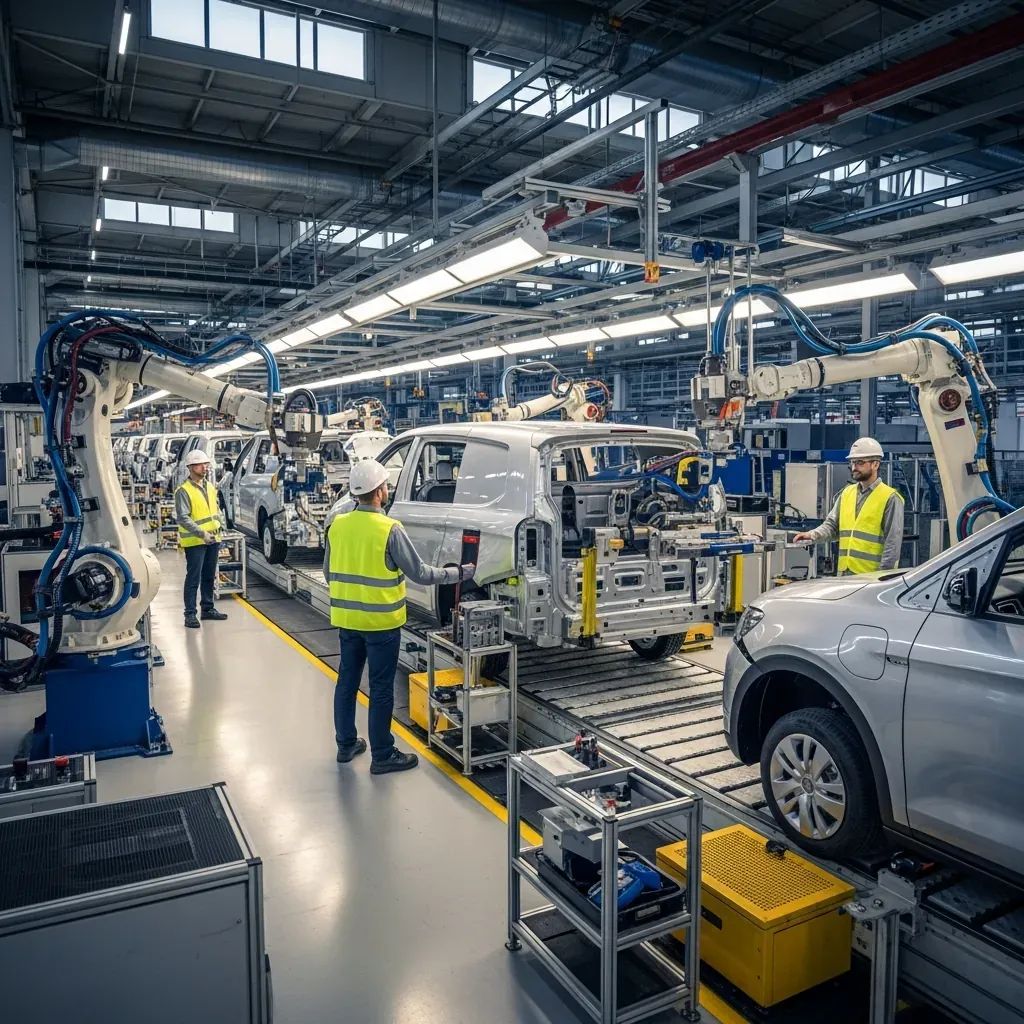
Portugal’s car factories are closing in on a new production record, with fresh data showing healthy gains across every vehicle segment and an export machine that rarely misses a beat. While 2025 numbers are now locked in, executives and analysts are already debating whether 2026 can keep the momentum going against a backdrop of soft European demand, fragile supply chains and the costly dash toward electrification.
Assembly Lines Shift Up a Gear
The country’s four major plants rolled 341,361 vehicles off their lines in 2025, edging 2.7% above the previous year and posting the second-best performance ever, only behind 2019. Passenger cars remain the backbone, with 269,468 units (+3.3%) followed by 68,809 light commercial vans (+0.2%) and 3,084 heavy trucks and buses (+5.2%). The modest yet broad-based growth matters because each extra percentage point keeps thousands of skilled jobs intact and helps justify new automation projects that raise productivity.
Exports: The Lifeline of the Sector
Roughly 97.8% of every vehicle bolted together in Portugal leaves the country, a figure that dwarfs even Germany’s export ratio. Germany, Italy, Turkey, France and Spain snap up most of the output, jointly absorbing over 60% of shipments, while Morocco and the United States headline the smaller African and American slices. The export bias explains why domestic registrations represent barely 2.2% of the cars that Portuguese factories churn out, a startling imbalance that shields manufacturers from the limited size of the home market but exposes them to fluctuations abroad.
Electric Dreams in Mangualde
The most eye-catching milestone of 2025 was Stellantis’ decision to fast-track full-electric van production in Mangualde. The revamped line now has room for up to 55,000 zero-emission vehicles a year, though actual output will mirror demand. For the moment, early runs were symbolic—about 100 battery-powered cars and 844 electric light commercials—yet they mark Portugal’s entry into the tight club of European EV producers. Policymakers see the move as a down payment on a wider lithium-to-battery value chain, tapping the country’s ore reserves while anchoring high-skill manufacturing in the interior.
Looking Toward 2026: Tailwinds and Potholes
Industry insiders expect Europe’s overall production to grow a lukewarm 1.6% in 2026, according to Crédito y Caución, and Portugal’s volumes will likely track that trend. The forecast, however, comes with a list of caveats:
• Weak household demand for big-ticket items could put a lid on orders.
• Semiconductor bottlenecks and price spikes for rare earths linger.
• A 15% U.S. tariff on EU vehicles adds costs for some niche exporters.
• The slow migration to electric powertrains—still just 15.8% of new EU registrations— forces plants to juggle two very different technologies.
• Lisbon’s 2026 budget keeps IUC changes and plug-in incentives on the table, a mixed bag that both helps and hurts depending on the drivetrain.
Employment and Regional Ripple Effects
Auto manufacturing directly supports 167,000 Portuguese jobs and feeds a network of 35,000 supplier firms, many clustered in the Centro region where the industry anchors local economies. Wage bills are rising as factories recruit software engineers alongside welders, yet the same electrification wave that creates high-tech posts is squeezing traditional drivetrain specialists. Trade unions are already pressing for retraining funds to avoid another pandemic-style contraction.
Key Figures on One Dashboard
• 341,361 vehicles built in 2025 (+2.7%)
• 97.8% shipped abroad, mostly to Europe (88%)
• 19.1% of exports land in Germany
• 55,000-unit EV capacity at Stellantis Mangualde
• 167,000 jobs tied to the sector nationwide
While the road ahead features more curves than straightaways, the Portuguese auto industry enters 2026 with its engines running smoothly—and a brand-new electric drivetrain humming in the background, ready to kick into higher gear when market demand finally accelerates.


