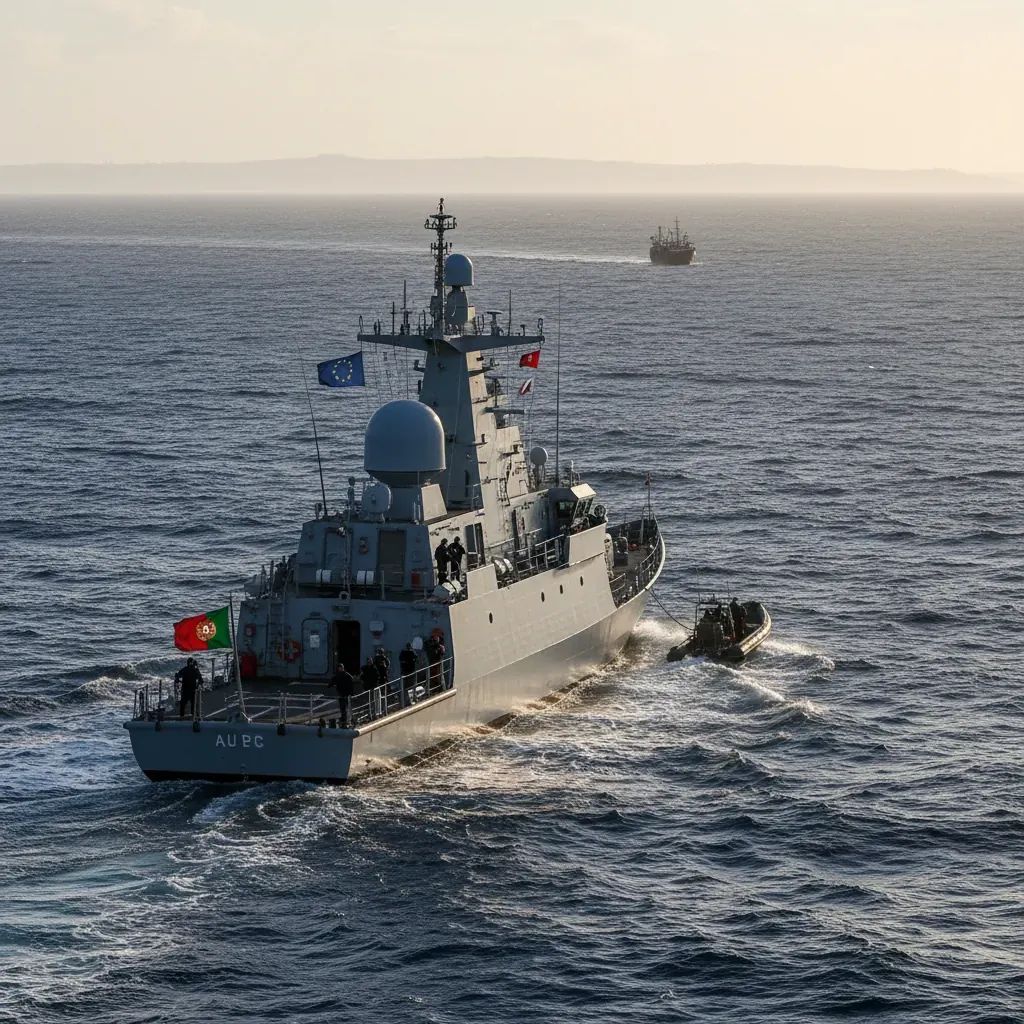
The Portugal Judiciary Police has helped Spanish authorities dismantle a major international cocaine transport network operating as a logistics provider to multiple trafficking cartels, a case that underscores the increasingly sophisticated methods criminals use to evade cross-border law enforcement in the Iberian Peninsula. The operation, which concluded this week after investigations launched in July 2025, seized more than 3,400 kg of cocaine — enough to supply roughly 340,000 individual doses — along with firearms, armored vehicles, and over €1 M in cash.
Why This Matters
• Cross-border networks are evolving: Criminal groups now operate like service companies, offering transport logistics to multiple cartels simultaneously, using modified vehicles with hidden compartments and counter-surveillance techniques.
• The Iberian corridor is heating up: Portugal and Spain have become critical entry points for cocaine from Venezuela and Colombia, with traffickers shifting from traditional ports to Atlantic maritime routes and semi-submersibles.
• Enforcement is intensifying: Authorities in both countries have dismantled at least 10 major trafficking networks since January 2026, with combined seizures exceeding 10 tonnes of cocaine in the first two months of the year alone.
The Madrid Connection
Spanish investigators, working closely with Portugal's Judiciary Police, identified an organization that functioned as a specialized logistics arm for narcotic cartels. Unlike traditional trafficking cells that control the entire supply chain, this group offered a narrow but critical service: moving cocaine from southern Spain to Madrid using vehicles fitted with hidden compartments designed specifically for clandestine cargo.
The operation's modus operandi was methodical. Teams would travel south in convoys composed of rental cars registered to third parties, cargo trucks, and passenger vehicles, picking up shipments and ferrying them north to the capital, where the cocaine was repackaged into smaller consignments for distribution across Europe. To avoid detection, the group deployed rigorous counter-surveillance measures, including scouting vehicles that could identify police checkpoints and tail law enforcement units.
Raids across eight locations in Spain netted the massive cocaine haul, along with 10 firearms, magazines, ammunition, a bulletproof vest, and six vehicles. Authorities also seized approximately 500 grams of hashish and equipment used to manipulate and conceal narcotics, some of it hidden in false ceilings and custom-built compartments inside the vehicles.
What This Means for Residents
Portugal's role in this case — primarily intelligence sharing and operational support — reflects the country's position as both a transit corridor and a strategic partner in dismantling Iberian trafficking networks. The Portugal Judiciary Police contributed analysis that helped characterize the network's structure, map its routes, and identify international contacts, allowing Spanish authorities to execute the takedown.
For residents and businesses in Portugal, the case is a reminder that the country sits at the intersection of two major cocaine trafficking routes: the Atlantic maritime corridor, where semi-submersibles and fast boats from Venezuela and Colombia deliver shipments to Portugal's coast and the Azores, and the Iberian land corridor, where drugs transit from southern Spanish ports to distribution hubs in Madrid, Barcelona, and eventually northern Europe.
The intensification of cross-border cooperation means Portuguese territory is under closer scrutiny, but it also means enforcement resources are stretched. Since January 2026, Portuguese authorities have participated in or led operations that seized nearly 10 tonnes of cocaine in a single semi-submersible interception off the Azores — the largest drug bust in the country's history — and dismantled networks operating in the Algarve, Setúbal, Aveiro, and Valença.
The Sintra-Cádiz Pipeline
Separately, Portuguese prosecutors this week charged 16 individuals connected to a cannabis trafficking operation that ran product from Cádiz, Spain, to the municipality of Sintra, just outside Lisbon, where it was resold to local buyers. The network had been active since at least 2020, according to the Portugal Public Prosecutor's Office, and operated in an organized fashion with dedicated transport and distribution roles.
Ten of the accused were placed in preventive detention — Portugal's most restrictive pre-trial measure — while five face periodic check-ins at local police stations and one was released under identity and residence reporting requirements. Two suspects face additional charges for money laundering, and four for possession of prohibited firearms. The case is being handled by the Criminal Investigation Department of the Sintra Nucleus in collaboration with the Portugal Republican National Guard's Criminal Investigation Unit, and remains under judicial secrecy.
The Sintra case is part of a broader trend. In February 2026, a Portugal Republican National Guard megaoperation concluded a two-year investigation that resulted in 20 arrests across Portugal and Spain, with 11 placed in preventive detention. That network also sourced hashish in Cádiz and transported it to the Lisbon region, where authorities seized approximately 60 kg of hashish, along with cocaine, cannabis, synthetic drugs, cash, and weapons. The operation included execution of a European arrest warrant in Spain with assistance from the Guardia Civil.
Airport Interception and Island Busts
Lisbon's international airport remains a key chokepoint for narcotics entering Portugal. This week, Portugal Public Security Police officers intercepted two women after they collected a suitcase at Lisbon Airport and prepared to hand over 41.8 kg of cocaine to a male suspect in Setúbal. The operation, based on intelligence gathered during an ongoing investigation, resulted in preventive detention for both women, while the male recipient was released under a reporting requirement of three times per week at his local precinct.
The Azores, meanwhile, continue to see enforcement pressure. On Terceira Island, a 31-year-old man was arrested by the Portugal Public Security Police's Complex Squad in Praia da Vitória after officers found 22 individual doses of methamphetamine and more than seven doses of hashish, along with a mobile phone and drug-related paraphernalia. He was placed in preventive detention. On São Miguel Island, two men aged 37 and 48 were arrested in Ribeira Grande following a tip-off about suspected drug trafficking at a residence in the Matriz parish. Police seized various drug types, pills, and trafficking equipment, and both suspects are now in preventive detention awaiting trial.
Mainland Crackdown
In a coordinated sweep across Oeiras, Amadora, Elvas, and the Vale de Judeus Prison, the Portugal Public Security Police's Lisbon Metropolitan Command detained 10 men and one woman as part of an investigation delegated by the Amadora Department of Investigation and Penal Action. The probe targeted a group suspected of trafficking large quantities of narcotics to buyers in Lisbon, Oeiras, and Elvas.
After months of surveillance, authorities executed 16 home searches and seized a firearms arsenal that included a semi-automatic pistol, a submachine gun, and a rifle, plus ammunition of various calibers. Drug hauls were substantial: 3,050 doses of hashish, 12,575 doses of cocaine, 1,350 doses of heroin, 150 doses of amphetamines, 50 doses of cannabis, and 250 doses of ecstasy, along with 3,600 grams of cutting agent. Police also recovered more than €13,000 in cash, two presses, a safe, eight precision scales, 12 mobile phones, and 20 packages of anabolic steroids.
According to the police statement, the suspects had the capacity to acquire multiple drug types and operated from residential areas, selling directly to end users while evading routine patrols.
The Wider Iberian Battle
Portugal and Spain have significantly intensified cooperation on drug enforcement since late 2025, driven by a surge in cocaine shipments using novel methods. In January 2026, Europol flagged the unprecedented growth of cocaine trafficking into Europe, highlighting the increasing use of semi-submersibles and non-commercial vessels on Atlantic routes. That same month, Portuguese naval and air forces intercepted a semi-submersible 230 nautical miles off the Azores carrying nearly 9 tonnes of cocaine with four crew members aboard — three Colombian, one Venezuelan.
In February 2026, Operation "Teia Branca" resulted in the dismantling of a transnational network that had been under investigation since 2023. Portugal Judiciary Police and Spain's National Police arrested five suspects and seized 1.5 tonnes of cocaine, six AK-47 Kalashnikov rifles, one submachine gun, two pistols, seven fast boats, and 22 vehicles. The network had operational bases across Portugal's Algarve, Valença, Aveiro, Guarda, Lezíria do Tejo, and Setúbal, introducing and distributing cocaine throughout the Iberian Peninsula via maritime and land routes.
Another February operation, "Valhalla," led to 10 arrests in Portimão and the seizure of 1,300 kg of cocaine, with collaboration from Portuguese Maritime Police and authorities in Spain and Denmark. Meanwhile, Spanish authorities dismantled three networks linked to the Balkan Cartel, arresting 30 people and seizing over 2,475 kg of cocaine.
Portugal and Spain agreed in November 2025 to deepen cooperation, particularly after Portugal passed regulations allowing the use of fast boats — so-called "narcolanchas" — in counter-narcotics operations, a measure praised by Spain's Interior Minister as a "major step against organized crime."
Impact on Expats & Investors
For expatriates, entrepreneurs, and investors in Portugal, the spike in enforcement activity signals both heightened security and increased operational friction. Property transactions in coastal areas, particularly the Algarve and regions near major ports like Setúbal, may face additional due diligence as authorities scrutinize buyers and ownership structures tied to money laundering. Businesses involved in maritime services, vehicle rentals, or logistics should expect closer regulatory oversight.
The legal landscape is also shifting. Portugal's adoption of fast-boat enforcement powers and the creation of joint investigation teams with Spain and other European nations under Eurojust auspices means that cross-border legal cooperation is faster and more invasive. Residency applicants with past involvement in sectors flagged for trafficking risk — such as maritime transport, vehicle modification, or cash-intensive retail — may encounter longer processing times and heightened background checks.
For residents concerned about public safety, the data is mixed. While cocaine seizures have spiked, indicating higher volumes entering the country, the number of dismantled networks and preventive detentions suggests enforcement is keeping pace. The challenge lies in the adaptability of trafficking organizations, which continue to fragment supply chains and innovate around traditional chokepoints like commercial ports.
Portugal's geographic position — straddling Atlantic maritime routes and the European distribution network — ensures it will remain a focus of both criminal logistics and law enforcement attention. The operational tempo set in early 2026, with multiple megaoperations and record seizures, is likely to continue as Venezuelan cocaine shipments increasingly favor European markets over saturated U.S. routes.