
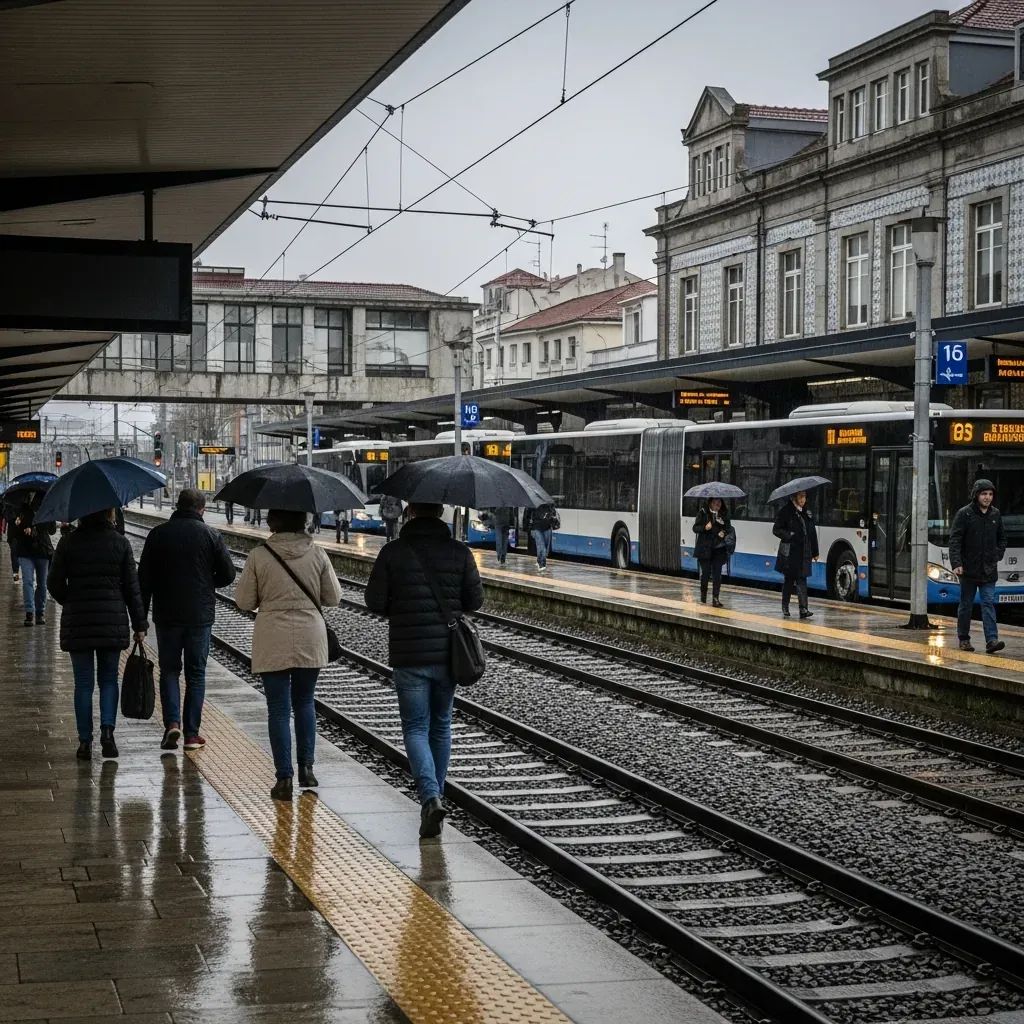
The commuter rush across Portugal woke up to yet another morning of overturned schedules, replacement buses and nervously refreshed phone apps. Two days after Storm Kristin barrelled through the mainland, rail traffic is still returning only in fits and starts, and the knock-on effects stretch from Porto Campanhã to Setúbal.
Snapshot for the morning crowd
• Northern Line long-distance trains remain halted between Porto and Lisbon.
• Urban services on the Sintra-Azambuja corridor work exclusively between Mercês and Sintra.
• The Sado Line is running, yet with reduced speed limits on open stretches.
• A single track keeps Fertagus crawling south of the 25 de Abril Bridge, after a fallen tree near Venda do Alcaide.
• CP urges travellers to consult its website, app or 707 number before heading to the platform.
Where trains are still idle
Rail operator CP confirmed overnight that damage to the catenary, signalling relays and embankments forces a continued blackout on wide sections of the network. Alfarelos, a low-lying junction notorious for flooding, remains impassable, cutting the Northern Line in two. On the Beira Alta and Beira Baixa corridors, crews found loose ballast, snapped poles and vegetation debris wedged beneath sleepers. Further west, the winding Douro valley track between Régua and Tua is still closed after mudslides sheared off part of the hillside. Meanwhile, the suburban Oeste Line struggles with intermittent power supply and a handful of blockages near Caldas da Rainha.
Storm Kristin’s costly detour
Meteorologists at IPMA describe Kristin as a “bomb cyclone” that deepened almost 30 hPa in 24 hours, slamming the central strip of the country with gusts topping 140 km/h. That surge uprooted pines outside Palmela, twisted overhead wires north of Entroncamento and scattered metal sheeting across tracks close to Mafra. According to preliminary figures from Infraestruturas de Portugal (IP), at least €12 M in immediate repairs will be required, not counting the wider economic drag estimated by transport economist Luís Farinha at €1.6 M a day in lost productivity. Government officials, including Infrastructure Minister Miguel Pinto Luz, have already labelled the episode an “extreme climate event”, promising an accelerated audit of vulnerable sections flagged in IP’s Resilience Plan (PRIAC).
If you must travel today
Commuters still have options, but they involve patience. Rede Expressos added 18 extra coaches on the Porto-Lisbon route, while local operators in the Lisbon Metropolitan Area honour CP tickets on parallel bus corridors between Alverca, Odivelas and Cacém. Driving, however, is not a guaranteed escape: N118 near Almeirim remains partly flooded, and sections of the A1 enforce 60 km/h limits because of standing water under viaducts. Aviation is largely unaffected after ANA cleared debris from the runway gutters at Humberto Delgado Airport, yet strong cross-winds could still shuffle departure slots. To trim uncertainty, passenger groups advise: carry a power bank, sign up for push alerts on the CP app, and keep an eye on the Infraestruturas de Portugal live dashboard updated every 30 minutes.
Building back stronger – or merely patching?
Civil-engineering lecturer Maria Andrade argues the recurring washouts expose a “reactive maintenance mindset”. She calls for predictive sensors, slope stabilisation mesh and storm-proof signalling cabinets as standard along high-risk corridors such as Beira Alta. CP shares the ambition but points to an annual maintenance budget that barely equals the cost of two modern Alfa Pendular trainsets. Meanwhile, IP’s long-term resilience blueprint—PRIAC Phase II—pledges a network-wide vulnerability audit and prioritises €400 M in fortifications, from higher drainage culverts near Figueira da Foz to wind-resistant poles on the Douro bridge at Pocinho. Whether Brussels greenlights extra cohesion funds or Lisbon taps its own coffers, commuters will judge success by one metric alone: fewer mornings like this.
Passengers can follow live updates at cp.pt, fertagus.pt and ip.pt. The situation is fluid and advisories may change within minutes.