
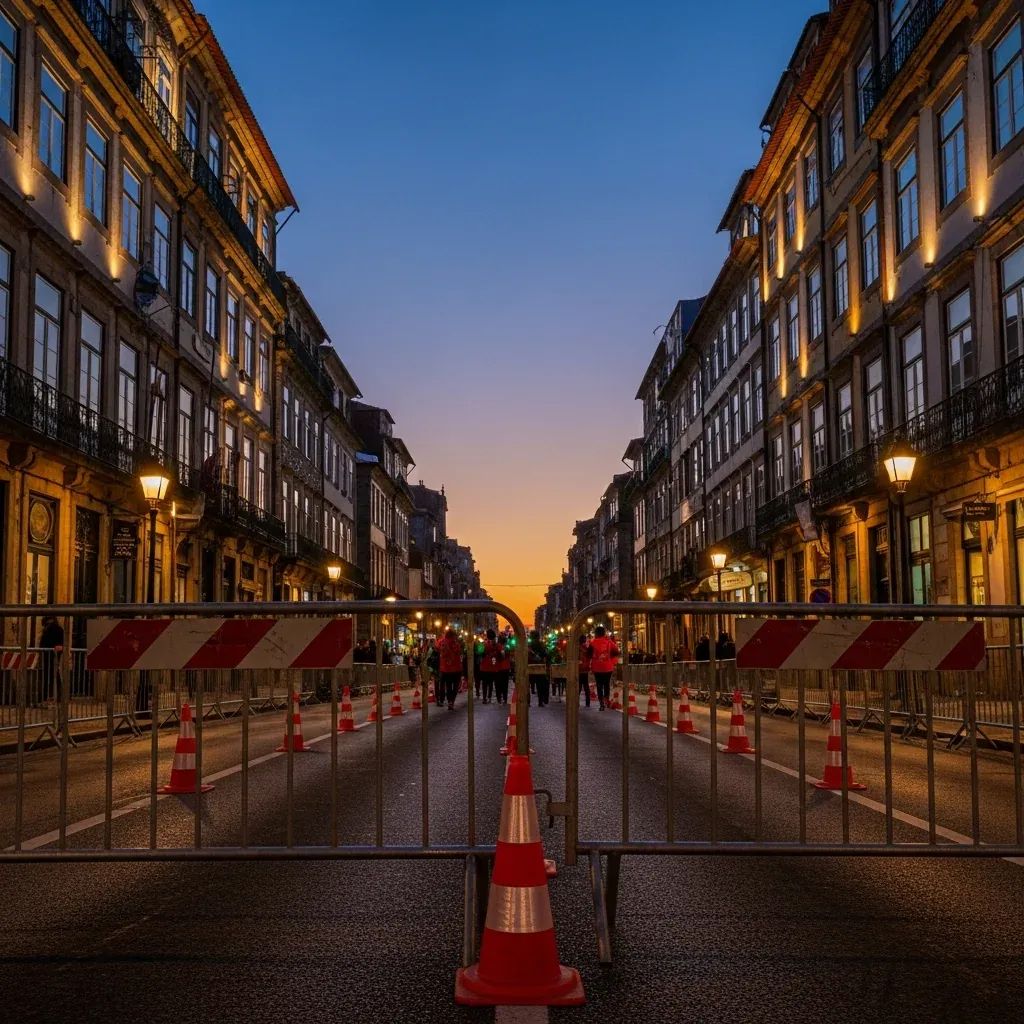
Porto’s signature end-of-year run will again paint the city blue on Sunday evening, but the festive atmosphere comes with an unavoidable side-effect: dozens of streets in the Baixa will be off-limits to cars for most of the day. From early morning parking bans to night-time tunnel closures, residents and visitors would be wise to rethink how they move around the country’s second-largest metropolis.
Snapshot for the time-pressed
• 18 000 registered athletes split between a 10 km race and a 5 km fun walk.
• Parking forbidden from 00:00 near the Aliados axis; tow-trucks will be active.
• Full road closures start at 09:00 and expand in phases until 22:00.
• Metro do Porto increases frequency on every line except the Airport route.
• CP offers €3 return tickets on suburban trains to São Bento.
• The Túnel de Ceuta and Túnel dos Almadas will both shut between 14:00 and 22:00.
What drivers need to know
The heart of the course is Avenida dos Aliados, where both the start and finish arches are installed. That means cars are barred from the entire square around Praça do General Humberto Delgado well before sunrise. From 09:00, closures spread to Rua do Dr. António Luís Gomes, Praça da Trindade and the upper segment of Rua de Camões. By mid-afternoon, an even larger cordon—Praça da Liberdade, Rua do Clube dos Fenianos, Rua de Sá da Bandeira in the opposite direction, and several feeder lanes—essentially seals off the historical core.
Police traffic engineers have designated Rua do Almada and Rua de José Falcão as one-way southbound escape valves, while Rua Formosa and Rua de Sá da Bandeira flip to a northbound only flow. Anyone still intent on bringing a vehicle downtown after lunch should plan a detour via Avenida da Boavista or the riverside bypass; trying to cut through the Fontainhas viaduct is futile, as marshals will block access.
Parking garages inside the perimeter—particularly Trindade, Cardosas, Aliados—may close their exits without notice once runners populate the grid. The municipality recommends relocating cars on Saturday night and leaning on public transport until the clean-up crew reopens the last barriers around 22:00.
Public transport: more seats, shorter waits
The city’s mobility companies have polished a playbook honed over three decades of São Silvestre logistics. Metro do Porto promises 10 trains per hour on the Yellow line from 16:00, ideal for anyone hopping off at Aliados station. Additional rotations hit the Blue and Red lines, while the Green line will still manage half-hourly departures—far better than a Sunday norm. Service winds down at 21:00, giving spectators time to reach home before the evening chill bites.
Bus riders face detours rather than boosts. STCP will short-turn or suspend stops inside the cordon, so lines usually terminating in Aliados, Cordoaria or Bolhão will end on the periphery—Boavista, Campo 24 de Agosto or Trindade metro hub. Schedules appear in real time on the operator’s app, yet seasoned users know to expect delays as vehicles jostle with roadblocks.
For rail travellers, CP’s €3 day-return promotion covers all suburban stations to Porto São Bento; regional tickets carry a 30 % discount through Monday, a nudge that could lure visitors from Braga or Aveiro for a winter city-break that ends with fireworks rather than gridlock.
Why the city closes its streets at Christmas time
The São Silvestre tradition arrived in Porto in 1994, inspired by the original Brazilian race in São Paulo. What began with fewer than 500 athletes has become a mass-participation ritual that blends community sport, charity fund-raising and tourism marketing. Organisers argue that an uninterrupted 10 km loop is the only way to guarantee medical coverage, fair timing mats and spectator safety, and the city council agrees—hence the sweeping traffic plan each December.
Urbanists note that Porto’s medieval street pattern offers scarce alternatives for east-west car flow once the Aliados–Trindade spine is blocked. Closing big rather than small segments allows emergency lanes and tram access to remain predictable. The trade-off is a Sunday afternoon when locals driving to the Christmas sales must park far from Santa Catarina or resign themselves to a metro ride.
Voices from the Baixa
Resident boards often light up with complaints about the annual clampdown, but many shopkeepers near Rua de 31 de Janeiro admit race day brings an uptick in coffee sales and souvenir purchases. Cláudia Pereira, who manages a stationery kiosk by São Bento, says she staffs an extra helper for the post-race rush: “Runners want a pastel de nata, a fridge magnet and back on the train—if the roads were open, they’d just drive straight home.”
Hotels fill earlier than on an average winter weekend, and occupancy data from Turismo do Porto e Norte shows an 11 % spike in last-minute bookings linked to the event. Still, neighbourhood associations press the council to shorten closure times; marshals now dismantle fencing street by street rather than waiting until every finisher crosses the line, shaving around sixty minutes off the 2023 lockdown.
Quick survival guide
Shift your car out of the Aliados–Trindade–Ceuta box before midnight to avoid towing fees.
Top up the Andante card on Saturday; long ticket queues build at metro machines once the race crowd arrives.
If you live inside the ring, schedule grocery deliveries for Monday or ask couriers to leave parcels at a pick-up point outside the barrier.
Cyclists can still use Avenida da Boavista and the riverside cycleway—organisers welcome two-wheeled commuting, just not on the course itself.
Follow the city’s live traffic map (transito.cm-porto.pt) for colour-coded updates; barriers are removed progressively, so north–south crossings reopen faster than east–west.
Porto has learned that the price of hosting one of Europe’s most atmospheric end-of-year races is a day of recalibrated routines. For those able to swap the steering wheel for a metro pass—or lace up and join the throng—the reward is a carnival of headlamps and cheering that few urban spectacles can match.


