

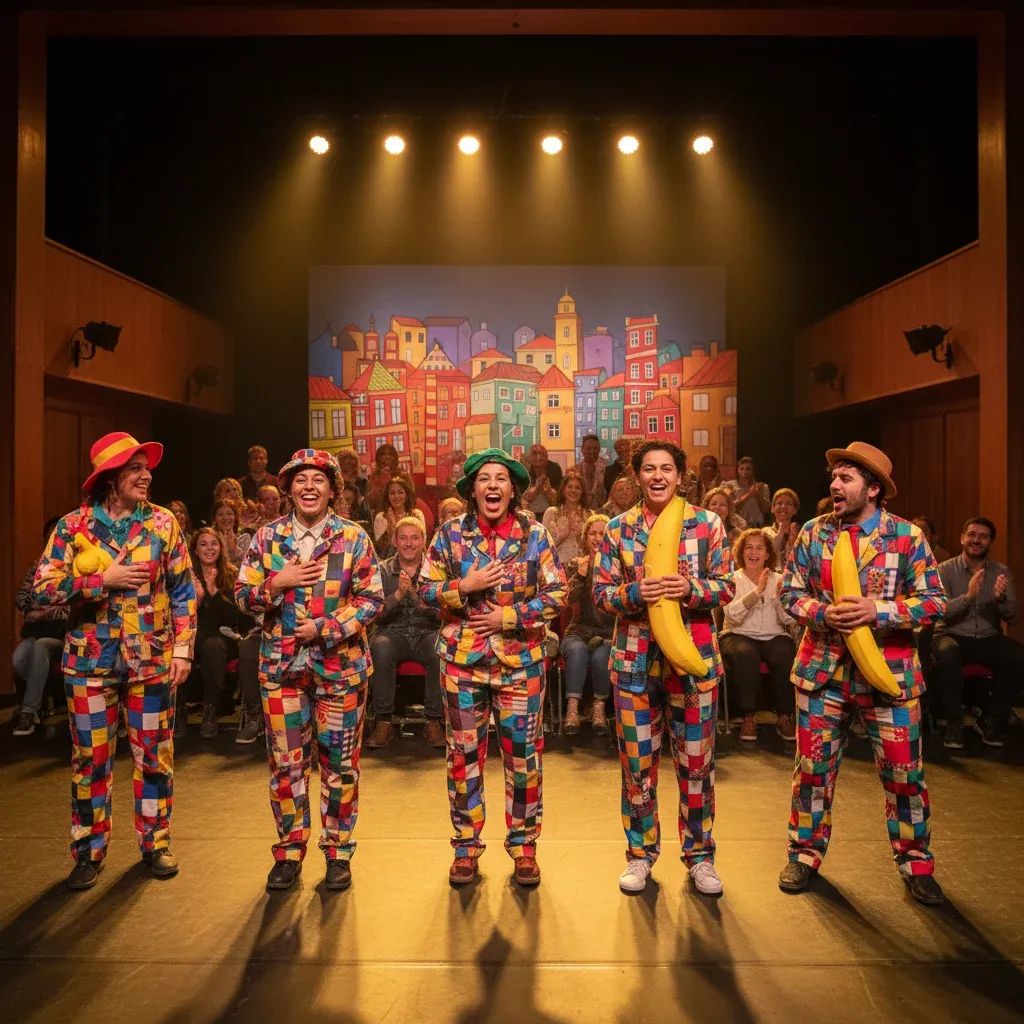
March Brings Seven Amateur Troupes to Porto de Mós as a Local Festival Turns 20
The Teatremos festival in Porto de Mós moves forward into its third decade this March despite weather damage that forced planners to find new ground. When winter storms battered the region's main performance venue, the municipal government didn't delay the celebration—it simply relocated. The festival opens March 1 at the Fórum Cultural de Porto de Mós, the same building where the program launched two decades ago. This isn't a crisis response; it's institutional rhythm continuing despite disruption.
Why This Matters for Residents
• Affordable theater access holds firm: Tickets stay capped at €5 or free, a deliberate municipal choice to prevent inflation from pricing residents out of live performance during a cost-of-living squeeze.
• Weather damage totals €5M in public infrastructure, but the festival recovered—demonstrating how municipal contingency planning keeps cultural continuity alive when primary venues fail.
• A €2M renovation project could accelerate: Insurance settlements from the damage may finally unlock funding for expanding the damaged Cine-Teatro from 230 to 350 seats, positioning Porto de Mós as a regional touring hub rather than a local venue.
The Storm Opened a Door Instead of Closing One
Depression Kristin left exterior damage across Porto de Mós's public infrastructure—shattered windows, compromised cladding, a temporarily unusable performance auditorium. Insurance assessors and municipal engineers have catalogued roughly €5M in losses. The Cine-Teatro, which normally holds March's festival programming, absorbed enough harm that moving was the only practical option.
What might have triggered mass cancellations instead produced a quiet relocation. The Porto de Mós municipal administration activated what planners call a contingency framework. The Fórum Cultural, which housed early editions of Teatremos in the 1990s, reopened its doors. Performances will run Fridays through Sundays at 21:00 through March 21. Tickets distribute through a straightforward system: arrive at the box office from 19:00 on show nights, collect up to four per person, and confirm your seat before a 30-minute pre-curtain cutoff. The process favors fairness over waitlists or advance booking chaos.
Pricing stayed deliberately accessible. Holding €5 or free admission during a period when wage growth in rural areas continues lagging regional living costs signals that municipal leadership prioritizes access over revenue optimization. That choice, repeated year after year, shapes how residents perceive their town's cultural commitment. It says: this is for everyone, not just those with discretionary income.
Two Decades of Building Something Durable
When Teatremos launched in 2006, few people outside Porto de Mós took notice. Theater in small Portuguese municipalities doesn't generate arts journalism or cultural prestige. Yet the festival's real purpose lay elsewhere entirely. The Porto de Mós municipal government structured Teatremos not as seasonal entertainment or a tourism draw, but as a foundational instrument of civic cultural policy. That language—repeated in municipal statements across 20 years—reveals what locals understand: culture here operates as a tool for preventing social fragmentation in places where demographics trend downward and younger people leave.
Theater groups scattered across the municipality's parishes became the festival's backbone. Mendigal draws members from the northern parishes. Os Miúdos da Serra originates from Alqueidão. Juncateatro represents Juncal. Teatro Olaré claims Serro Ventoso. These aren't professional circuits or experimental ensembles; they're neighbors gathering in parish halls, rehearsing evenings and weekends, performing for other neighbors and extended family. The productions reflect that reality: comedy dominates the 2025 lineup because comedy travels well across age groups and doesn't demand theatrical sophistication from audiences or performers.
For these seven groups, Teatremos provides guaranteed stage time, a predictable annual deadline, and public validation that their work matters. None of these ensembles would secure comparable performance opportunities independently. The festival anchors their activity and gives members reasons to keep rehearsing and recruiting younger participants. In municipalities experiencing population decline, that institutional rhythm—the reliable gathering, the scheduled performance, the applause—becomes a mechanism for maintaining civic participation and social cohesion.
Twenty years of consistency builds something real: an expectation among residents that cultural life is normal in Porto de Mós, not exotic or superfluous. Children grow up attending their neighbors' performances. Adults make March a standing date. The festival becomes woven into the calendar and identity of the place.
What the March Lineup Reveals About Regional Theater Culture
The 2025 program opens March 1 with Mendigal's "Sentir o Zumba – Um Caos de Comédia" (Feeling the Buzz—A Comedy Chaos), a piece constructed explicitly around physical humor and improvisation. The title signals the content: loose, boisterous comedy without pretense toward literary sophistication.
By March 7, Os Miúdos da Serra shifts register entirely with "GIL VICENTE X6 – By Las Hermanas Canastras," a contemporary reinterpretation of Portugal's 16th-century foundational dramatist. This approach—extracting classical figures or themes and remixing them for modern audiences—appears frequently in amateur theater spaces. The original text becomes raw material rather than sacred text. Gil Vicente's socially observant plays become vehicles for contemporary critique and humor. The adaptation strategy reflects a practical understanding: unmodified centuries-old drama rarely holds focus in parish halls; clever remixing does.
March 8 brings Juncateatro's "Médico à Força (Adaptado)", a Portuguese-language version of Molière's "Le Médecin Malgré Lui"—the farce about an unwilling physician thrust into absurd medical situations. This piece has survived theater curricula globally because the premise—incompetence flourishing amid social hierarchy—remains universally legible.
Teatro Olaré performs "SE EU FOR PRESIDENTE" on March 13, a satirical commentary on municipal and village governance. Such material thrives in small-town theater because audiences are laughing at recognizable local dynamics and personalities. Political satire grounded in community experience lands far more effectively than abstract commentary.
Ala d'Artistas opens March 14 with "MANUAL PARA SOBREVIVER A DOIS" (Manual for Surviving as a Couple), a relationship comedy that works equally well in rural villages or urban apartments because the subject—the mundane friction of shared domestic life—transcends geography.
March 15 sees Teatr'Ambu bring "Frei Luis de Qualquer Cousa" (Friar Luis of Whatever), a comedic religious sketch exploiting the peculiarities of clerical life or religious practice. March 21 concludes with Trupêgo, Porto de Mós's own resident troupe, performing "Uma Vontade, Um Destino" (One Will, One Destiny), a melodrama or historical piece providing emotional closure to the month-long festival.
The programming strategy reflects a clear understanding of what works in community theater. Recognizable narratives, accessible humor, genre familiarity. Audiences leave theaters understanding what they watched and why. Performers maintain confidence and enthusiasm precisely because the material allows entertainment to flourish.
Regional Theater Networks Quietly Reshape Portuguese Culture
Porto de Mós doesn't operate in isolation. Across Leiria and the surrounding Oeste region, a constellation of festivals and initiatives has built an infrastructure for theatrical production and distribution—one that runs parallel to the capital-centric circuits that typically dominate Portuguese cultural life.
The ACASO Festival, founded in 1996 by the independent collective O NARIZ – Teatro de Grupo, spreads across municipalities in Leiria and Santarém. Rather than centralize programming, ACASO deliberately decentralizes: an independent artistic group partners with municipal governments, local businesses, and cultural associations to distribute performances across multiple venues. This creates reach without requiring any single municipality to bear full production costs.
SINOPSE, anchored in Leiria, evolved from theater exclusively to encompassing all performing arts—dance, music, performance art, artist residencies. The festival presents work produced outside Lisbon and Porto, a deliberate counter-programming stance against geographic cultural concentration.
The Festival de Teatro Juvenil de Leiria annually gathers school-based theater troupes from Batalha, Marinha Grande, Ourém, and neighboring municipalities. This program ensures young performers accumulate stage experience and maintains generational continuity in regional theater culture.
The Portuguese state contributes through the CCDR Lisboa e Vale do Tejo (the Regional Coordination and Development Commission covering the Oeste region), which distributes grants to cultural projects. Municipalities contribute venues and logistical support. The RTCP (Portuguese Theater and Cinema Network) functions as a federation designed to challenge regional cultural asymmetry by routing touring productions to smaller venues that wouldn't otherwise access them.
These overlapping initiatives reflect how smaller cities sustain cultural life: through persistent municipal commitment, independent artistic initiative, and deliberate coordination among cities and cultural networks.
Storm Damage May Accelerate Long-Delayed Infrastructure Investment
Before the weather struck, the Porto de Mós municipal government had drafted an ambitious renovation plan for the Cine-Teatro. The project proposed expanding from 230 to 350 seats and upgrading the overall facility at an estimated cost of €2M. The plan existed in municipal files—approved in principle but perpetually deprioritized. Why? Because rural municipalities face relentless resource scarcity. Discretionary cultural facility improvements compete against essential needs: basic sanitation systems, road repairs, utilities maintenance, water treatment. When budgets face constraints, cultural infrastructure loses out.
The storm has disrupted that calculus entirely. Insurance settlements are beginning to flow. Damage assessments are complete. The Porto de Mós administration now confronts a decision: treat Cine-Teatro renovation as a nice-to-have, something to undertake when finances allow, or accelerate the work using emergency funding and insurance compensation as justification and financing mechanism.
The decision carries consequences beyond the building itself. A 350-seat theater signals serious cultural infrastructure to the regional touring circuits and arts networks. RTCP programmers and other distribution systems route productions more readily to municipalities demonstrating visible investment in performance space. That, in turn, creates employment during construction phases, draws visitors once the facility opens, generates ticket sales and local spending, and—most importantly—signals to residents and younger people that the municipality sees cultural life not as expendable amenity but as core municipal obligation.
In regions experiencing population decline and emigration, such signals matter enormously. They provide citizens reasons to stay or return. They suggest that the place values community participation and civic gathering, not merely economic productivity. Whether that signal survives the next decade as rural municipalities face more severe budget pressures remains an open question. For now, however, the opportunity exists.
Practical Information for March Theater Season
Performances run Fridays, Saturdays, and Sundays at 21:00 throughout March at the Fórum Cultural de Porto de Mós. The box office opens at 19:00 on performance evenings. Ticket limits are four per person per visit. Reservations and ticket collection must conclude 30 minutes before curtain. Pricing holds at €5 or free depending on the performance.
The complete schedule runs March 1 through March 21, 2025, with seven performances by local and regional theater collectives. For accessibility questions, venue details, or performance-specific information, consult the Porto de Mós municipal website or contact the Fórum Cultural directly.


