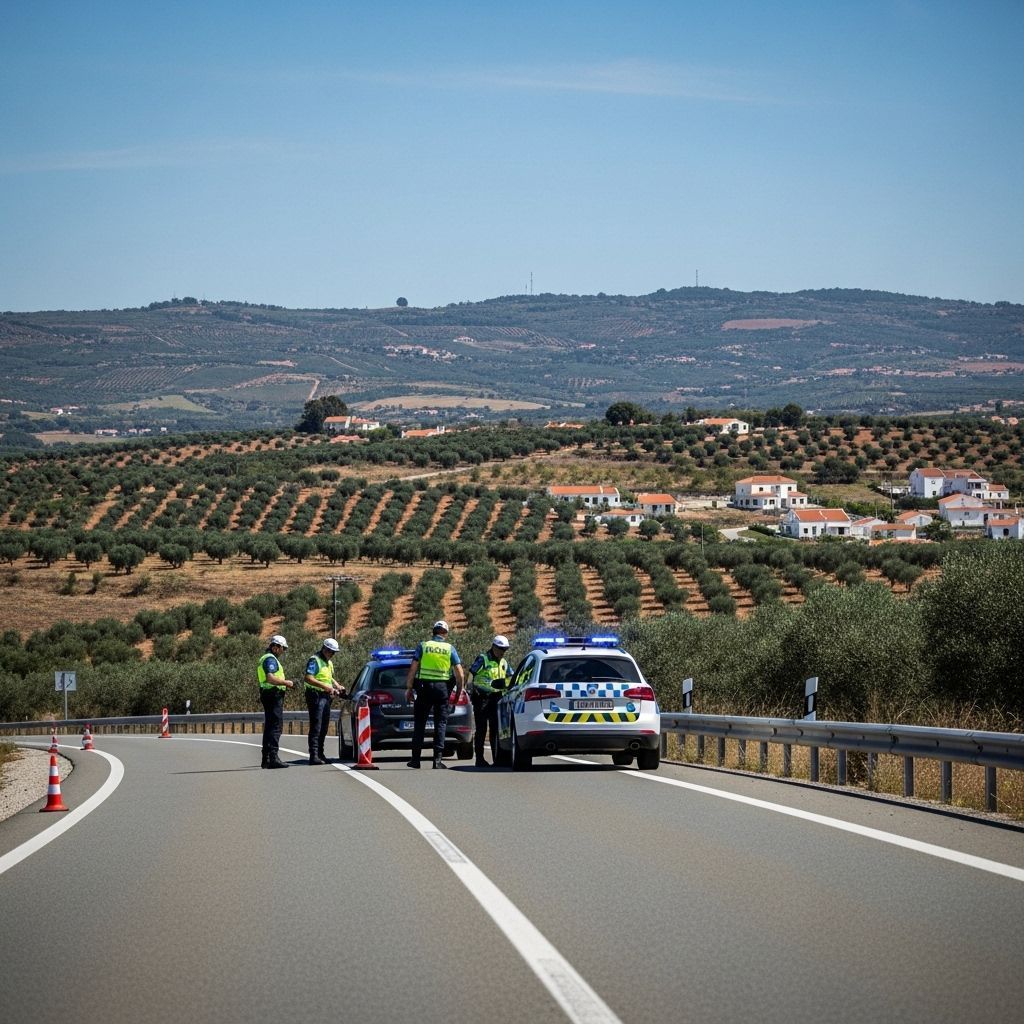
The Portugal Judicial Police (PJ) has arrested a 39-year-old man on terrorism charges following last month's gasoline bomb attack on a peaceful anti-abortion march in Lisbon, escalating what began as a public order incident into a national security investigation with potential prison-time implications for ideologically motivated violence.
The suspect now faces potential terrorism charges along with illegal weapons possession, attempted arson, and aggravated assault offenses. He appeared before Lisbon's Central Criminal Instruction Court for a judicial hearing where prosecutors requested preventive detention.
Why This Matters
• Legal precedent: This marks one of Portugal's first domestic terrorism prosecutions tied to political demonstrations in decades.
• Public safety: The incident occurred in broad daylight in front of the Assembly of the Republic, where roughly 500 demonstrators—including children—were gathered.
• Ideological motive: Investigators identified an "ideological motive," transforming the case from common assault into a counter-terrorism matter.
From Street Incident to National Security Case
The attack unfolded on the afternoon of March 21 during the annual Marcha pela Vida (March for Life), an event opposing abortion and euthanasia that draws hundreds to central Lisbon each year. According to the Portugal Public Security Police (PSP), the assailant threw an improvised incendiary device—essentially a gasoline-filled Molotov cocktail—toward participants assembled on the steps of Parliament.
The device struck near demonstrators but failed to ignite upon impact, averting potential injuries. Some marchers were affected by the flammable liquid, though no serious physical harm was recorded.
Initial police response treated the episode as a weapons offense. The suspect was detained at the scene by PSP officers and released under periodic reporting requirements. But by late March, the Portugal Judicial Police's National Counter-Terrorism Unit had assumed control, signaling authorities' belief that the assault crossed the threshold into politically motivated violence with terrorist characteristics.
Investigation and Legal Proceedings
The detained man remains in custody pending the court's ruling on coercive measures. The Department of Central Investigation and Penal Action (DCIAP)—Portugal's specialized prosecutorial unit for organized crime and terrorism—is handling the inquiry.
Prosecutors argue the suspect poses risks of flight, evidence tampering, and social alarm, justifying preventive detention. If convicted on terrorism counts, the suspect could face up to 15 years in prison under Portugal's penal code, significantly beyond penalties for simple assault or weapons possession.
Parliamentary Condemnation and Political Debate
On March 26, the Lisbon Municipal Assembly (AML) debated and approved multiple resolutions condemning the attack. A joint motion from the Communist Party (PCP) and Socialist Party (PS), along with a Social Democratic Party (PSD) proposal, passed with unanimous support. A Chega resolution—which blamed "extreme-left" violence—passed with support from right-leaning factions.
Francisco Camacho (CDS-PP) characterized the incident as "not a loss of control but a premeditated act with political ideological content" deserving "vehement repudiation." Liliana Fidalgo (PSD) warned that "political violence never starts big; it starts when we stop taking it seriously."
Natacha Aramo (PCP) accused Chega of "spreading hate rather than condemning violence," citing the party's stance on far-right extremism. Duarte Carreira (PS) emphasized that "democracy lives not only on laws and institutions but on practices, behaviors, and values—essential values like freedom of expression and the right to manifest one's convictions, however different from our own."
Interior Minister Luís Neves publicly labeled the episode an example of "violent extremism."
What This Means for Residents
For those living in Portugal, the case signals authorities' willingness to invoke counter-terrorism frameworks when political violence involves symbolic targets and large crowds. While Portugal has largely avoided the street clashes that occur in neighboring countries, this incident demonstrates a hardened legal response.
The case also reflects broader political tensions documented in recent years, with increased polarization surrounding migration, social policy, and economic concerns. The targeting of a high-profile demonstration underscores how such divisions can translate into acts of political violence.
Next Steps
The DCIAP investigation continues as the court considers detention measures. The outcome will establish a legal precedent for how Portugal prosecutes politically motivated violence amid deepening social division—a precedent closely watched by legal scholars and political parties across the spectrum.
Whether this case marks an isolated incident or the beginning of sustained political street violence remains to be seen. What is clear: Portugal's democratic institutions face a test of resilience in managing ideological tensions in an increasingly polarized society.