

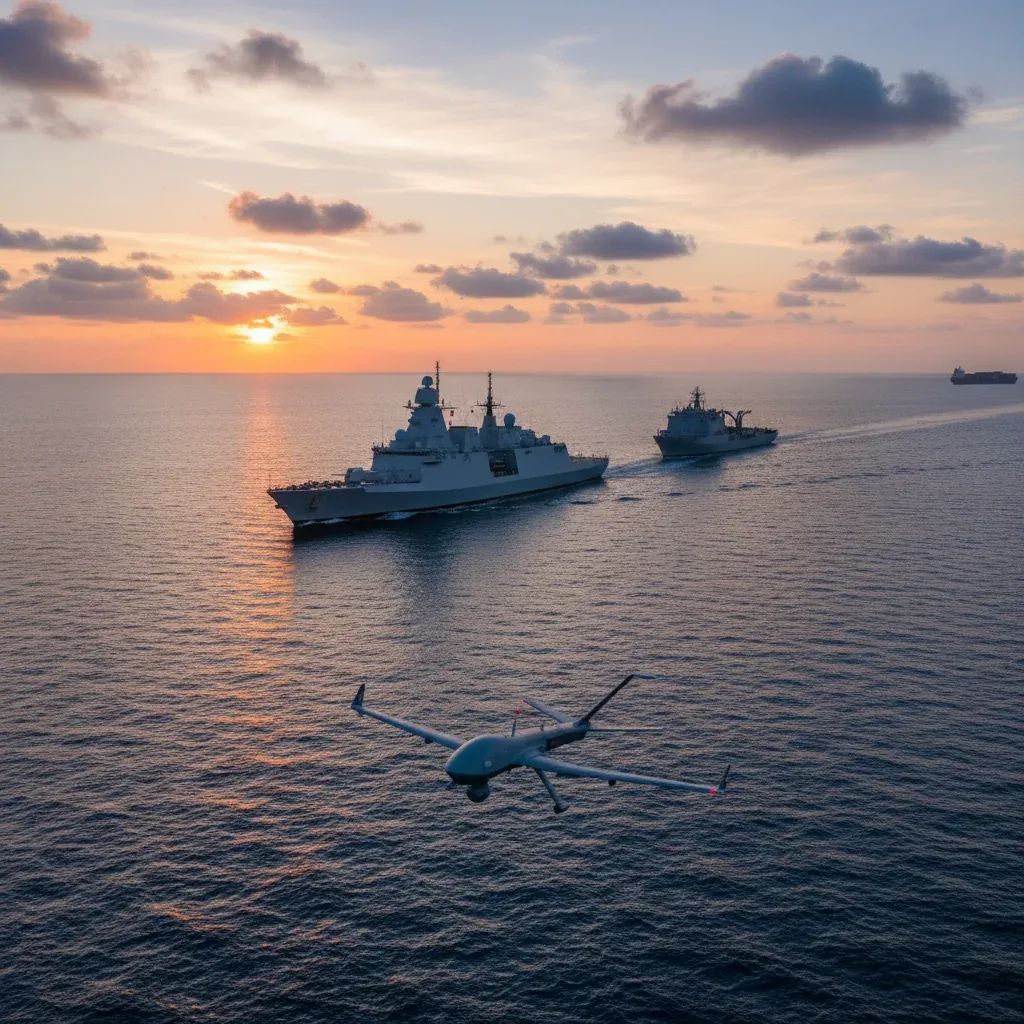
The Pentagon has publicly rebuked European allies for what it calls a "pretty absurd conference" on maritime security in the Strait of Hormuz, signaling a deepening rift over who should shoulder the burden of protecting a chokepoint that funnels a significant share of global oil exports. The U.S. Defense Department's pointed critique comes as France and the United Kingdom push forward with plans for a European-led naval escort mission, one that Washington says it would welcome—yet clearly doubts will materialize.
Why This Matters:
• Energy supply routes: The Strait of Hormuz channels a critical portion of the world's petroleum, making disruptions a potential threat to European energy security and, by extension, fuel prices across Portugal.
• Transatlantic tensions: The Pentagon's public dismissal of European planning efforts exposes fractures in NATO coordination and raises questions about collective defense commitments.
• Regional escalation: Recent tensions in the region have raised the stakes for commercial shipping and threatened freedom of navigation in the Persian Gulf.
Harsh Words from Washington
Defense Secretary Pete Hegseth dismissed recent European discussions as theater without substance, accusing allied governments of convening to "discuss the possibility of doing something in the future" rather than deploying tangible naval assets or operational plans. The comment came in response to a summit held in Paris, where roughly 30 international leaders—including French President Emmanuel Macron and UK Prime Minister Keir Starmer—announced intentions to launch a "neutral" commercial escort mission in the Gulf.
Hegseth made clear that while Washington would not object to a European-led operation, he sees no "serious efforts" underway. He added that regional instability has laid bare the limitations of European defense capacity, warning that without independent capabilities, allied nations remain vulnerable to threats in the region. The Defense Secretary further argued that the Strait of Hormuz is far more strategically vital to Europe than to the United States, given the continent's dependence on energy imports that flow through the waterway.
His remarks also revived a long-standing American grievance: that European and Asian partners have for decades enjoyed the protective umbrella of U.S. naval power without matching contributions. The subtext is unmistakable—Washington wants burden-sharing, not more talking shops.
The Franco-British Plan and Its Limits
The initiative that drew Hegseth's ire stems from a Paris summit that concluded with a joint French-British commitment to organize a defensive maritime mission. The proposal envisions multinational naval escorts for commercial vessels transiting the Strait of Hormuz, Gulf of Oman, and adjoining waters. Germany and Italy, both of which had previously refused to send warships in support of a U.S.-led combat mission, have now signaled willingness to contribute to this European framework.
Yet the plan remains vague on timelines, command structures, and rules of engagement. The mission would ostensibly operate under a "neutral" and "purely defensive" mandate, separate from the parties in conflict, and ideally backed by a United Nations Security Council resolution. Critics note that such a resolution is unlikely, given Russia and China's stance on regional conflicts.
The European Union's top diplomat, Kaja Kallas, stated that there is "no appetite" among member states to expand the bloc's existing maritime operations in the region. Instead, several European governments have relied on existing monitoring missions focused on maritime awareness and surveillance in strategic waterways. These missions deploy surveillance assets and naval vessels to improve situational awareness, but stop short of active combat or blockade enforcement.
Europe's Approach to Regional Tensions
European governments have emphasized that they prioritize de-escalation and prefer multilateral frameworks for addressing regional instability. This approach reflects broader EU concern about being drawn into conflicts without full consultation of alliance members. Several European capitals have limited their responses to diplomatic and monitoring support rather than direct military deployments.
Germany and Italy have emphasized the importance of diplomacy over military escalation, while Portugal and other member states have focused on political support for existing regional stability efforts.
The refusal to join unilateral military operations does not mean Europe is indifferent to the security of the Strait. Rather, European capitals view regional tensions through a different lens: they prioritize de-escalation, prefer multilateral frameworks, and are wary of unilateral military commitments. The Franco-British proposal reflects this approach—defensive, limited, and contingent on reduced hostilities.
What This Means for Portuguese Residents
For anyone living in Portugal, the geopolitical tensions in the Persian Gulf region carry economic implications. Portugal imports a meaningful share of its petroleum and natural gas from or via the Middle East, and any significant disruption or militarization of the Strait of Hormuz could affect fuel prices, transportation costs, and energy-related expenses.
Potential impacts on fuel prices would depend on the severity and duration of any disruption to shipping through the Strait. Industry analysts have suggested that significant supply interruptions could place upward pressure on energy costs across Europe, though the magnitude of such increases would vary based on circumstances.
Beyond the pump, the broader transatlantic discussions raise questions about Portugal's security commitments. As a NATO member, Portugal benefits from collective defense guarantees, yet the current friction suggests that alliance dynamics are evolving. The Portuguese government has so far limited its role to political backing of regional stability efforts, avoiding direct naval deployments. This posture aligns with the broader EU stance but reflects the careful balancing act Lisbon must maintain between Washington, Brussels, and other international actors.
There is also the matter of legal and diplomatic precedent. Portugal has historically supported international law and UN mandates in maritime disputes. Any European response to regional tensions should proceed with careful attention to these principles.
The Strategic Calculus
The Strait of Hormuz remains one of the world's most critical maritime chokepoints, handling a substantial percentage of global petroleum trade. For Europe, which sources energy from multiple regions including the Gulf, freedom of navigation here is strategically important. For the United States, the strategic imperative is tied to alliance credibility and the global economic order.
Hegseth's critique taps into a broader American perspective: that European allies must either build the naval capacity to protect their own interests or accept depending on U.S. military power for security assurance.
European governments counter that they are not shirking responsibility but rather seeking approaches that respect international law and prioritize de-escalation over force projection.
What Comes Next
The immediate question is whether European governments will move forward with coordinated maritime efforts. France and the UK have signaled commitment to deploying vessels, but operational details remain to be determined. Germany and Italy, despite their political endorsements, have not announced specific ship deployments or timelines. Portugal, given its strategic position and limited naval resources, is likely to continue focusing on political support and participation in existing multilateral maritime awareness initiatives.
Any European maritime operation is likely to emphasize monitoring, information-sharing, and civilian vessel protection in non-combat scenarios rather than direct military confrontation or enforcement actions.
For now, the Pentagon has made its position clear: Europe must take concrete action, not merely discuss options. And for residents of Portugal, the unfolding developments are a reminder that regional stability, alliance politics, and energy security are interconnected in an increasingly complex geopolitical landscape.


