

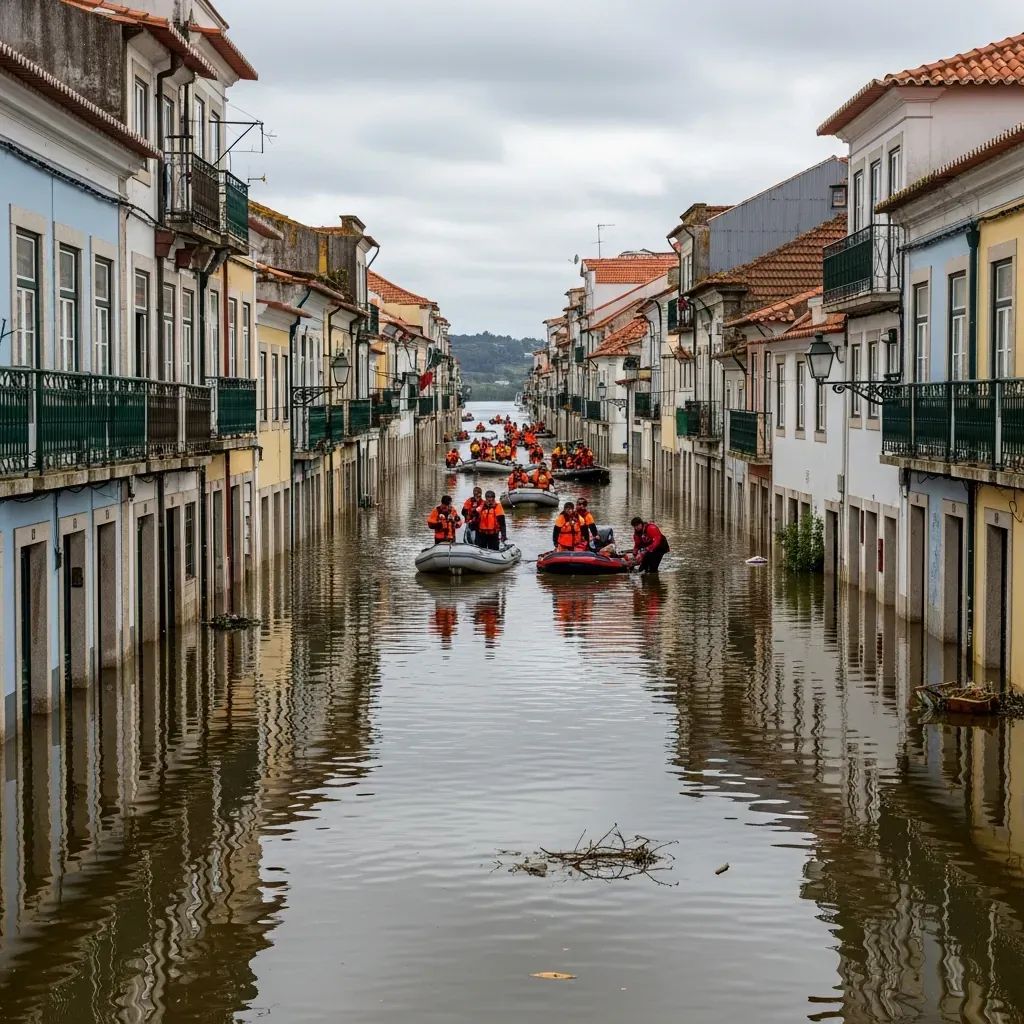
The Portugal Environment Ministry has signalled it may trigger a formal Estado de Calamidade for Alcácer do Sal after flood-waters climbed past 1 m in the historic riverside town, a step that would open the door to fast-track grants and subsidised credit for home-owners, farmers and shopkeepers.
Why This Matters
• Emergency cash: A calamity decree would speed up compensation payments and tax relief.
• Travel disruption: Portions of the EN10 and local bridges remain under inspection; detours can add 30 km to a Lisbon–Algarve trip.
• Power & telecoms: Crews are still restoring fibre lines and low-voltage grids in the low-lying “Baixa.”
• Higher insurance bills: Insurers already warn premiums for properties along the Sado could rise by double digits next renewal cycle.
How the Water Reached Door-Handles
A rare cocktail of Atlantic storm Kristin, upstream dam releases and an abnormally high spring tide pushed the Rio Sado over its quays shortly before dawn on 29 January. According to the Portugal Hydrological Institute, the flow rate at Santa Catarina gauge hit 1 900 m³/s, quadruple the seasonal average. That surge breached the 19th-century retaining wall that shields the Avenida dos Aviadores, funneling muddy torrents into cafés, grocery stores and the municipal market.
Local civil-protection councillor António Grilo explained that engineers opened dam sluices after reservoirs neared their safety threshold. "If we had not released, we risked structural failure upstream," he said, acknowledging the move amplified flooding downstream.
The On-The-Ground Response
Within hours, the Municipal Emergency Plan was activated, dispatching more than 120 firefighters, GNR officers and volunteer rescuers. Priority tasks included:
• Evacuation of the AURPICAS elderly home, relocating 47 residents to a school gym.
• Distribution of 2 000 sandbags and 500 portable power banks for households left without electricity.
• Free shuttle buses linking the cut-off Forno da Cal neighbourhood to vital services.
• Continuous pumping operations that removed an estimated 400 000 m³ of water from basement levels.
The Portugal Navy provided two rigid-inflatable boats to reach farms marooned on the rice-paddy plain east of the N120.
What This Means for Residents
Households• Expect municipal teams at your door this week to record losses; keep photos and receipts for reimbursement.• Property owners with Seguro Multirriscos should file claims within 8 days to preserve coverage. Deductibles average €500, roughly a month’s rent in Setúbal.
Businesses• The Portugal Tax Authority confirmed affected SMEs can defer February VAT and social-security payments for 6 months interest-free.• A dedicated help-desk is operating at the Town Hall from 09:00-17:00 to guide paperwork for the IAPMEI emergency credit line (loans up to €100 000 at 1% fixed).
Farmers• The Ministry of Agriculture activated a 100 % subsidy for repairs under PDR2026, capped at €10 000. Larger recovery projects between €5 000–€400 000 require a co-financing share of 25 %.• Agronomists advise flushing salt-water-tainted paddies within 72 hours to save next season’s rice crop.
Counting the Damage So Far
Preliminary tallies compiled by the Alcácer do Sal Câmara show:
• 70+ homes with structural impairment.
• Losses topping €3.5 M among 110 retail outlets in the downtown grid.
• Collapse of 300 m of earthen levees protecting rice fields, jeopardising roughly 800 ha of arable land.
While no fatalities were reported, medical teams treated 14 residents for hypothermia or minor injuries.
Could It Happen Again Next Week?
Meteorologists at the Portugal Weather Service (IPMA) warn a new frontal system could bring 50 mm of rain by mid-week. Combined with continued dam outflows—necessary until reservoirs dip below the 80 % safety line—and a late-winter high tide, another peak cannot be ruled out. Authorities advise residents in the floodplain to keep go-bags ready and subscribe to the Proteção Civil SMS alert (text “SADO” to 3838).
Long-Term Fixes on the Table
The crisis has reignited debate over Alcácer’s antiquated flood defences. Options being discussed in Lisbon include:
Raising the riverfront wall by 70 cm and integrating removable aluminum gates.
Creating an upstream retention basin near Torrão to buffer dam discharges.
Offering tax incentives for flood-proof renovations such as elevated electrical systems.
Environmental NGOs caution against over-engineering. "Restoring wetland buffers could absorb peak flows naturally and improve biodiversity," argues biologist Filipa Silveira of Liga para a Conservação da Natureza.
Bottom Line for the Rest of Portugal
Even if you live far from Alcácer do Sal, the episode is a reminder that climate-charged flash floods are no longer confined to mountain valleys. Home-insurance add-ons for flood cover still cost less than €5/month in many policies—cheap peace of mind compared with the five-figure clean-up bills residents here now face.


