
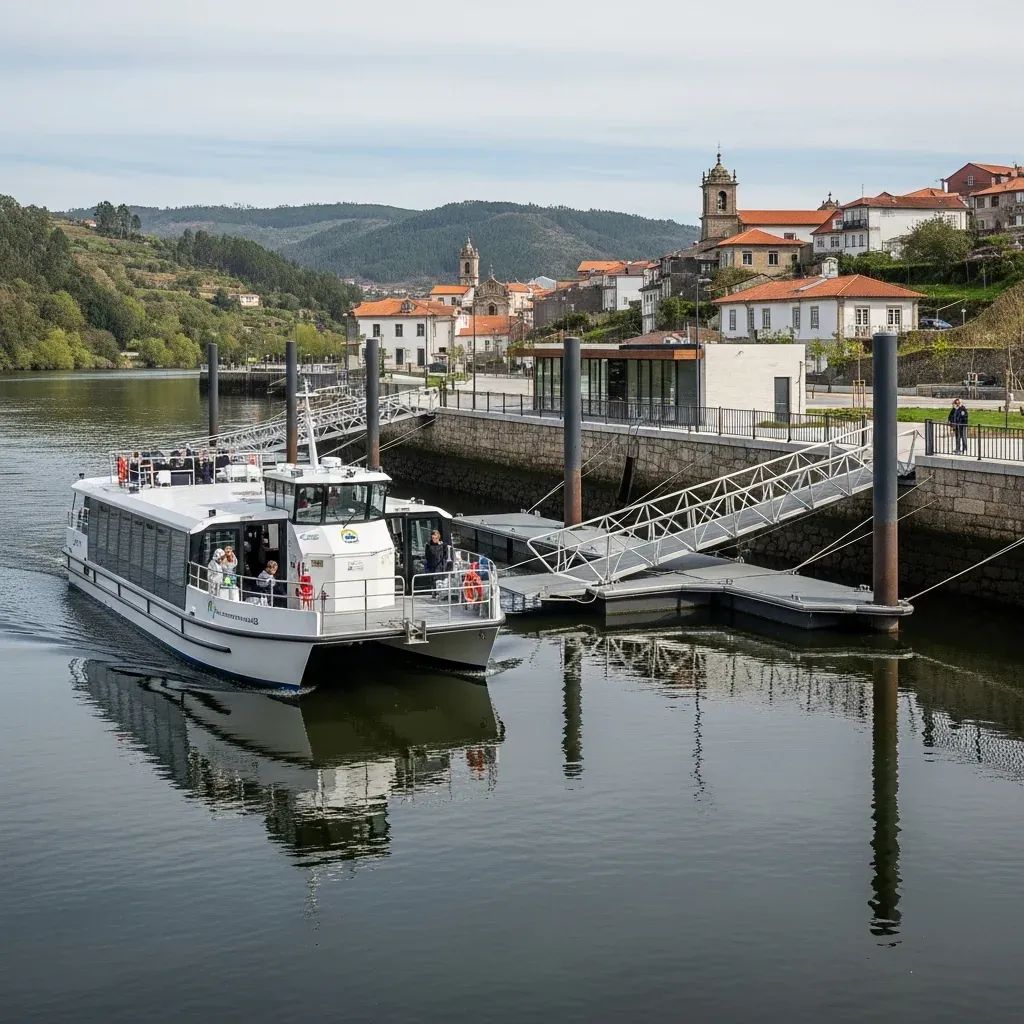
Portugal’s northernmost communities are gearing up for the return of a direct river crossing on the Minho, as local leaders blend municipal funding, EU backing and innovative vessel design to reconnect Caminha and A Guarda by the summer of 2026. After sidelining the Santa Rita de Cássia for over five years, plans now imagine a sleek shallow-draft ferry, renewed pontoon facilities and a dredging programme to ensure an uninterrupted link.
In Brief
• Idle since 2020: ferry service halted by border closures and mechanical failures.
• €1.2 M assessment: vessel inspected in A Guarda after towing.
• 50–60 seats: new shallow-draft boat under negotiation for 2026.
• €30k–€40k commitment: Caminha budget covers pontoon repairs and sand removal.
• €573k POCTEP grant: funds to establish Eurocidade Foz do Minho.
A River Bond Renewed: The Heart of the Minho
The Minho River has long served as a historical lifeline between Caminha on the Portuguese bank and its Galician neighbours, ferrying pedestrians, cyclists and daily commuters for generations. Its waters frame the eco-tourism corridor that feeds both local economies and the Camino de Santiago’s coastal route.
Across the water, the towns of A Guarda and O Rosal share more than geography: they nurture a cross-border unity through the creation of Eurocidade Foz do Minho, fostering cultural exchange, economic ties, intermunicipal cooperation and a shared heritage.
Navigating Silting and Infrastructure Woes
The veteran ferry Santa Rita de Cássia, which had run since 1995, was first idled by Covid-19 restrictions and then grounded when a Spanish pontoon fell into disuse. In July 2025, tug crews pulled her into a shipyard in A Guarda, where a €1.2 million evaluation laid bare extensive wear.
Meanwhile, unchecked riverbed silting has transformed the channel into a shifting maze. The Portuguese Environment Agency (APA) has earmarked resources for a dredging plan, poised for debate at the next Iberian Summit, with a two-year commitment, and Caminha has carved out a €30,000–€40,000 budget line for pontoon repair and sand removal.
Charting a New Course with Shallow-Draft Design
Mayor Liliana Silva champions a shallow-draft vessel engineered to carry 50–60 passengers, gliding on waters just 60 cm deep. The proposed aluminium hull promises swift turnaround, fuel efficiency and a nimble profile ideal for the estuary.
Local officials report that talks with a private consortium are in advanced stages, covering licensing process, crew training, safety certification and insurance savings. The modular pontoon will accommodate bicycles, e-scooters and foot passengers more easily than its predecessor.
Financing the Revival: Local Budgets Meet Brussels Backing
Caminha’s 2026 budget allocates €30,000 to €40,000 for immediate dredging and pontoon reinforcement, signalling urgency in restoring river mobility and marking a local outlay aligned with broader strategic aims.
Complementing municipal funds, the Interreg VI Spain-Portugal (POCTEP) programme has unlocked €573,000, co-financed at 75% by the EU, to formalise the Eurocidade Foz do Minho. This intermunicipal framework brings together A Guarda, O Rosal and Caminha to oversee transboundary governance, joint maintenance, and a slate of economic and cultural initiatives.
Bridging Horizons: Road Links and Long-Term Vision
Beyond the ferry, Portugal and Spain are quietly advancing technical studies by Infraestruturas de Portugal into a permanent bridge spanning the Natura 2000 estuary. Detailed environmental impact assessments are underway, with Lisbon and Madrid eyeing a medium-term project mapped on a decadal timeline.
Meanwhile, the AECT Rio Minho collective urges coordinated river management for navigability, economic development, tourism promotion and safety standards. Joint governance at the next cross-border summit aims to harmonise policies for the shared river basin.
Looking Ahead to Summer 2026
If June 2026 brings the promised vessel, pilgrims, local commuters and eco-tourists could once again cross on a fast ferry, just in time for the Festival do Minho and peak cultural season. This renewed connection underscores the region’s enduring spirit: geography may separate communities, but cooperation can bridge them.


