
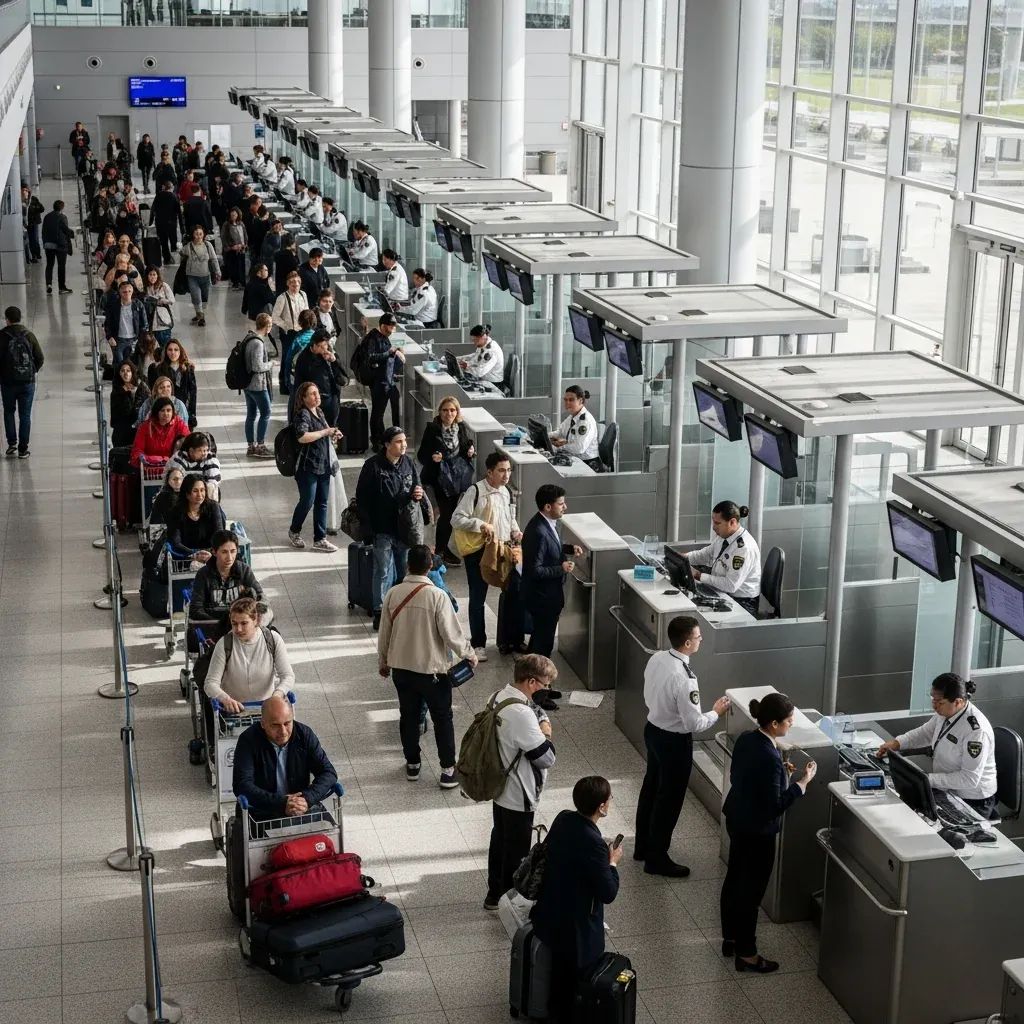
Lisbon’s main gateway will be testing the limits of patience—and the ingenuity of Portuguese authorities—after the three-month suspension of the European Entry/Exit System. Passengers from outside the Schengen Area should brace for manual passport checks, but officials promise shorter lines by Easter.
What travellers in Portugal need to know
Long waits are back—but fixes are coming.
• Queues could still stretch for hours at Humberto Delgado until March, especially at morning peaks.• All arrivals from non-EU countries will receive the familiar ink stamp instead of a biometric scan.• Extra agents from the Polícia de Segurança Pública (PSP) and the Guarda Nacional Republicana (GNR) will staff the booths.• A 30 % expansion of e-gates and counters is being rushed into place.• Airlines advise a minimum 4-hour layover in Lisbon for onward flights.
How the situation spiralled
Portugal switched on the EU-wide EES system in October 2025 without the space or staff the airport needed. By Christmas, arriving visitors reported eight-hour bottlenecks, missing connections and even sleeping on luggage belts. The PSP, which took over border duties after the abolition of the Serviço de Estrangeiros e Fronteiras (SEF), conceded it was “operating at the edge”. The Interior Ministry therefore invoked a European regulation that permits a “temporary derogation” when public order is at stake.
The emergency toolkit
Authorities will flood the arrivals hall with 80 extra PSP officers and up to 120 GNR soldiers trained in border control. Meanwhile, VINCI Airports, which manages Humberto Delgado, is installing eight additional e-gates, reviving six dormant desks and widening the queuing area. A €7.5 M capital injection—approved this week—covers new servers, biometric cameras and maintenance through 2028, when Brussels expects the EES to be fully standardised again.
Ripple effects for airlines, tourism and the TAP hub
Carriers are already adjusting schedules to avoid missed connections in Lisbon. TAP Air Portugal’s Atlantic network, reliant on swift transfers, faces the greatest risk; industry group RENA warns of lost market share to Madrid and Paris if spring chaos persists. Hoteliers fear reputational damage that could undo last year’s 23 % jump in long-haul arrivals from the US and Brazil.
How Lisbon compares with Europe’s other gateways
Madrid-Barajas and Amsterdam-Schiphol introduced EES pilots in 2024 but rolled them out gradually, preserving spare desks for manual fallback. Lisbon, by contrast, has just 16 permanent counters (plus six in Terminal 2) to process peak loads of more than 7,000 inbound non-Schengen passengers per hour. The mismatch illustrates a broader issue: Portugal’s busiest airport still operates within a footprint designed in the 1950s.
What happens after the three months
If officials hit their March target, the EES software will return with upgraded hardware, more staff and a new passenger-flow layout. Failure would force Lisbon to request a second derogation—an outcome Brussels says should be “strictly exceptional”. For now, travellers should keep boarding passes handy, download airline apps for real-time alerts, and leave extra room in their itineraries.
Key insights at a glance
– Temporary manual controls last until late March.– Personnel surge: PSP + GNR = roughly 200 officers on the frontline.– Infrastructure boost: e-gates rise from 16 to 24; desks from 22 to 28.– €7.5 M investment earmarked for modernisation through 2028.– Airlines revising layover advice and contingency budgets.
For residents heading abroad—or welcoming family from outside Europe—the best strategy is simple: plan for delays, follow airport messaging, and expect Lisbon’s border to look old-school until spring.


