
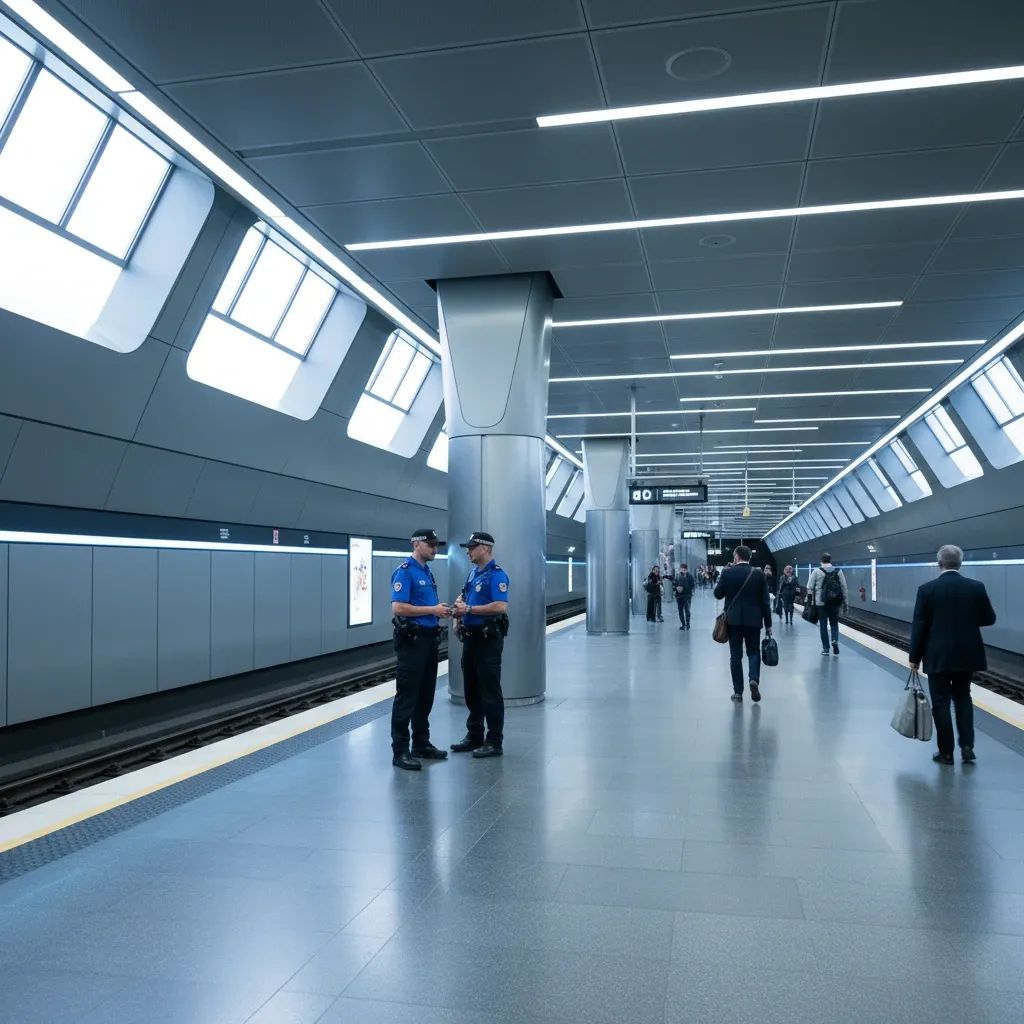
The Portugal Public Security Police (PSP) arrested a 25-year-old man late Saturday night at Sete Rios railway station in Lisbon after a suspected drug consumption incident escalated into verbal threats and physical resistance against officers. The arrest highlights ongoing challenges with maintaining order in the capital's transport hubs, where surveillance and enforcement have intensified but incidents of confrontation persist.
Why This Matters
• Legal consequence: Resisting or threatening law enforcement now carries criminal liability under Portugal's Penal Code. Recent legal developments have strengthened protections for security personnel and transport inspectors responding to public order violations.
• Pattern of confrontation: According to the 2023 Annual Internal Security Report (RASI), crimes of resistance and coercion against officials remained a recurring concern nationwide, a trend that continues to challenge transport security operations.
• Transport security focus: The PSP's specialized Public Transport Security Division maintains zero-tolerance policing on the Metro and rail network, a response to persistent criminal activity in stations.
What Happened at Sete Rios
Officers from the Lisbon Metropolitan Command of the PSP approached the suspect at approximately 11:20 PM on Saturday after detecting a strong odor consistent with narcotics consumption. According to the official police statement, the man was actively using what officers believed to be an illegal substance when first contacted.
Upon being questioned, the individual immediately threw the material onto the railway platform and refused to cooperate with standard identification procedures. When officers informed him of the legal steps they intended to take—including formal identification and potential charges—the man's behavior turned hostile. He issued multiple verbal threats aimed at intimidating the police, forcing officers to restrain and handcuff him.
The suspect was transported to the COMETLIS detention facility in Lisbon, where he was held pending initial judicial interrogation. A judge will now determine appropriate coercive measures, which may include bail conditions, travel restrictions, or pre-trial detention depending on his criminal history and flight risk assessment.
The Legal Framework: Resistance and Coercion
The formal charge—resistance and coercion against a public official—is distinct from simple drug possession. In Portugal, personal drug consumption was decriminalized in 2001, but the law does not shield individuals from criminal liability when they obstruct, threaten, or assault officers in the line of duty.
Under Portugal's Penal Code, individuals charged with resistance and coercion against public officials face serious judicial consequences. The legal framework explicitly protects PSP officers, transport inspectors, and other security personnel when performing their duties. Aggression or threats directed at these officials trigger criminal charges with potential sentencing.
According to the 2023 Annual Internal Security Report (RASI), resistance and coercion offenses represented a significant problem nationwide. This legal context explains why the Sete Rios incident moved beyond a minor drug consumption issue to a formal criminal arrest.
Transport Security in Lisbon: A Persistent Challenge
The Sete Rios station arrest is not an isolated event. Lisbon's transport network—particularly the Metropolitano de Lisboa (Metro) and suburban rail lines operated by CP Comboios de Portugal—has long struggled with petty crime, public disorder, and sporadic drug activity.
Drug consumption and trafficking visibility remain concerns in Lisbon's transport infrastructure. Recent PSP operations have targeted narcotics distribution networks, acknowledging the reappearance of drug activity in crowded public spaces. While comprehensive statistics breaking down drug consumption by location within transport infrastructure are not regularly published by authorities, police acknowledge heightened vigilance is necessary.
Transport-related offenses—including pickpocketing, fare evasion, and vandalism—remain persistent challenges for Metro operators and PSP enforcement teams. The police acknowledge that drug activity and petty crime continue to require focused attention across stations and trains.
What This Means for Residents
For daily commuters and occasional travelers, the Sete Rios incident underscores a reality of urban transit in Lisbon: enforcement is visible, reactive, and increasingly confrontational. The PSP's Public Transport Security Division maintains a permanent uniformed presence on the Metro and rail network, supplemented by plainclothes officers targeting pickpockets and drug users.
Passengers should be aware of several practical implications:
Behavioral expectations: Consuming drugs—even in small quantities for personal use—on transport property is illegal and will prompt police intervention. While Portugal's decriminalization policy treats possession for personal use as an administrative offense rather than a crime, public consumption in enclosed spaces like stations triggers immediate enforcement.
Officer authority: PSP officers have broad powers to demand identification, search bags, and detain individuals who refuse to comply. Verbal threats or physical resistance transform a minor infraction into a criminal charge, with judicial consequences that can include fines, community service, or imprisonment.
Enhanced surveillance: Lisbon has expanded its public CCTV network in transport hubs. The Metro operates a closed-circuit system with recorded footage across stations and trains, used both for evidence and real-time monitoring.
Reporting and alerts: The Metro's "Esteja Alerta" (Stay Alert) campaign, launched in partnership with the PSP, encourages passengers to report suspicious behavior or criminal activity to station staff or by calling 21 765 42 42. The initiative targets pickpocketing, aggressive begging, and drug use.
Policing Strategy and Public Perception
The PSP's approach to transport security blends visible deterrence with rapid-response enforcement. Officers patrol high-traffic stations during peak hours and position themselves near known problem zones, such as platform exits and ticket halls. The force has prioritized proactive policing aimed at disrupting criminal activity in transport infrastructure.
Arrests related to transport violations and public order offenses have increased as enforcement visibility has expanded. The strategy reflects a commitment to maintain order, though critics argue that zero-tolerance approaches may escalate minor infractions into confrontational situations, particularly when individuals with substance abuse issues encounter police enforcement.
Supporters of the current approach counter that visible policing reassures commuters and disrupts criminal networks before they entrench.
Practical Advice for Passengers
Residents and visitors using Lisbon's rail and Metro network should follow standard urban transit safety practices:
• Stay aware: Avoid using headphones at high volume or staring at your phone in crowded stations.
• Secure belongings: Keep bags zipped and in front of you; pickpockets target tourists and distracted commuters.
• Travel during peak hours: Trains and stations with more passengers are statistically safer.
• Sit near staff: Position yourself near the driver on buses or near station attendants when waiting.
• Report incidents immediately: Use the emergency intercom on trains or approach uniformed personnel if you witness drug use, theft, or aggression.
The PSP's enforcement posture means that any behavior perceived as threatening or disruptive—whether verbal, physical, or merely non-compliant—will likely result in arrest rather than a warning.
What Comes Next
The 25-year-old arrested at Sete Rios will undergo a first judicial interrogation within 48 hours of detention, during which a judge will assess whether coercive measures are warranted. Possible outcomes range from conditional release with a travel ban or curfew to pre-trial detention if the suspect is deemed a flight risk or poses a continued threat to public order.
If convicted of resistance and coercion, he faces criminal penalties under Portugal's Penal Code, with sentences potentially including imprisonment depending on the severity of the threats or resistance.
For the PSP, the incident serves as a routine enforcement action in a high-volume, high-visibility environment. The Public Transport Security Division reaffirmed its commitment to maintaining safety and order across Lisbon's rail and Metro networks.
Whether this enforcement approach effectively reduces crime or merely displaces it to less-policed areas remains a subject of ongoing discussion among public safety experts and civil liberties advocates. For now, Lisbon's transport hubs remain a focal point of both criminal activity and law enforcement attention, with passengers navigating the balance between security and their daily commute.