

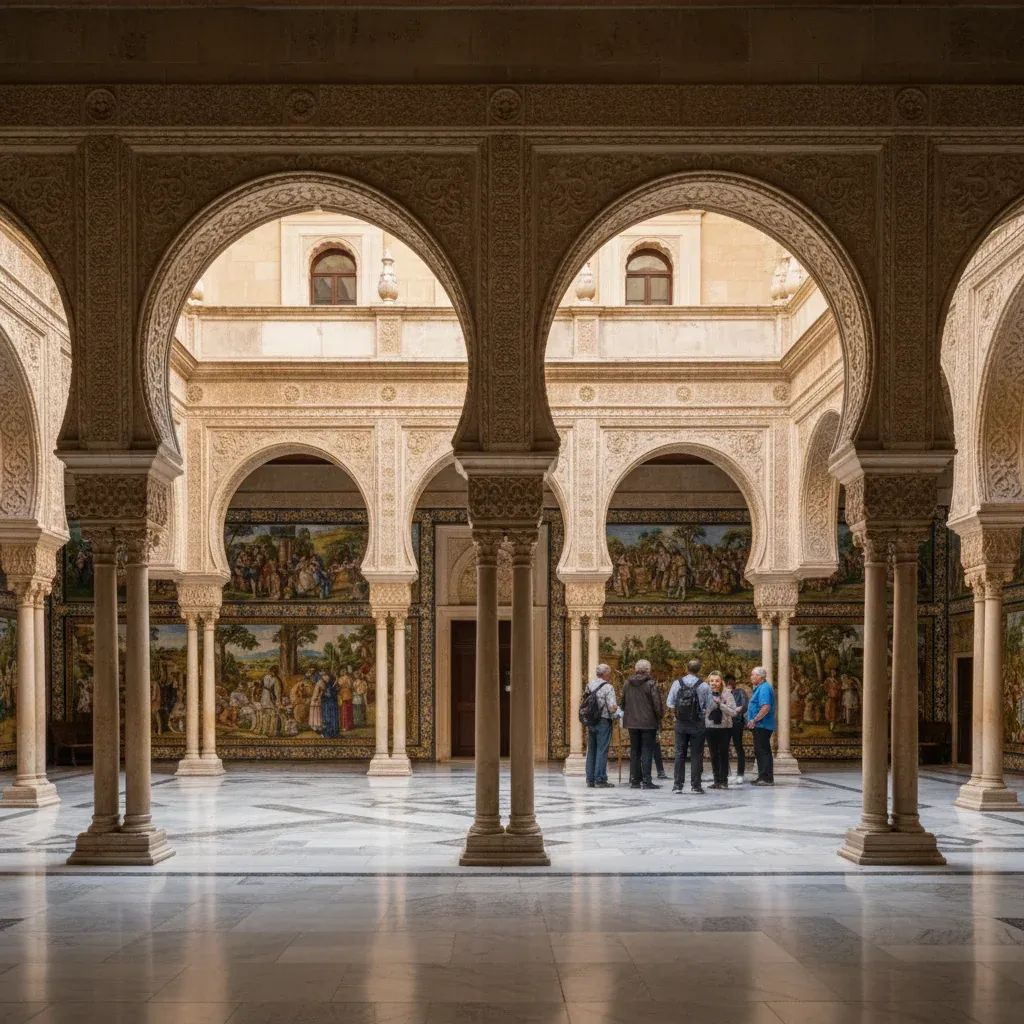
A Monument to Regional Memory
When you walk through the imposing wooden doors at 58 Rua das Portas de Santo Antão in Lisbon's Baixa, you're stepping into something rarely preserved intact in contemporary European cities: a functioning bridge between past and present, built not from nostalgia but from concrete architectural ambition and sustained institutional commitment. The Casa do Alentejo is a membership organization housed in a 17th-century palace that has cycled through aristocratic grandeur, early casino decadence, and nearly a century of social transformation—yet remains anything but a museum piece.
Why This Matters:
• A classified Monument of Public Interest that operates as an active cultural venue, not a rope-off display. Nearly 10,000 books in its library; regular concerts, exhibitions, and restaurant service within revivalist interiors from the early 20th century.
• Affordable cultural access for residents with Alentejo ties: Most library use is free, exhibitions cost nothing, membership dues around €50–100 annually, restaurant lunch menus €12–16. Weekend events rarely exceed €5–10.
• A test case for regional diaspora integration: As the Alentejo's primary institutional footprint in the capital, it anchors community identity for roughly 10,000–15,000 residents with family origins in the region, while confronting the reality that younger generations increasingly bypass formal civic structures.
The Building's Chameleon History
The structure itself tells the story. Constructed in the 17th century by the Paes de Amaral merchant family, the palace was initially conceived as a private residence—the kind of space where wealthy Lisbon traders entertained and displayed accumulated status. That incarnation lasted roughly 250 years until the early 20th century arrived with different appetites.
Between 1917 and 1919, under the direction of architect António da Silva Júnior, the entire interior underwent a sweeping renovation that gutted the original layout to accommodate the Magestic Club, one of Portugal's earliest licensed gambling establishments. This was no modest rebranding. Silva Júnior imported theatrical design principles then circulating through European fin-de-siècle revival movements. The result: layered architectural pastiche that feels simultaneously excessive and disorienting. Neo-Gothic archways frame Neo-Renaissance plasterwork. A Neo-Moorish courtyard occupies what once functioned as a stable yard. Rococo-inflected chandeliers hang in salons decorated with tile work by Jorge Colaço, the era's most prolific Portuguese ceramicist, whose designs depict rural Alentejo scenes—harvests, cork-stripping, shepherds—rendered in period tilework that has survived untouched.
The transformation fundamentally altered how the space functioned. Where the original palace contained private chambers and service corridors, the casino required grand halls suited to prolonged social gathering and the performance of wealth. This architectural reconfiguration—opening interior walls, standardizing ceiling heights across expanded rooms—inadvertently created the infrastructure that would make the building suitable for its third and current life.
How Regional Identity Found a Home
The actual pivot came through organized community action. Beginning in 1912, leaders within Lisbon's growing Alentejo migrant population conceived the idea of a "league for the Alentejo colony" in the capital. That notion circulated informally for over a decade until formal incorporation occurred: June 10, 1923, when the Grémio Alentejano officially registered as a mutual-aid organization. Nine years later, in 1932, the organization acquired the Paes do Amaral palace at precisely the moment when the casino sector was contracting due to regulatory pressure from the nascent Estado Novo regime.
By 1939, the institution had adopted its current name: Casa do Alentejo. That timing mattered. The Alentejo region—Portugal's poorest and most rural—had begun funneling workers toward Lisbon during the 1930s and would continue accelerating migration through the 1960s and 1970s. What the Casa's founders recognized, either consciously or intuitively, was that migration itself wasn't simply an economic transaction. Workers arriving from agricultural villages to industrial Lisbon carried cultural memory, family networks, linguistic particularities, and regional attachments that no factory wage could replace. The palace purchase acknowledged this psychological reality: provide a physical anchor for scattered community members, and you preserve something more durable than folklore—you preserve functioning social cohesion.
Inside the Romantic Interior
The current visitor experience is structured around sequential revelation. The street facade—modest, almost apologetic—betrays nothing of what lies behind. Enter the lobby, and you encounter a scale shift. The Pátio Árabe (Arabic courtyard) materializes as an open-air atrium surrounded by covered colonnades. The tilework here operates as visual narrative. You encounter 18th-century galant panels salvaged from the original palace—elegant, restrained compositions—interspersed with Colaço's early 20th-century rural scenes: figures harvesting wheat, extracting cork from stripped tree trunks, pastoral encounters rendered with documentary precision.
Climb the staircase—its iron banister exhibits Art Nouveau ornamentation—and the architectural details become increasingly elaborate. The Salão dos Espelhos (Mirror Salon) preserves the Magestic Club's theatrical design intact: mirrored walls amplify the sense of infinite social space; stucco molding cascades across the ceiling; chandeliers emit theatrical illumination across parquet flooring. The Salão Neo-Renascentista maintains similarly grand proportions—all arched ceilings and applied classical ornamentation—still functional for weekend dance events and member gatherings.
The result is a space where five centuries of Iberian architectural tradition coexist simultaneously: 16th-century structural logic, 17th-century domestic scale, 19th-century casino design, early 20th-century eclecticism, and 21st-century social function all occupy the same rooms without apparent hierarchy or protective barriers.
The Practical Function Today
For residents with family origins in the Alentejo's eight districts—Évora, Beja, Portalegre, Castelo Branco, and smaller municipalities—the Casa operates as a practical institution with overlapping roles. Historically, the organization functioned as a social-service provider: it operated a school, clinic, and employment placement service for newly arrived migrants. Contemporary welfare systems have absorbed those functions, but the Casa persists as a membership organization offering material benefits.
The ground-floor restaurant maintains white tablecloths and vaulted ceilings while serving canonical regional cuisine. Carne de Porco à Alentejana—braised pork with clams and a sweet spice profile—represents the region's most recognizable dish outside its borders. Açorda de Bacalhau, a thick bread stew with salted cod and coriander, exemplifies the region's peasant-cuisine principle: transform cheap staples into satisfying meals. Lunch menus position pricing between €12–16, deliberately affordable rather than tourist-trap expensive. The ground-floor Taberna operates a counter-service model with simpler offerings and lower price points.
Both operations consciously source ingredients through agricultural cooperatives in the three main Alentejo provinces. This sourcing strategy serves dual purposes: it maintains economic relationships between Lisbon institution and rural suppliers, and it functions as a culinary education mechanism for Lisbon-born descendants of migrants experiencing grandparent-era food traditions for perhaps the first time.
The membership framework—approximately €50–100 annually depending on category—grants access to restaurant privileges, event pricing, library use, and community directory listings. Non-members can enter the restaurant as walk-ins, attend most exhibitions and lectures (often free or €3–5), or simply cross through the courtyard during business hours. This partial accessibility represents a post-1974 shift. Before the Carnation Revolution, membership was reserved almost exclusively for Alentejo natives. The institution formally opened doors to general Lisbon residents after the dictatorship ended, establishing a public-facing cultural mandate that persists today.
Cultural Programming Across Generations
The Casa's current programming reflects an institution balancing preservation with contemporary engagement. Sunday social dances continue as they have for decades: ballroom standards performed by a live trio, drawing regulars in their seventies and eighties who have attended consistently for half a century or more. Saturday afternoon cultural sessions regularly feature Cante Alentejano groups—the polyphonic work-song tradition that UNESCO recognized as Intangible Cultural Heritage of Humanity. These sessions present traditional vocalists performing in their original acoustic context.
The Casa's recent event calendar also demonstrates programming experimentation. Events like Recante pair traditional Cante vocals with electronic production, synthesizers, and percussive tracks, designed to reach younger Alentejo descendants unfamiliar with regional dialect or agricultural traditions. Such programming reflects an institutional question: can heritage connect with younger generations when expressed through contemporary production rather than acoustic tradition alone?
The broader calendar reflects diverse programming. Municipal weeks dedicate rotating programming blocks to each of Alentejo's 58 councils, hosting exhibitions, food tastings, and panel discussions. The Casa do Alentejo Prize, awarded annually since the institution's 102nd anniversary on June 10, 2025, recognizes contributions to visual art, literature, and photography rooted in regional themes. Book launches and thematic conferences address structural regional challenges: rural population decline, water scarcity and irrigation conflicts, renewable energy siting impacts on municipal governance. This programming frames Alentejo's future as a policy area requiring sustained attention.
The Library as Intellectual Infrastructure
The second-floor library—approximately 10,000 volumes—functions as an intellectually ambitious resource. The collection spans 19th-century travel narratives through contemporary doctoral theses addressing cork-oak forestry economics and EU agricultural subsidy structures. Book events held here regularly attract scholars, policymakers, agricultural economists, and journalists addressing regional economic questions. Recent conferences examined land-use regulation affecting cork production, subsidy mechanisms affecting grain cultivation, and transition impacts of renewable energy infrastructure on municipal tax bases.
This programming establishes the Casa as a Lisbon institutional platform where regional economic concerns receive sustained analytical attention. The library functions as an intermediary between dispersed Alentejo interests and power centers concentrated in Lisbon's government and financial sectors.
The Membership Challenge
Despite energetic programming, the Casa confronts demographic realities that internal strategy documents frankly acknowledge. Peak Alentejo-to-Lisbon migration occurred during the 1960s and 1970s; that generation has now entered their seventies and eighties. Younger Alentejo natives migrating to the capital for university education or employment frequently bypass civic and associative structures entirely. This pattern—described internally as "civic abstention" among residents under 30—represents an institutional vulnerability.
The organization has responded with targeted interventions: subsidized membership tiers for university-age participants, formal programming partnerships with Universidade de Lisboa, Instituto Superior Técnico, and ISCTE student unions, and digital outreach attempting to reach Alentejo migrants active in professional networks rather than neighborhood-based community structures. Whether these efforts materially reverse generational disengagement remains uncertain. The Casa's own records suggest modest uptake among under-30 cohorts, though weekend social-dance events continue attracting multi-generational participation.
One structural limitation warrants acknowledgment: the Casa's legal mandate and membership framework remain anchored to Alentejo regional identity. The organization does not operate integration programs targeting non-Alentejo migrant communities or refugee populations, despite Lisbon's rapidly expanding international resident population. This specificity preserves organizational coherence and mission clarity but functionally limits the institution's role as a broader urban social-integration tool.
Accessing the Space
Casa do Alentejo sits at Rua das Portas de Santo Antão 58, roughly a 5-minute walk from Restauradores station (Blue Metro Line). Public areas remain accessible weekdays 9 AM to 11 PM, weekends 10 AM to midnight. Restaurant reservations are advisable for Friday and Saturday evenings. Most exhibitions and library use cost nothing; cultural events and concerts typically range from €5–10 depending on programming.
The building functions as an active social organization rather than heritage site, meaning sections periodically become unavailable due to private member functions or facility maintenance. Consulting the Casa's official website agenda before visiting—particularly during municipal weeks when programming density increases significantly—prevents wasted trips.
An Institutional Paradox
Few Portuguese regional associations maintain comparable institutional footprints in Lisbon. The Casa dos Açores operates at smaller scale; other regional organizations function primarily as dance troupes or recreational-sports clubs. The Casa do Alentejo's unusual institutional breadth—encompassing architecture, gastronomy, library holdings, ballroom facilities, gallery space, and intellectual programming—reflects both the historical scale of mid-20th-century southern migration and the organizational foresight of early leaders who secured real-estate ownership at a propitious historical moment.
That physical anchor—a transformed palace in the capital's commercial center—has allowed institutional continuity across political regimes, economic cycles, and profound generational shifts in how Lisbon residents understand community and belonging. It functions as evidence that migration represents more than labor transaction; it constitutes a cultural and social fact that institutions can honor through architectural preservation, thoughtful programming, and sustained commitment to community rather than profit.
As the Casa approaches its second century, its leadership confronts an open institutional question: can an organization built substantially on collective memory and traditional practice adapt rapidly enough to engage a diaspora increasingly native to urban life, digitally engaged, and skeptical of formal membership structures? The answer will determine whether this palace continues operating as a functional community hub or gradually transitions into an architectural curiosity from an earlier era of urban life.


