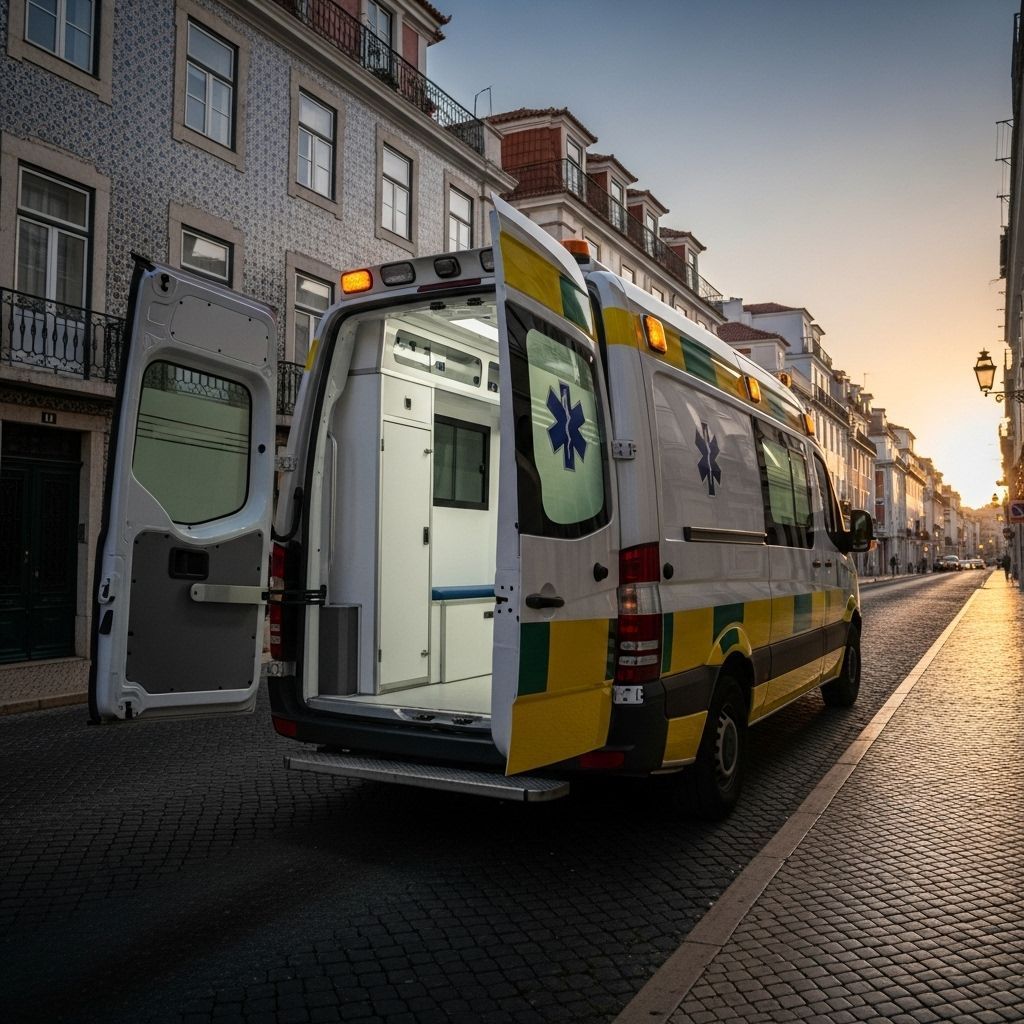
The Portugal National Emergency Medical Institute (INEM) has rolled out a threefold expansion of basic life-support ambulances operating out of volunteer fire brigade stations across Lisbon, a reorganization that aims to cut response times and bring emergency medical care closer to residents in the capital's dense urban core.
As of midnight today, 12 new Medical Emergency Posts (PEM) began operations, with a further 6 slated to come online by the end of April. This will raise the total from 6 to 18 PEM units citywide—effectively tripling the network of basic ambulances coordinated by INEM but staffed and housed by local volunteer firefighter corps.
Why This Matters
• Faster response: Direct dispatch from emergency call centers eliminates intermediaries, streamlining ambulance deployment across Lisbon's congested neighborhoods.
• Stable funding model: Reserve ambulances now receive fixed subsidies from INEM, enabling permanent crews and predictable operational capacity.
• 83 nursing posts: Two recruitment competitions are underway to staff the expanded system, addressing chronic personnel shortages.
How the New System Works
The expanded PEM network integrates volunteer-run ambulances into the Integrated Medical Emergency System (SIEM), managed by INEM in partnership with fire brigades and the Portuguese Red Cross. Each PEM unit provides basic life support (SBV) and is now activated directly by the Urgent Patient Guidance Centers (CODU), the dispatch hubs that field emergency calls.
Previously, many of these ambulances functioned as "reserve" units, called into service only during peak demand or seasonal spikes. Under the new arrangement, they transition to permanent operational status with guaranteed monthly subsidies, allowing fire brigades to maintain dedicated crews around the clock. INEM officials say this shift eliminates the uncertainty that plagued seasonal contracts, which often left stations unable to retain trained personnel or commit vehicles full-time.
The direct-dispatch protocol also marks a departure from earlier practices. In the past, CODU would relay calls through intermediaries or rely on ad hoc arrangements with fire stations. Now, CODU controllers can assign the nearest available PEM in real time, cutting out delay and miscommunication—a problem that surfaced publicly during a 2026 strike by pre-hospital technicians, when the institute failed to inform the Portuguese Firefighters' League (LBP) of service disruptions.
What This Means for Residents
For anyone living or working in Lisbon, the expansion translates into a denser safety net. With 18 posts distributed across the municipality, INEM calculates that urban neighborhoods previously served by a handful of stations will now see greater capillarity—medical jargon for finer geographic coverage. In practical terms, that means shorter drive times when someone calls 112 for chest pain, a fall, or a traffic accident.
Emergency medicine experts note that every minute counts in life-threatening situations like cardiac arrest or stroke. By positioning ambulances in more fire stations, INEM reduces the distance crews must travel, especially during rush hour when Lisbon's arterial roads can grind to a halt. The institute says the reorganization also accounts for traffic patterns, roadworks, and peak-hour congestion—factors the LBP has long argued should inform dispatch decisions, rather than relying solely on straight-line distance.
Beyond speed, the funding shift offers indirect benefits. Permanent crews foster institutional memory, allowing firefighters and emergency medical technicians to develop familiarity with their catchment areas—knowing which streets flood, where scaffolding blocks access, or which apartment buildings lack elevators. That local knowledge can shave precious seconds off response times and improve patient handover at hospital emergency departments.
Parallel Adjustments to Advanced Units
While expanding basic-support coverage, INEM is simultaneously recalibrating its fleet of Advanced Medical Emergency Ambulances (AEM), which carry physicians or nurse specialists and handle the most critical cases. The institute said it will adjust AEM deployment schedules and station assignments to reflect actual staffing levels and operational activity, rather than theoretical targets.
This pragmatic approach follows months of tension over resource allocation. Ambulances sitting idle because no qualified nurse is available, or crews pulled from quieter zones to cover chronic shortfalls in busier areas, have been recurring complaints. By aligning schedules with real workforce capacity, INEM hopes to avoid phantom units on dispatch boards and ensure that advanced teams are positioned where data show they are most needed.
Tackling the Staffing Crisis
To underpin the expansion, INEM has opened two competitive examinations for 83 nursing positions, aiming to build a reserve recruitment pool. The move addresses a longstanding bottleneck: Portugal's emergency medical system has struggled to attract and retain nurses, who often face irregular hours, high stress, and compensation that lags behind hospital counterparts.
The new posts will be drawn from this reserve as vacancies arise or new units launch. INEM has not disclosed salary bands, but the institute emphasized that the competitions target permanent contracts rather than short-term or seasonal arrangements—an attempt to offer job security in a sector notorious for precarious employment.
Context and Criticism
The Lisbon push fits within INEM's 2024–2026 Strategic Plan, which calls for integrated network optimization, complete territorial coverage, and innovation in pre-hospital care. In January, INEM and the LBP reached a broader accord to reinforce permanent emergency medical staffing, with initial focus on Lisbon's south bank—areas like Almada and Seixal that have faced chronic delays.
Yet the rollout comes against a backdrop of operational friction. The LBP has publicly criticized INEM's dispatch algorithms, arguing that proximity-based assignment can backfire when the nearest station is stuck in traffic or has its crew tied up at a hospital waiting to hand over a patient—a phenomenon called stretcher retention that can lock ambulances out of service for hours. INEM counters that proximity remains the gold standard for high-acuity cases, where seconds matter more than local traffic knowledge.
Communication breakdowns have also eroded trust. During a recent technician strike, firefighters reported arriving at scenes only to discover INEM had not informed them of service changes, leaving both responders and patients confused.
A European Trend
Lisbon's restructuring mirrors broader patterns across European capitals. Cities from Berlin to Madrid are layering emergency response: assigning basic-support tasks to fire services or private contractors, reserving advanced teams for trauma or cardiac arrest, and equipping dispatch centers with real-time telemetry and GPS. The aim is to create a pyramid of care, where the least specialized—but fastest—responder arrives first, stabilizes the patient, and hands off to higher-tier units if needed.
Technology plays a growing role. Some jurisdictions are piloting smart ambulances that transmit vital signs and video feeds to hospital emergency departments en route, allowing physicians to guide treatment before arrival. INEM has not announced similar trials in Lisbon, but the institute's strategic plan references innovation and digitalization as priorities.
What Comes Next
By the end of April, all 18 PEM units are expected to be fully operational. INEM has not released a map showing exact station locations, but officials indicated the network will span both historic downtown neighborhoods and outlying residential zones.
The institute also confirmed plans to relocate its Lisbon headquarters to Oeiras, a suburb west of the capital, as part of a broader reorganization meant to improve facilities and strengthen ties with the 112 emergency call system. That move, however, has drawn concern from staff unions worried about longer commutes and reduced coordination with central Lisbon hospitals.
For now, the tripling of ambulances represents the most tangible change. Whether it delivers on the promise of faster, more reliable emergency care will depend on factors beyond fleet size—namely, whether INEM can fill nursing vacancies, resolve dispatch disputes with firefighters, and persuade hospitals to release ambulances faster. Lisbon residents, accustomed to hearing sirens echo through narrow streets, will be watching response times closely.