
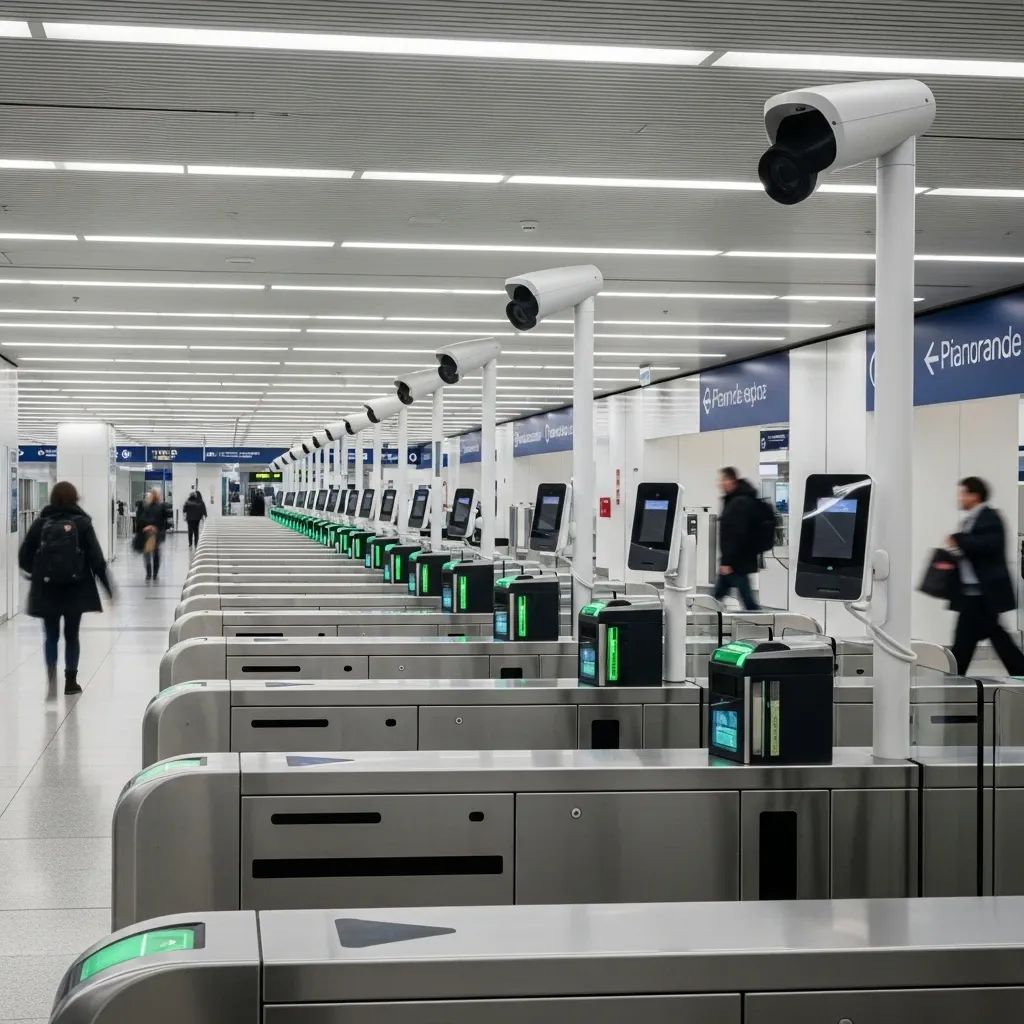
A €7.5 million greenlight from Lisbon sets the stage for faster passport checks, biometric screening and shorter queues at Portugal’s busiest airports—but the plan hinges on technology that has already caused turbulence elsewhere in Europe.
Snapshot: what matters now
• €7.5 million budget approved for new e-gates, software and maintenance
• Roll-out scheduled 2026-2028, beginning with Humberto Delgado Airport
• Part of the EU’s Entry/Exit System (EES), which went live in Portugal late-2025
• Number of e-gates in Lisbon to rise from 16 to 24
• Expected cut in average processing time to ≈20 seconds per passenger
• Privacy safeguards promised, yet critics warn of biometric over-reach
Brussels’ ticking clock
When the Schengen bloc decided to replace passport stamps with a continent-wide database, member states were handed a deadline: be ready or face bottlenecks. Portugal felt the pressure first in October 2025, when the EES soft-launched and Humberto Delgado’s arrivals hall morphed into a maze of lines that snaked past duty-free. Authorities blame the logjam on the extra seconds needed to collect fingerprints and facial images from non-EU travellers. The new investment aims to transform that early-stage headache into a seamless flow before the system becomes mandatory in 2026.
Where the money goes
The Council of Ministers has authorised the Polícia de Segurança Pública to sign multi-year contracts covering:
• Hardware: e-gates equipped with high-definition cameras and e-passport readers.
• Software licences that connect the gates to Schengen security databases.
• Corrective maintenance for three years to avoid downtime.
More than €4 million is front-loaded for 2026, with the balance split between 2027 and 2028. Lisbon gets the lion’s share—raising its gate count to 24—while Porto, Faro and Madeira are in line for incremental upgrades should funds remain after the capital’s overhaul.
What travellers will notice
Upon first arrival after April 2026, citizens of the United States, Brazil or any other non-EU country will place their passport on a reader, look into a camera and scan four fingerprints. Subsequent trips will be quicker, because the biometric profile will already sit inside the EES cloud. EU, EEA and Swiss nationals will still breeze through RAPID4ALL lanes, although the government has hinted that Portuguese ID cards could eventually plug into the same network.
Applause—and alarm bells—from specialists
Border-security analysts interviewed by Diário Económico call the e-gates “an essential triage tool” for an airport that handled 33 M passengers in 2025. They point to Germany’s EasyPASS, which clears most travellers in under 12 seconds, as proof that automation can out-perform manual checks. Yet data-protection advocates counter that Portugal is collecting sensitive biometrics on a scale never seen before, warning of mission creep if databases are cross-referenced with policing systems beyond migration control.
Lessons Lisbon cannot ignore
• Build redundancy: Frankfurt’s gates went dark for hours last summer after a software glitch. Back-up kiosks and roving officers are non-negotiable.• Phase the roll-out: Copenhagen’s gradual introduction kept wait times stable. Fast-tracking hardware without staff training did the opposite in Budapest.• Tell people early: Clear signage and airline briefings cut down on rookie errors—crucial during peak Algarve holiday weekends.
What it means for people in Portugal
For residents flying home, the upgrade promises shorter queues behind tour groups and cruise-ship charters. Tourism operators expect smoother arrivals to translate into higher satisfaction scores, while unions argue that automated gates free PSP officers for intelligence-driven tasks rather than box-ticking. The debate now shifts to Parliament, where opposition parties demand rigorous audits to verify the system’s cost-benefit ratio before the first gate clicks open in 2026.


