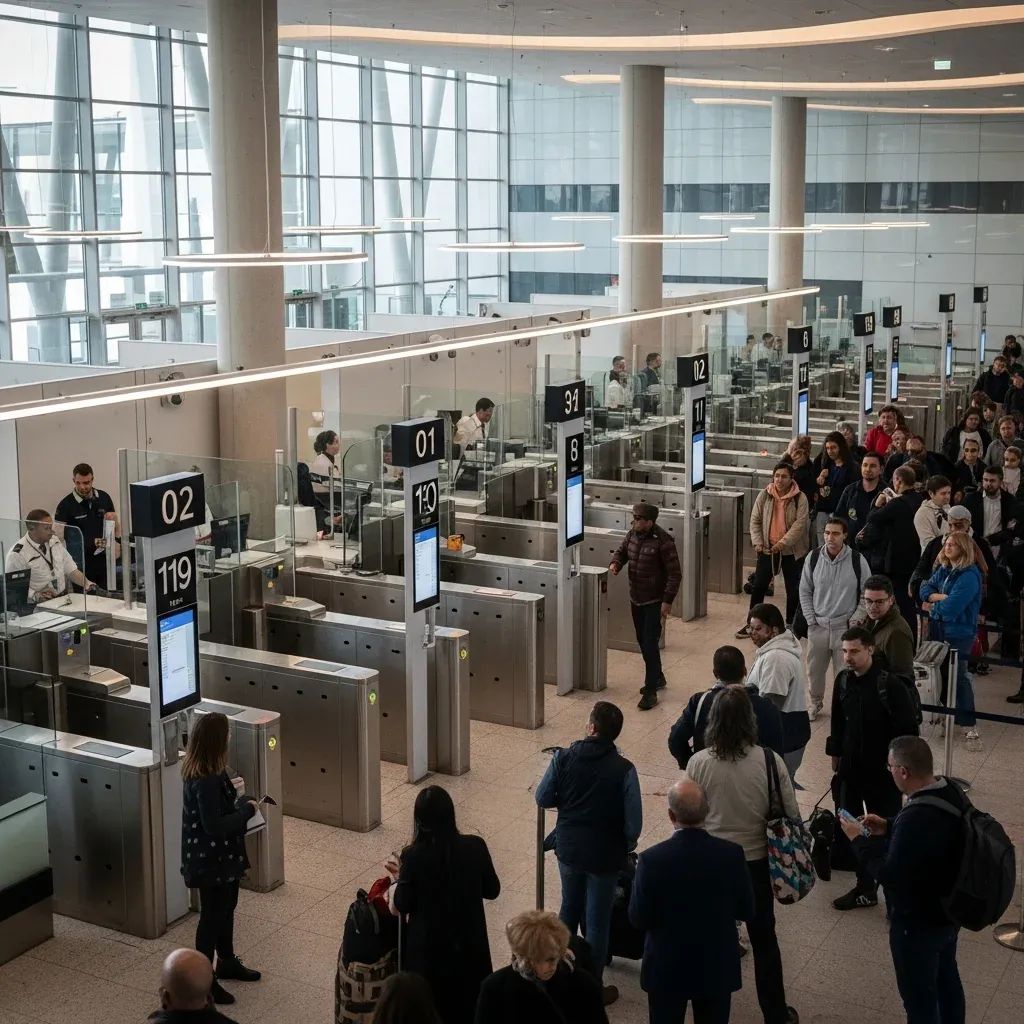
Portuguese residents flying home for the holidays may notice the passport line at Lisbon’s Humberto Delgado Airport creeping forward faster than it did just a few weeks ago. Authorities insist the improvement is real, even if the experience is still far from seamless.
Snapshot
• 80 extra police officers drafted in for a 15-day shift
• Average wait now ≈60 minutes instead of 3–6 hours
• New EU Entry/Exit System (EES) blamed for early-winter chaos
• Talk of a temporary suspension of biometric checks over Christmas
• Full EES roll-out scheduled for April 2026
Festive crowds meet a fragile system
The combination of record passenger volumes, a still-learning workforce and the second phase of the EES biometric regime turned Lisbon’s passport control into a choke point this autumn. By mid-November, tourists were sharing images of queues snaking through corridors, while local media described a “national embarrassment”. The Christmas rush threatened to make matters worse, prompting the Ministry of Internal Administration to deploy reinforcements from the Public Security Police (PSP). Senior officials say every inspection “box” is now permanently manned, and early indications show a measurable drop in bottlenecks.
What changed after October
October 12 marked Portugal’s switch-on of the EU-wide EES, a database that stores photographs, fingerprints and travel histories for every non-Schengen visitor. The first entry is noticeably slower, requiring a full biometric capture. On December 10 the system expanded to cover more flights and nationalities, just as North-American and Brazilian arrivals surged for the holidays. PSP agents trained under the old manual-stamp model suddenly found themselves juggling tablets, fingerprint scanners and confused travellers. To buy breathing room, Lisbon asked Brussels for permission to pause the new protocol during peak days—an option already exercised by several Mediterranean airports.
The numbers behind the queues
According to internal dashboards seen by Lusa and confirmed by ANA – Aeroportos de Portugal, Humberto Delgado processed 36 M passengers in 2025, roughly 14 M above its design capacity. Of those, about 12 M originated outside Schengen, triple the 2021 figure. Before the police surge, non-EU passengers frequently waited 180–360 minutes; this week the average has fallen to 72 minutes, with EU/EEA citizens clearing in 24 minutes thanks to e-gates. The airport operates 16 manual booths and 14 automatic gates on arrivals, plus a mirrored setup on departures. Officials concede that hardware growth has not kept pace: the summer plan calls for extra e-gates and two new lines of booths in Terminal 1, while a refurbishment of the compact Terminal 2 should add 10 contact gates by January 2026.
Keeping the lines moving into 2026
The government’s emergency task force is working on four tracks:
Human resources – SEF inspectors now posted to the Polícia Judiciária will remain at the airport for another 6 months, buying time to finish training new PSP recruits.
Technology stabilisation – software glitches in the RAPID e-gate platform are being patched weekly; ANA claims “uptime now exceeds 97 %”.
Flexible rules – the Internal Security System has authority to switch off EES for short periods if wait times exceed predefined thresholds.
International support – a small Frontex contingent is scheduled to reach full strength in March 2026, giving Portugal access to extra border officers during summer spikes.
Tourism and aviation weigh in
Tour operators warn that continued delays could undercut the country’s post-pandemic rebound. Luis Mexia Alves, head of Discovery Hotel Management, calls the airport logjam “a memory of chaos impossible to erase”. Industry lobby CTP estimates each additional hour in line costs the capital €3 M in lost spending, as travellers skip meals, tours and duty-free shopping. Aviation analysts counter that the EES will ultimately bring streamlined, paperless travel, citing pilot projects in Frankfurt and Paris that cut manual checks by 35 % once passenger databases were fully populated.
Tips for holiday travellers
Seasoned flyers suggest a few survival strategies while the transition beds in:
• Download airline apps and complete pre-check-in data to shorten document review.
• Use e-gates if you hold an EU, EEA or UK biometric passport.
• Arrive 3 hours early for long-haul departures and allow at least 90 minutes for arrivals connections.
• Keep fingerprints clean—hand lotion can confuse scanners.
• Monitor live wait times on airport websites or the independent FlightQueue tool before setting off.
Bottom line
Lisbon’s border control crisis is not over, but the worst appears to have passed. A cocktail of extra police manpower, patches to glitchy software and the possibility of temporary rule relaxation has shaved hours off the bottleneck. What remains to be seen is whether the gains can survive the full tourist onslaught of summer 2026, when the EES will be mandatory, permanent and unavoidable.