
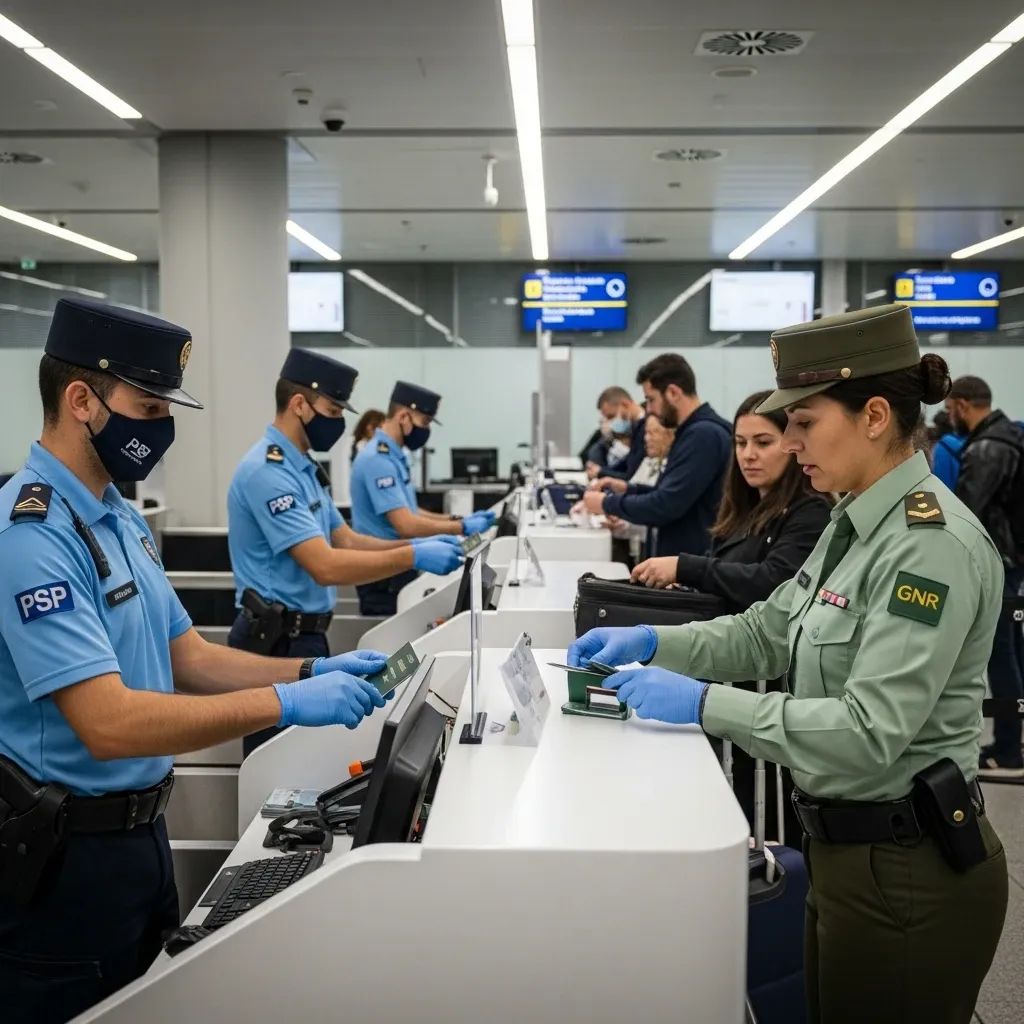
Every Lisbon-based traveler knows the sinking feeling of watching an ever-growing queue snake through passport control. After weeks of chaotic scenes, the Government has finally decided to throw extra boots – and a dash of controversy – at the problem.
Snapshot for busy readers
• 24 extra GNR border-trained soldiers will replace the previously announced 10-person boost
• Deployment begins Tuesday, 6 January, after a lightning two-day administrative course
• EU’s Entry/Exit System (EES) frozen for 3 months at Humberto Delgado Airport to unclog arrivals
• Rivalry between civil PSP agents and military GNR resurfaces, with unions calling the move a “political stunt”
Why the queues became unbearable
Humberto Delgado handled 31 M passengers in 2025, roughly double the volume of a decade ago. The latest bottleneck, however, was triggered by the new EU Entry/Exit System, designed to record biometrics of travellers from outside Schengen. Each non-EU passenger must now stare into a camera and press four fingers on a scanner, adding precious seconds that balloon into hours when several flights land simultaneously.
Airport operator ANA installed extra kiosks, but a December inspection by the European Commission flagged “serious deficiencies” in staffing. The Government responded in two steps: pull the EES plug for a quarter-year and draft in GNR personnel who already hold certified border-guard qualifications from earlier overseas missions.
The deployment plan – version 2.0
Forget the headline that promised just 10 soldiers for one day. After behind-the-scenes wrangling, 24 GNR members will report for duty next Tuesday. They will work in rotating platoons of 10 agents plus a supervisor, allowing management to flex manpower at peak arrival banks – early mornings from Brazil and late afternoons from Africa.
Unlike ad-hoc reinforcements in the past, each soldier has completed the Frontex-endorsed Border Security Course, so they are allowed to stamp passports, not merely shepherd lines. All will first attend a crash briefing by PSP, ANAC and ANA that covers airport layouts, local IT log-ins and passenger-rights protocols.
What changes for passengers – and for locals receiving visitors
For holidaymakers landing in Lisbon from Luanda, São Paulo or Newark, the most visible tweak will be additional manned booths and a return to classic passport stamping while the EES remains paused. ANA predicts a 30 % cut in average wait time to under 20 minutes; independent travel groups are more cautious, betting on 25–30 minutes if all booths stay staffed.
Portuguese residents expecting relatives should still advise them to fill in the electronic pre-registration form offered by the Foreigners and Borders platform – it speeds the manual check. Airlines have been told to warn passengers in advance that fingerprints will not be captured during the freeze, but may be requested again after April.
Police rivalry or pragmatic fix?
The move revives an old turf battle. PSP legally controls all nine Portuguese air borders, while GNR is a gendarmerie with authority everywhere except airports – unless specifically deputised. The main PSP union brands the swap “window-dressing” that dodges deeper issues such as ageing e-gates and chronic recruitment delays.
On the GNR side, officers privately relish the assignment as proof that their military discipline can plug civilian gaps. Yet even within their own ranks, some fear becoming “a political football,” as the National Association of GNR Officers complained this week. Security analyst Marta Ramos notes the wider European pattern: Spain, France and Italy already blend civilian and military units at large hubs when holiday peaks collide with manpower shortages.
The next three months – and the tech fix still to come
Suspending the EES is only a breathing space. By April the EU expects every Schengen gateway to resume biometric border checks, or risk infringement proceedings. The Ministry of Internal Administration has therefore ordered:
20 new automatic e-gates compatible with facial-and-fingerprint capture, arriving in March;
A permanent intake of 110 PSP border agents graduating in June;
Ongoing cooperation with Frontex liaison teams, who will dispatch 26 officers to Lisbon later this year.
If the timetable sticks, Humberto Delgado could be the first Iberian airport fully compliant with the upgraded EES ahead of next summer’s tourism rush. Until then, passengers will be greeted by a mixed force of blue and khaki uniforms – and, authorities hope, a line that moves fast enough to keep tempers in check.


