
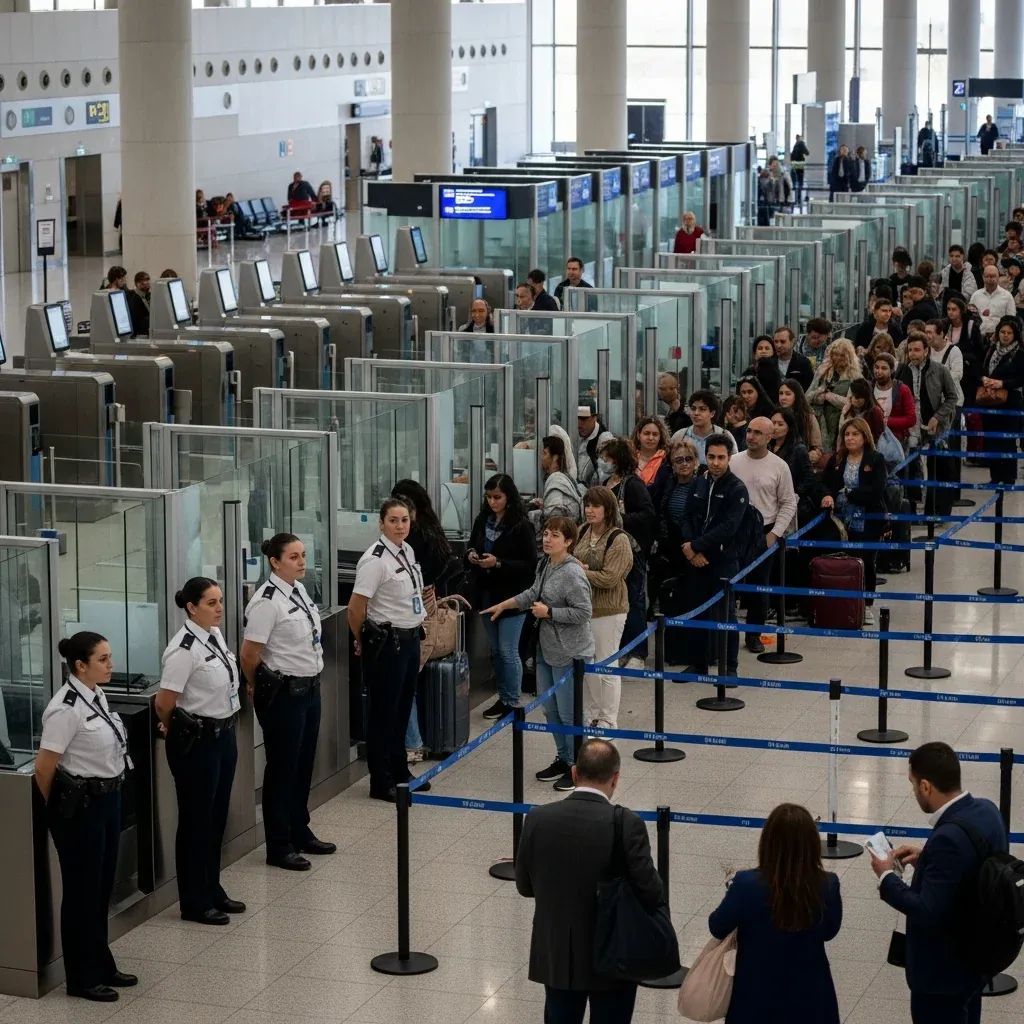
Travellers landing in Lisbon this week will find a more crowded passport hall—but also a stronger uniformed presence—after the Government’s late-night push to untangle the gargantuan queues that dominated the Christmas period. Twenty-four freshly assigned officers from the National Republican Guard (GNR) slide into position on 6 January, just as the controversial European Entry/Exit System (EES) goes offline for a three-month reset.
Quick glance at what is changing
• 24 additional GNR agents with border-control certification start work on Tuesday, joining the Public Security Police (PSP) at the booths.
• The new agents will rotate in flexible shifts of 10 plus 1 supervisor, focusing on the arrivals corridor.
• EES biometric checks suspended for 3 months, returning officers to the classic passport-and-stamp routine.
• Government has earmarked €7.5 M to upgrade hardware—including expanding e-gates from 16 to 24—over the next 2 years.
• The European Commission has demanded a detailed justification for Portugal’s pause, citing “serious deficiencies” spotted during an unannounced December audit.
What travellers will notice from 6 January
Holidaymakers disembarking at Humberto Delgado will now be funnelled toward lines staffed by both PSP and the newly drafted GNR teams. Officials insist the extra manpower will open more desks during peak arrivals, trimming the eye-watering waits that stretched to 7 hours on some December days. The GNR officers, all with border-control accreditation, spent last weekend in brisk, administrative refreshers with the PSP, civil-aviation watchdog ANAC and airport operator ANA.
The root of the gridlock
Portugal switched on the EES in mid-October, aiming to tighten security for non-EU nationals by recording fingerprints and photos on arrival. Instead, the biometric step overloaded staff and equipment, paralysing throughput. Lisbon’s airport layout only offers 16 service counters in arrivals—a figure PSP calls insufficient whenever multiple wide-body flights land within minutes. ANA, meanwhile, blames the bottleneck on “closed booths and powered-down e-gates” caused by staff shortages rather than infrastructure.
Brussels steps in
A three-day inspection by the European Commission (15-17 December) flagged “grave shortcomings” in Lisbon’s first- and second-line checks. Inspectors pinpointed long queues, inconsistent procedures and ad-hoc work-arounds that were never communicated to EU authorities. The Commission’s migration unit has since asked Lisbon for a timeline showing when full EES compliance will be restored and how further breaches will be prevented.
Technology vs. manpower
While extra boots on the ground offer instant relief, long-term fixes revolve around reliable tech. The Cabinet approved a 30 % surge in border-control equipment, with ANA tasked to nearly double the number of e-gates, install new biometric readers and streamline software that interfaces with Schengen databases. The €7.5 M budget also covers maintenance, after repeated complaints that electronic lanes sit dark whenever minor glitches appear.
Roadmap for spring 2026
Officials say the EES suspension expires in early April. By then, Lisbon aims to have:
• 24 operational e-gates in arrivals;
• a re-trained pool of 120 border officers fluent in the updated biometric workflow;
• live dashboards tracking real-time queue lengths shared between ANA, PSP and the Interior Ministry.Failure to meet those benchmarks could invite infringement proceedings from Brussels, a scenario Lisbon’s diplomatic corps is keen to avoid.
How passengers can prepare
Until the upgraded system is in place, non-EU travellers should brace for manual passport stamping, arrive earlier than usual, and keep printed proof of onward travel handy. Portuguese residents meeting visitors may also need to factor in an extra hour before friends and family clear the hall—though authorities promise the added GNR presence will shrink that buffer soon.
The bottom line for people living in Portugal: expect a slightly smoother arrival experience for international guests, a visible military-police mix at the booths and a race against the clock to modernise one of Europe’s most congested entry points before the summer surge returns.


