

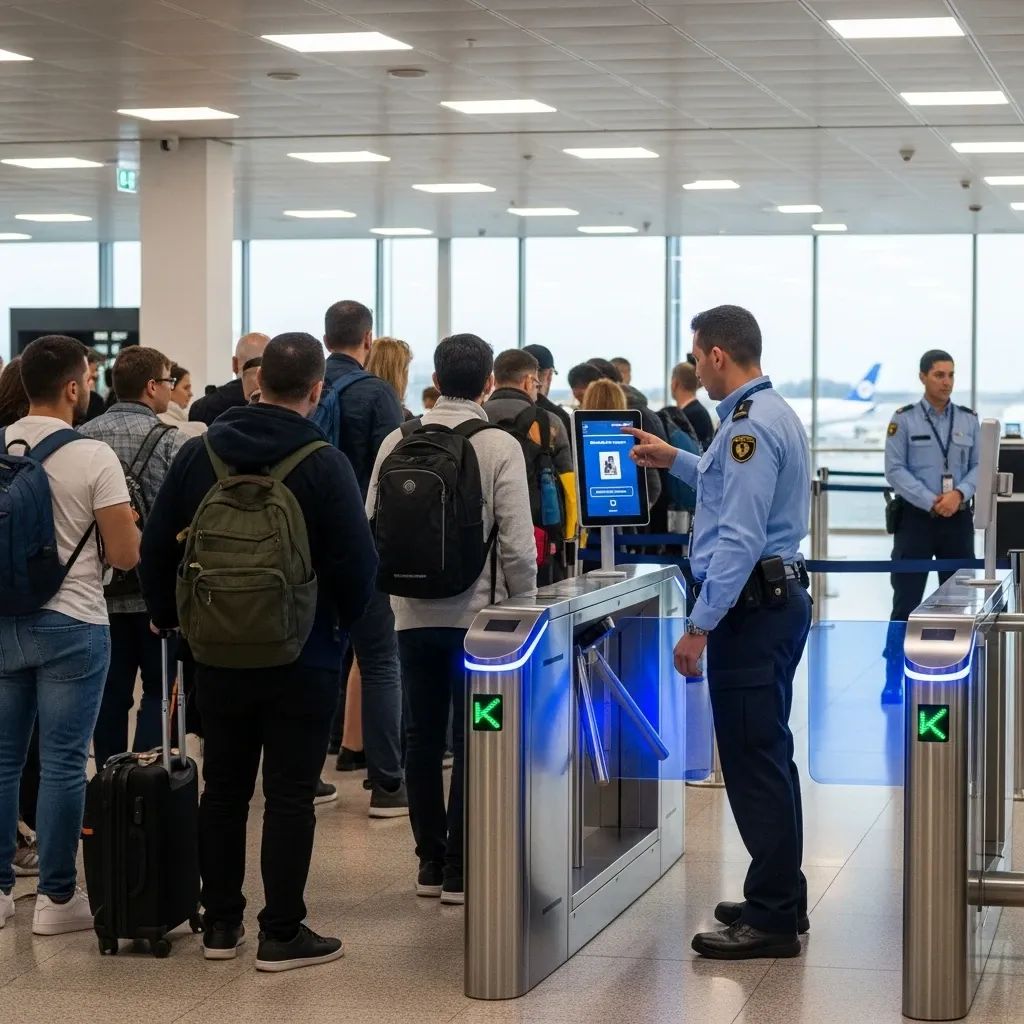
Eleven million check-ins, nearly two thousand refusals, and an experiment with biometric gates that had to be paused: that is the short version of what happened at Lisbon Airport in 2025. For Portuguese residents who depend on Humberto Delgado to travel, work or welcome family, the figures reveal both the scale of the operation and the frictions that lie ahead.
Key take-aways at a glance
• 11.377.097 passengers screened by the Public Security Police (PSP)
• 1.867 travellers denied entry, most from outside Schengen
• 263 arrests ranging from document fraud to outstanding international warrants
• EES biometric system launched in October, temporarily suspended three months later after queues stretched for hours
• Waiting times now capped at roughly 60 minutes thanks to extra officers and new equipment
Why the 2025 numbers matter for Portugal
Faro and Porto may be growing fast, yet the capital still handles the lion’s share of arrivals. By processing more than 6.4 million entries and 4.9 million exits, Lisbon Airport operated at a record rhythm, illustrating how strongly tourism and migrant travel contribute to the national economy. At the same time, the data signal where public funds are flowing: staffing, biometric infrastructure, and coordination with the Unidade Nacional de Estrangeiros e Fronteiras (UNEF), the PSP unit created in August to centralise border security.
A year of trial and error at the checkpoints
The European Entry-Exit System (EES) went live on 12 October with the promise of seamless facial recognition and fingerprint collection for non-EU citizens. Instead, peak-season queues regularly topped three hours. In December the government opted for a three-month suspension, an unusual step that drew criticism from police unions worried about potential security gaps. Reinforcements followed: eighty PSP agents over Christmas and, from early January, twenty-four GNR soldiers trained in travel-document forensics. Combined with a 30 % boost in inspection kiosks, the measures cut the worst wait to about one hour.
Crime snapshots behind the statistics
Beyond the visible lines, officers uncovered 464 forged passports, flagged 25.736 passengers for secondary screening, and issued 9.490 precautionary measures that range from temporary seizure of documents to mandatory re-routing. Arrests included a luso-Venezuelan sought for extortion, a suspect wanted for sexual assault, and couriers linked to drug-trafficking networks. While such cases represent a fraction of total travellers, PSP commanders argue they justify the layered control regime that some critics label excessive.
The balancing act: speed versus security
For business travellers commuting to Brussels or families heading to Brazil, reliability at the gate is as important as safety. Aviation analysts note that Lisbon still lags behind Madrid-Barajas or Paris-Charles de Gaulle, where extra-Schengen processing rarely tops forty minutes. Yet those hubs employ far more automated e-gates and have larger dedicated police contingents. Portuguese officials insist the temporary halt to EES will allow software fine-tuning and additional biometric enrolment stations, aiming for a smoother relaunch by April 2026.
Looking ahead to 2026
Infrastructure Ministerial sources hint at three priorities:
Strategic hiring of specialised PSP agents fluent in multiple languages.
Full deployment of 3-D baggage scanners to shorten security lines.
Real-time data sharing between PSP, ANA Airports and airlines to predict surges.If budgets hold, passengers could see processing times converge with European averages by next summer.
Practical advice for travellers
• Arrive at least two hours before a Schengen flight and three hours for long-haul.• Make sure passports issued outside the EU have at least three blank pages; last year most refusals stemmed from document irregularities.• Families should pre-register children’s biometrics online once EES resumes to avoid duplicate scans.• Keep a digital copy of travel documents; it speeds up secondary checks if you are among the few singled out.
In short, 2025 showed the strain of record demand on a legacy terminal still awaiting expansion. For people living in Portugal, the coming months will determine whether the promised blend of technology and manpower finally delivers a border experience that feels 21st-century rather than pre-pandemic.


