
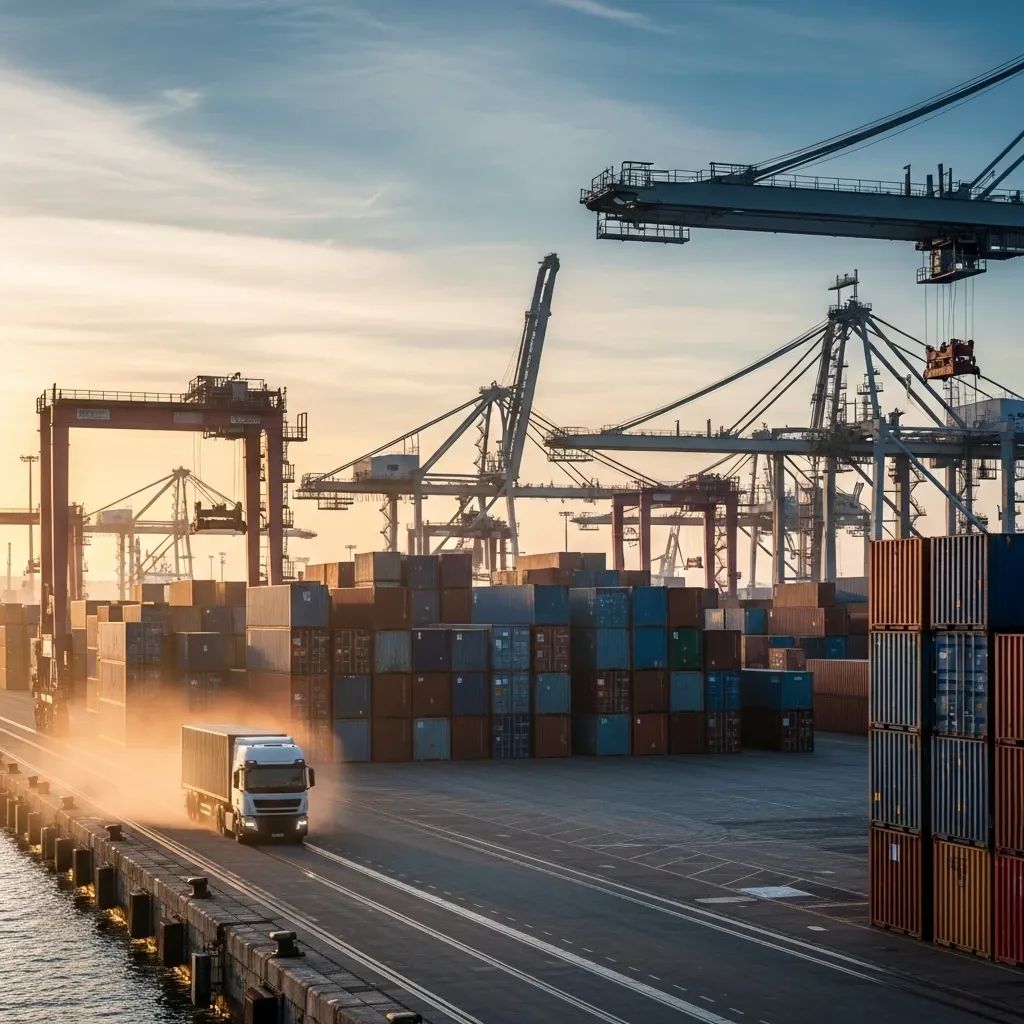
The customs gates at Leixões have begun to swing open again, yet hundreds of steel boxes remain on the quayside. Port officials are urging companies to collect the containers already cleared for exit, warning that every extra day on the dock raises storage fees and keeps the supply chain under pressure.
At a Glance
• APDL is pressing freight owners to remove cargo that has been green-lighted by customs.
• The plea follows December’s rollout of the SimTem digital clearance system, which briefly jammed authorisations.
• Congestion late last year pushed terminal capacity to the limit, prompting fears of shortages in the islands.
• New online tools such as the infoContentor search page show which boxes are ready to go.
• Analysts say Leixões will stay busy in early 2026, but €931 M in upgrades promise smoother operations over the next decade.
Why the Hurry From APDL?
Port managers insist the call-up is not a public-relations stunt. December’s switch to the Integrated Transport and Merchandise System—better known locally as SimTem—created a backlog of export and import declarations. Although the software bugs were largely ironed out before New Year’s Eve, the late-December pile-up left the terminal with yards more than 90 % full.
APDL’s operations director, Luís Coutinho, told radio station TSF on Wednesday that "every container that leaves the yard frees up nearly 3 m² of premium waterfront space needed for January imports." If the stock remains, ships due this week may face costly diversions or slow-steaming at anchor off Matosinhos. The authority’s request is therefore meant to prevent another round of berth congestion, a scenario that hit refrigerated cargo bound for the Azores especially hard last month.
How to Verify Your Container Status
Forwarders no longer need to rely on e-mails or telephone hotlines. APDL now lists all cleared equipment on the infoContentor portal_—a searchable database accessible from the agency’s website. Shippers can input the booking reference or container number, check whether customs holds are lifted, and download the exit code required at the gate.
For trucking companies, the concessionaire TCL has added a real-time traffic light to its dashboard: green means immediate pick-up, orange signals minor issues, and red indicates a remaining stop order. APDL recommends that drivers schedule slots in advance because gate-in peaks between 14:00 and 18:00, coinciding with vessel operations. Firms that fail to collect within the free-time window face demurrage of €37 per TEU per day, a charge that doubled after the Christmas congestion.
Ripple Effects on Transport Costs
The December jam cost the industry more than €2 M in extra haulage and storage, according to estimates from the Portuguese Freight Forwarders Association. Small retailers in Madeira reported shelf gaps in perishables, while manufacturers in Aveiro had to fly spare parts from Frankfurt, paying several times the maritime rate.
Economist Clara Martins from Porto Business School warns that domestic inflation could tick higher in Q1 if similar gridlocks occur: "Our calculations show a 5-day hold-up at Leixões adds roughly 0.07 pp to CPI, mostly via food and chemical inputs." Conversely, faster turnarounds could help carriers scrap emergency surcharges that reached $150 per box in late 2025.
Freight broker Luís Neves notes a silver lining: "The scare persuaded many clients to adopt digital tracking, predictive ETA tools and smart seals, investments they had postponed for years." Those upgrades, he argues, will cut empty-run kilometres by 12 % on the Porto-Lisbon corridor this year.
What Comes Next for Leixões
Behind the immediate plea lies a wider overhaul plan. The government has earmarked €931 M through 2035 for the country’s second-busiest harbour, including a new north breakwater container terminal, deeper drafts for neo-Panamax vessels and expanded rail links to Campanhã. APDL forecasts that once the works are complete, Leixões could move 1 M TEU annually, up from today’s 720 000, and contribute 7.5 % of national GDP by 2026.
Construction starts later this spring, which means temporary lane closures and night-time piling near Matosinhos beach. Residents have been promised noise-mitigation screens, while truckers will gain an exclusive gate on the A28 to bypass urban traffic. Porto City Hall, meanwhile, hopes the redevelopment will spur logistics tech start-ups around the adjacent Cruise Terminal.
Advice From Logistics Experts
Collect cleared containers fast: each extra day erodes margins and clogs the yard.
Leverage the new digital dashboards—infoContentor and TCL’s traffic light—to avoid surprises at the gate.
Book haulage early; truck capacity is tight after holiday downtime.
Run stress tests on supply chains: simulate a 72-hour port closure and map alternative entry points like Vigo or Sines.
Engage with APDL’s stakeholder forums; the authority publishes weekly updates on construction phases and gate hours.
In short, Leixões is operational again, but the onus now falls on cargo owners to clear the decks. Doing so quickly will not only dodge escalating fees but also help Portugal’s busiest northern port transition smoothly into an ambitious era of digitised, high-capacity trade flows.


