

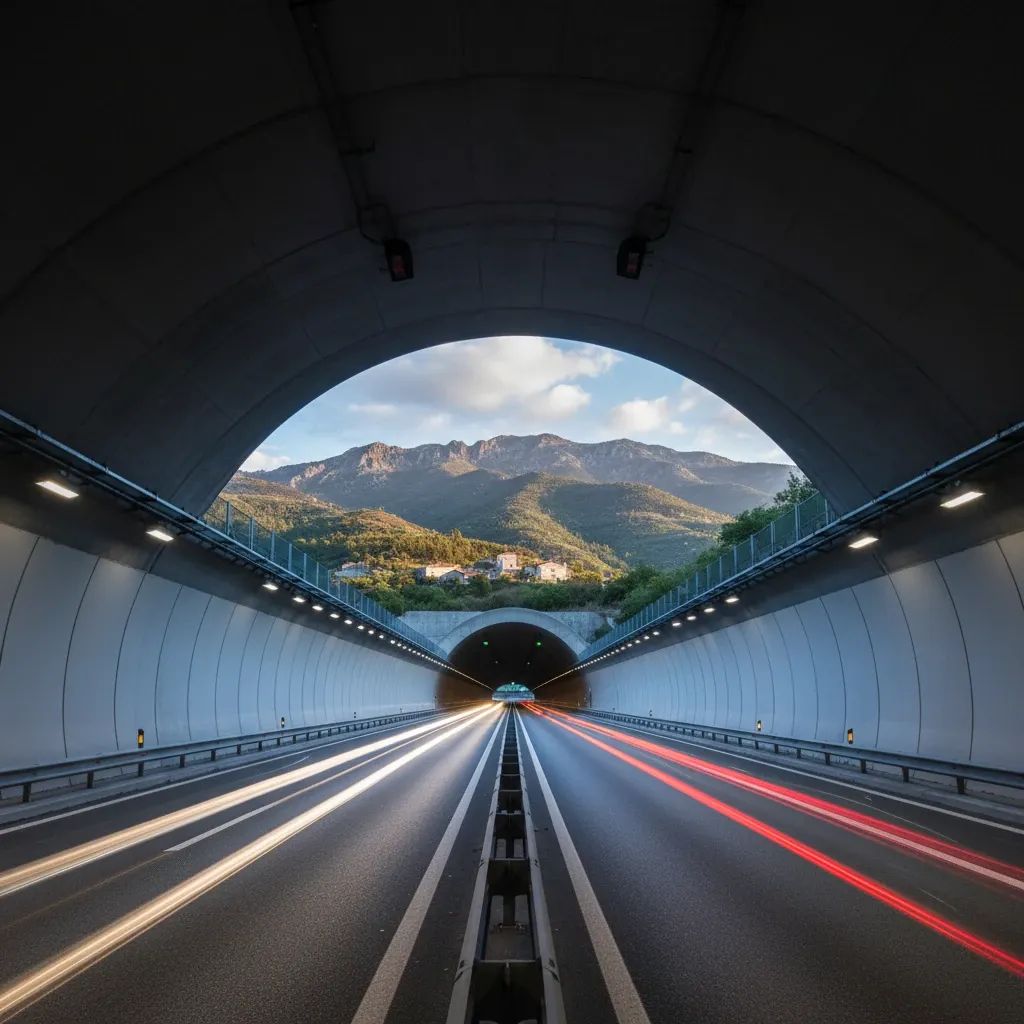
Infraestruturas de Portugal reports that the Marão Tunnel, the 5.6-kilometer engineering feat linking Porto and the northern interior, has now carried 45 million vehicles since opening 10 years ago—a milestone that reveals how critical infrastructure can reshape regional economies. With tolls abolished in January 2025, daily traffic surged past 17,000 vehicles, transforming what was once a deadly mountain pass into the preferred artery for work commutes, freight logistics, and business expansion in Trás-os-Montes.
Why This Matters
• Zero fatal accidents inside the tunnel since 2016, compared to 136 deaths on the old IP4 route over 20 years.
• Daily traffic jumped 32% from 13,312 vehicles in 2022 to 17,560 in 2025, driven partly by the toll elimination.
• Commute times slashed: Porto to Vila Real now takes roughly 1 hour instead of the previous white-knuckle mountain drive.
• Companies in Vila Real now organize shuttle buses from Porto, enabling coastal residents to work in the interior without relocating.
The Economic Lifeline for Vila Real
Alexandre Favaios, mayor of Vila Real, describes the tunnel as the infrastructure that placed his city "in the right place—precisely at the geodesic center of the entire North." That geographic advantage became tangible only when the A4 motorway section through the Serra do Marão opened on May 8, 2016, after seven years of construction, three work stoppages, and eventual state bailout. The total investment reached €398 million, with €89.9 million in European Union co-financing.
For a decade, the tunnel served as a safer, faster alternative to the notorious IP4 mountain road, infamous for its hairpin bends, fog, ice, and a grim mortality record. The old route claimed 22 lives and saw 111 injury crashes in Vila Real and Amarante alone in 2004. Government forecasts anticipated a 40% to 60% reduction in road deaths; the tunnel delivered better, recording no fatalities or serious injuries in its first decade of operation.
What the statistics don't fully capture is the tunnel's role as a job market connector. Aumovio (formerly Continental), a Portugal-based manufacturer of automotive electronics, operates a daily shuttle bus from Porto to its Vila Real plant, stopping in Campanhã, Leça do Balio, and Amarante. The journey takes 90 minutes—often shorter than the commute within Porto's metropolitan sprawl. Bruno Melo, a quality engineer who lives in Gaia, notes that he spends as much time driving from Leça do Balio to Gaia as he does traveling from Vila Real to Leça.
Colete Leite, who works in Aumovio's human resources department near Porto, says the shuttle and the tunnel make the job financially viable. "Without the transport, working in Vila Real would be difficult because of the costs," she explains. The toll removal in 2025 further sweetened the equation: drivers now save both time and money.
Recruitment and Retention: The Hidden Dividend
Miguel Pinto, a senior manager at Aumovio, started at the factory in 2014, when the tunnel was still under construction. He recalls candidates abandoning job interviews after the grueling drive on the old IP4, especially in winter when snow closures were routine. "Some people simply weren't willing to do that route on a daily basis," he says. The tunnel changed hiring dynamics entirely, making it "much safer, faster, and helpful in attracting qualified staff."
The same logic applies to research institutions. Marisa Rio, from the nonprofit Fraunhofer research center in the Regia Douro Park science campus, emphasizes that accessibility is a competitive asset. "We have highly qualified professionals who don't want to move to Vila Real, and this ease of having the tunnel and making the trip, which takes about an hour, ultimately allows them to work here and live in Porto," she notes.
Carlos Marinho, who studied at the University of Trás-os-Montes and Alto Douro (UTAD) in Vila Real and now works at Antarr, a forest management firm also based at Regia Douro Park, lives in Baião and makes the trip at least three times a week. He drove the old IP4 as a student. "The tunnel changed everything," he says. "I save so much time—I can be with my family instead of being on the road."
A Safer Spine for the Northern Interior
Infraestruturas de Portugal has equipped the tunnel with €17 million worth of safety and monitoring technology, including 126 surveillance cameras (one every 120 meters), 470 loudspeakers (one every 25 meters), 82 emergency SOS stations, and 13 pedestrian evacuation passages. Thermal cameras at the entrance detect overheating vehicles before they enter, and the ventilation system includes 72 fans designed to extract smoke in case of fire. Since 2018, a three-member fire brigade from the Cruz Branca (Vila Real) and Amarante fire departments has been stationed at the tunnel around the clock.
The tunnel's twin unidirectional galleries, each with two lanes, replaced the treacherous IP4 climb over the Serra do Marão, a route built for traffic volumes far below what it ultimately carried. Adverse weather—snow, fog, ice—routinely closed the pass and caused lengthy backups. The tunnel bypasses those hazards entirely, cutting roughly 35 minutes from the Porto–Bragança journey and diverting nearly all traffic away from the old road.
Traffic dipped to 9,590 vehicles per day in 2020 during pandemic lockdowns, but rebounded steadily. The 32% surge from 2022 to 2025 reflects both pandemic recovery and the toll abolition, which took effect on January 1, 2025. Residents and businesses interviewed uniformly cite the toll removal as a "significant advantage," lowering operating costs for freight and commuters alike.
What This Means for Residents
If you live in northern Portugal, the Marão Tunnel's decade of service has tangible implications:
• Commuting flexibility: Coastal residents can now realistically work in Vila Real or other interior towns without relocating, broadening job market choices.
• Lower logistics costs: The toll-free, time-saving route benefits anyone shipping goods between Porto and Trás-os-Montes, from wine producers to manufacturers.
• Improved healthcare access: Fábio Ribeiro, a communications professor at UTAD, highlights regular medical appointments at Porto hospitals as newly feasible. A recent campaign linking UTAD and the Portuguese Institute of Oncology (IPO) in Porto to attract young blood donors was logistically viable only because of the tunnel.
• Reduced road risk: The near-elimination of serious crashes compared to the old IP4 means safer daily travel for thousands of families.
The Missing Link: Rail
Mayor Favaios argues that the tunnel's success underscores the need for a parallel rail connection through Vila Real. In July 2024, Infraestruturas de Portugal, the Northern Regional Coordination and Development Commission (CCDR-NORTE), and the Intermunicipal Community of Terras de Trás-os-Montes (CIM-TTM) signed a collaboration agreement to study a new Porto–Vila Real–Bragança rail line, potentially extending to the Spanish border. The viability studies, budgeted from the NORTE 2030 program, are expected to run 32 months, placing preliminary findings around late 2026 or early 2027.
The project is enshrined in the National Railway Plan (Council of Ministers Resolution 77/2025), approved in April, and aligns with commitments made at the October 2024 Luso-Spanish Summit. While some Bragança stakeholders dream of high-speed rail, the 2026 phase remains analytical, with no construction timeline yet announced. Debate continues over whether the line should depart from central Porto or from a suburban junction.
Engineering and Endurance
Infraestruturas de Portugal describes the tunnel as a "milestone of national engineering," both for its technical complexity and its safety solutions. Periodic maintenance requires lane closures, but the infrastructure has proven resilient. The tunnel's twin galleries burrow through the Serra do Marão at a lower altitude than the old pass, sharply reducing ice, snow, and fog exposure—hazards that historically plagued the IP4.
The tunnel's role extends beyond personal mobility. It has become the strategic logistics spine connecting Porto's Leixões Port and Sá Carneiro Airport to the interior, facilitating freight movement and positioning Vila Real as a bridge city—"the last city of the interior or the first of the coast," as local boosters describe it. The improved accessibility is credited with attracting manufacturing, technology, and research operations to the Regia Douro Park and other industrial zones.
The Bigger Picture
The Marão Tunnel is a case study in how targeted infrastructure can reverse economic peripheralization. For decades, Trás-os-Montes lagged coastal regions in investment and employment, constrained by poor road access and high transportation costs. The tunnel, combined with toll abolition, has begun to level that disparity. Companies that once hesitated to establish operations inland now view Vila Real as a viable base, particularly for functions requiring skilled labor but not constant client-facing presence.
The €398 million price tag, spread over seven years and three work stoppages, initially drew skepticism. A decade on, with 45 million vehicles and zero tunnel fatalities, the investment appears justified. The question now is whether Portugal will replicate the model with rail, completing the multimodal transformation that local leaders believe is necessary to sustain momentum. Until then, the tunnel remains the indispensable link—quiet, efficient, and increasingly busy as more residents and businesses discover they can bridge Portugal's interior-coast divide with an hour's drive and no toll gate at the end.


