
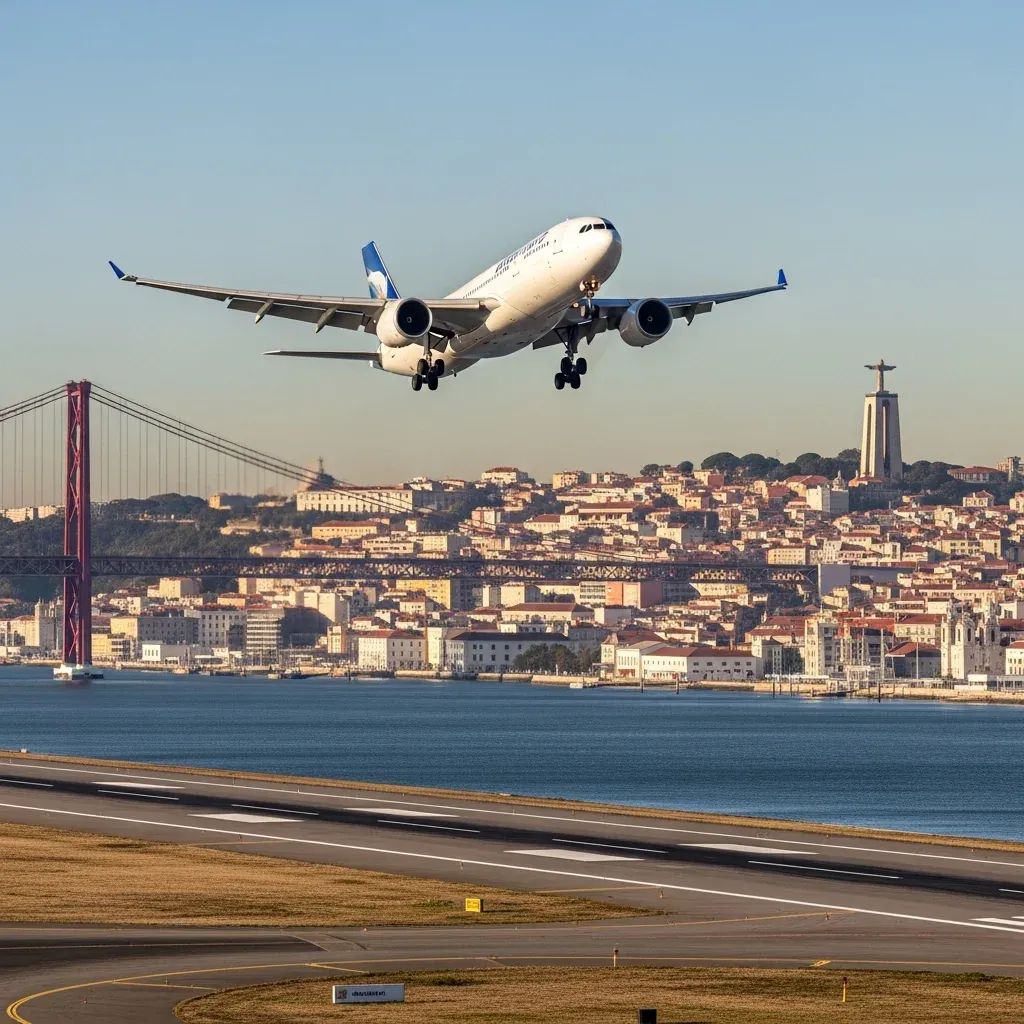
A momentary climb, an uneventful landing and a fresh reminder that Lisbon’s main airport is operating close to the edge—those were the take-aways for passengers on an Emirates service that was forced to abort its approach at the very last minute this week.
In a Nutshell
• The Emirates Boeing 777 interrupted its descent at 350 m above the Murtas district, roughly 1 km from runway 21, after the crew spotted another jet still on the tarmac.
• The manoeuvre, known as a go-around, occurred at 11:48 and ended safely with touchdown shortly after 12:00.
• Air-navigation provider NAV Portugal says such situations are planned for, yet the incident rekindles debate about Humberto Delgado Airport’s chronic congestion.
What exactly happened overhead?
Witnesses in northern Lisbon looked up to see the wide-body jet powering back into the sky rather than continuing its glide path. According to flight-tracking data reviewed by the press, the aircraft had been cleared to land when its pilots noticed that the preceding arrival had not vacated the runway. Rather than risk a compressed separation margin, the cockpit crew advanced throttles to full power, climbed to holding altitude and re-entered the landing queue. Twelve minutes later, the aircraft touched down without further drama.
A textbook manoeuvre—not a brush with disaster
A “go-around” may sound alarming, yet it is baked into every pilot’s training. As former TAP captain and safety commentator Rui Alves explains, “If the approach is not picture-perfect, you climb away and try again—no questions asked.” The move obeys strict vertical-speed and heading profiles already briefed before descent. In the Emirates case, air-traffic control also monitored the climb, ensuring safe separation from outbound traffic. NAV Portugal calls these events “studied and worked operations,” stressing that the decision can originate with either pilots or controllers.
Humberto Delgado: an airport under strain
Lisbon’s sole commercial runway handles close to 500 movements on a busy summer day, squeezing departures and arrivals into narrow slots between the city and the River Tejo. Ground delays ripple quickly: if one jet clears the tarmac late, the next aircraft may be forced into an extra circuit or, as seen on 4 January, a go-around. The partial night curfew imposed for noise reasons further compresses the timetable, leaving little slack when something goes wrong.
Are go-arounds becoming more common?
Hard data are scarce. ANAC’s annual safety digests count serious incidents nationwide but do not single out Lisbon-specific go-arounds. Still, informal tallies by local spotters suggest that 2025 saw roughly 45 aborted approaches at Humberto Delgado—about 1 every 8 days. A more dramatic sequence unfolded on 2 January 2026, when a Eurowings A319 had to climb away because a TAP A330, hampered by an engine surge, was stranded on the same runway. Experts point out that the figure itself is not worrying—major European hubs log dozens of safe go-arounds each month—but the frequency underscores the airport’s razor-thin operating margins.
What travellers should keep in mind
For passengers, a go-around typically means:
5-15 additional minutes in the air
Slightly higher fuel burn, rarely noticed on the ticket price
Possible missed ground connections if the schedule is tight
Aviation authorities advise booking longer layovers at Lisbon during peak hours (early morning and late afternoon) and keeping travel insurance current in case of knock-on delays.
Long-term fixes still circling the runway
Successive governments have floated solutions ranging from a second runway at Montijo to a brand-new airport near Alcochete, yet political stalemate has stalled concrete action. Meanwhile, NAV Portugal is redesigning airspace corridors, and ANA – Aeroportos de Portugal is tweaking stand allocation to squeeze a few extra movements per hour. Industry insiders warn, however, that “operational Band-Aids cannot replace new infrastructure.” Until then, the humble go-around will remain a routine—if noticeable—tool for keeping Lisbon’s skies safe.


