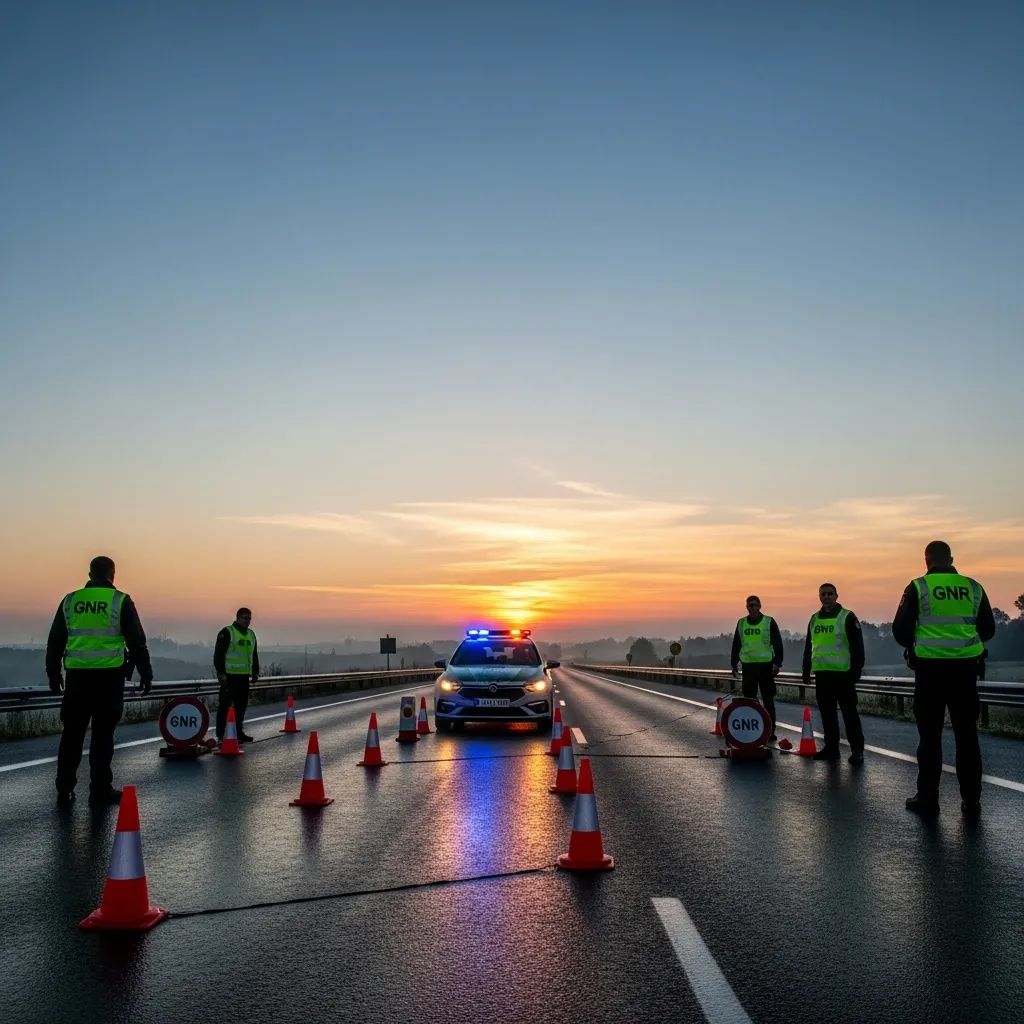
New Year’s celebrations left Portugal’s two main metropolitan areas and the Algarve ring-fenced by breath-test checkpoints that produced an unsettling headline: in just four pre-dawn hours, the National Republican Guard pulled 151 motorists off the road for crimes ranging from drink-driving to getting behind the wheel without a licence. Below is why the operation matters, how it stacks up against earlier holiday seasons and what road-safety specialists think should change next.
Quick Glance – What Stood Out
• 135 drivers registered a blood-alcohol level above 1.2 g/l – the threshold for criminal prosecution.
• 16 arrests stemmed from “driving without papers”.
• Nearly 9 000 vehicles were flagged down between 01.00 and 05.00.
• One motorist on the A2 attempted to evade officers by turning around and driving against the flow of traffic.
A Night of Hard Numbers
After fireworks faded over Lisbon’s 25 de Abril Bridge, Porto’s Ribeira and the Algarve’s bar-lined coast, GNR teams massed on arterial roads such as the A1, A2 and EN 125. In total, they stopped 8 962 drivers, issuing 465 citations for lower-level alcohol offences and compiling a handful of other infractions: a single fine for óxido nitroso possession, two drug-use notices and one drug-trafficking case involving 26 doses of hashish.While these figures feel large, officers highlight the bigger picture: the festive campaign, branded “Operação Natal e Ano Novo 2025/2026”, had already seen 63 904 breath tests since 27 December, resulting in 806 positive readings and 485 arrests.
Why the Holiday Crackdown Keeps Expanding
Portuguese road-safety data show December and the first week of January consistently rank among the most dangerous periods of the year. The combination of family travel, late-night parties and rural roads lacking public transport options creates a perfect storm for alcohol-related crashes.GNR commanders say the highly visible checkpoints are designed for deterrence as much as for enforcement. “People talk; knowing we’re everywhere pushes many to hand their keys to a sober friend,” one operational officer told Rádio Renascença. Research from the National Road Safety Authority backs that view, linking targeted holiday blitzes to a gradual decline in fatal collisions since 2017.
How 2025/26 Compares with Earlier Campaigns
A look at past operations suggests progress is lumpy rather than linear:
• 2022/23 (29 Dec – 2 Jan): 328 arrests for drink-driving or no licence.
• 2023/24 (15 Dec – 2 Jan): 1 492 arrests across a longer window, as GNR widened its net to smaller district roads.
• 2024/25 saw roughly 783 arrests (official total varies because of overlapping reporting periods).
• Current season so far: 485 arrests before the final tally is published.Experts warn that raw numbers alone can mislead. “Each year the methodology shifts—more patrol hours, better breathalysers—so the way to judge effectiveness is accident severity, not arrests,” argues Duarte Pires, a transport-safety lecturer at the University of Coimbra.
Voices from the Road
• Auto-school owner, Porto: “Courses now dedicate extra hours to the legal consequences of a 1.2 g/l reading, yet many young drivers still think the risk is worth it after two or three drinks.”• Ride-sharing driver, Faro: “Tourists landing at midnight expect lifts; some colleagues refuse the graveyard shift because checkpoints slow trips, but I welcome them—fewer drunk private drivers mean safer fares.”• Hospital emergency doctor, Lisbon: “Between midnight and 06.00 we brace for crash victims. When early-morning X-ray rooms stay quiet, we usually discover GNR had a major operation that night.”
What’s Next – Policy Ideas on the Table
Lower the criminal threshold from 1.2 g/l to 0.8 g/l, aligning Portugal with stricter EU peers.
Expand mobile testing vans into less-patrolled interior districts where holiday village parties are common.
Introduce a graduated penalty scale that links fines to income, a model Finland employs to hit habitual offenders harder.
Incentivise ride-hailing and regional rail with New Year transit vouchers, mirroring schemes tested in Germany and Denmark.
Continue public-health messaging that frames sober driving as a civic duty, not merely a legal requirement.
Bottom Line for Portuguese Drivers
The New Year blitz underscores a familiar lesson: alcohol and the ignition key remain a dangerous mix. With final statistics for the 2025/26 festive period due later this month, authorities will measure success less by arrest totals and more by how many families avoided tragic phone calls in the early hours of 1 January. Until then, GNR patrols will stay visible—and the breathalyser, for many, could be the first interaction of the year.