
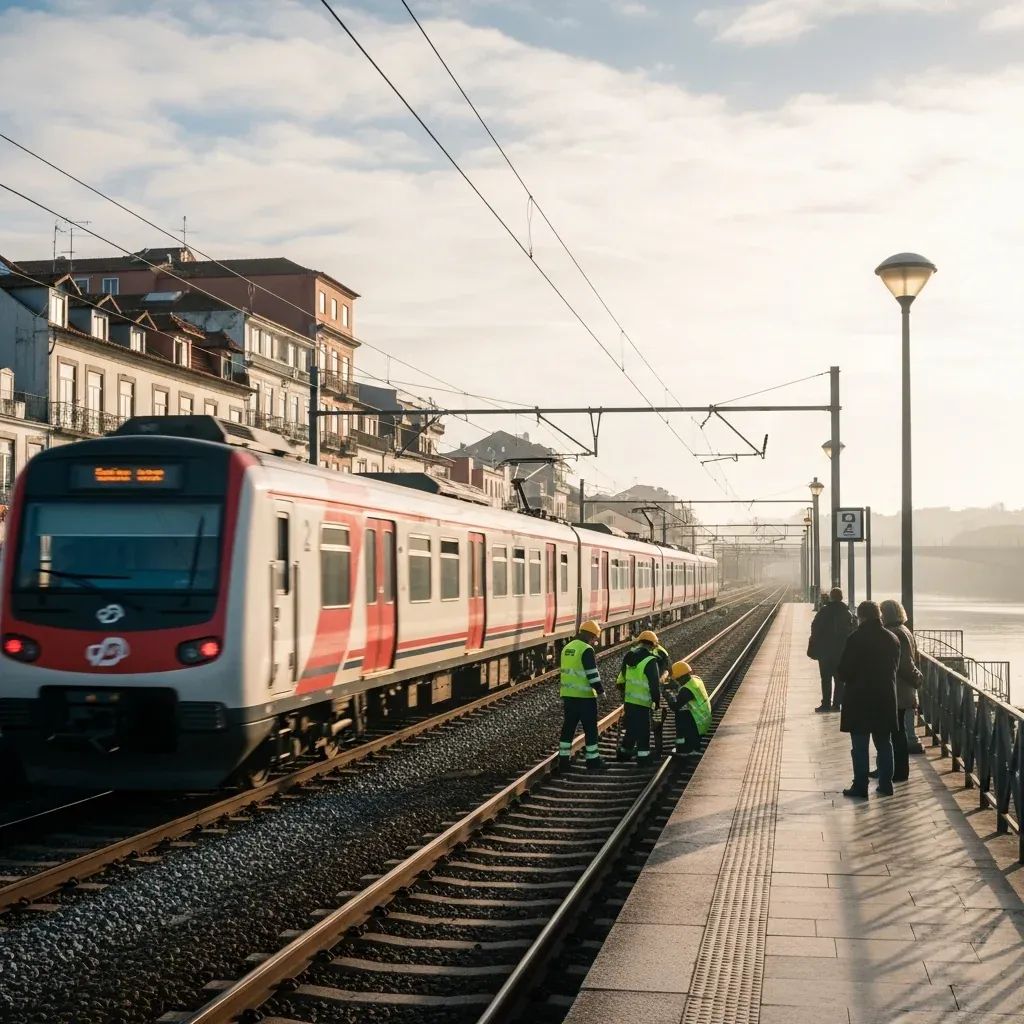
Commuters on the south bank of the Tagus may have thought the post-holiday rush could not get worse—until a broken rail between Sete Rios and Roma-Areeiro on Tuesday snarled the only private rail link into Lisbon. Although traffic is again moving, residual speed restrictions and memories of a New Year’s strike have left regulars wondering how resilient the network really is.
Quick view — what you need to know
• Cause: a snapped carril identified early 6 January between Entrecampos and Sete Rios.
• Impact: total suspension on that 3 km stretch; Fertagus trains ran only Setúbal–Campolide, generating crowding and delays.
• Partial fix: single-track operation resumed at 12:05; full double-track service at 16:15, but at reduced speed.
• Status now: normal two-way running reinstated on 7 January, yet a 30 km/h cap still applies between Sete Rios and Entrecampos.
• Alternatives: Metro Green Line at Roma or Areeiro, CP services on the Azambuja and Sintra corridors; no substitute buses were provided.
Why one broken rail halted an entire corridor
The faulty component lay on the North–South axis that funnels every Fertagus train into Lisbon’s central stations. Because both tracks are normally used at near-metro frequencies during the morning peak, the sudden closure of one line forced the operator to cut the timetable in half, prioritising safety over capacity. Infraestruturas de Portugal crews had to remove the damaged steel section, verify sub-soil conditions and weld a replacement—an operation that cannot be rushed without risking further cracks.
A familiar sense of déjà-vu for passengers
For thousands commuting from Setúbal, Palmela and the densely populated Seixal corridor, Tuesday’s fault felt like more of the same. Only five days earlier, a national signalling-and-maintenance strike reduced Fertagus to 25% of its regular offer. Social-media feeds quickly filled with photos of crowded platforms in Corroios and sarcastic memes demanding a refund on monthly passes. Although no major altercations were reported, several passengers told local radio they lost "an entire morning of billable hours" or missed medical appointments.
Gradual recovery—but not yet at full speed
Track workers reopened one rail at lunchtime, creating a rolling bottleneck: every northbound and southbound train had to share a single line and wait for clearance at Campolide. By late afternoon both rails were back, yet Infraestruturas ordered a temporary 30 km/h ceiling while ultrasonic inspections scanned for micro-fractures along 600 m of track. Fertagus warns that "isolated delays" may persist during dense periods until the restriction is lifted, possibly early next week.
A tense start to 2024 for rail operations
January traditionally sees heavy maintenance after holiday slowdowns, but two severe disruptions within one week sharpened calls for a long-term renewal plan on Lisbon’s suburban arteries. Industry analysts note that several rails on the North–South corridor date from the mid-90s, when Fertagus prepared for the 25 April Bridge service. The company leases the path from the state infrastructure manager, which remains responsible for the physical track. That split ownership often leads to finger-pointing: Fertagus apologised on its app yet reminded users that "the anomaly did not occur on material under our control."
Getting around when the trains stall
Metro stations Roma and Areeiro sit a short walk from Fertagus platforms, offering quick access to Alameda and downtown. CP’s Azambuja line can also serve as a back-up for travellers heading to Oriente or Rossio. However, the absence of official replacement buses underscores a systemic weakness: unlike the UK or Germany, Portuguese law does not oblige rail operators to supply road transport during unplanned stoppages, leaving commuters to improvise with ride-sharing apps or private coaches.
The bigger picture for south-bank commuters
The Tagus crossing has long been a barometer of Greater Lisbon’s mobility health. With housing still cheaper in Setúbal district than in the capital, daily passenger numbers on Fertagus surpassed 85,000 last autumn, near pre-pandemic highs. Urban planners warn that without fresh rolling stock and modernised track, even minor glitches can spiral into system-wide gridlock—just as Tuesday’s episode demonstrated.
Bottom line: the trains are running again, but the episode highlights the fragility of an artery that thousands in Portugal rely on to keep their livelihoods moving. Until deeper structural investments arrive, commuters would be wise to keep a plan B—and a generous buffer—baked into their morning routines.


