
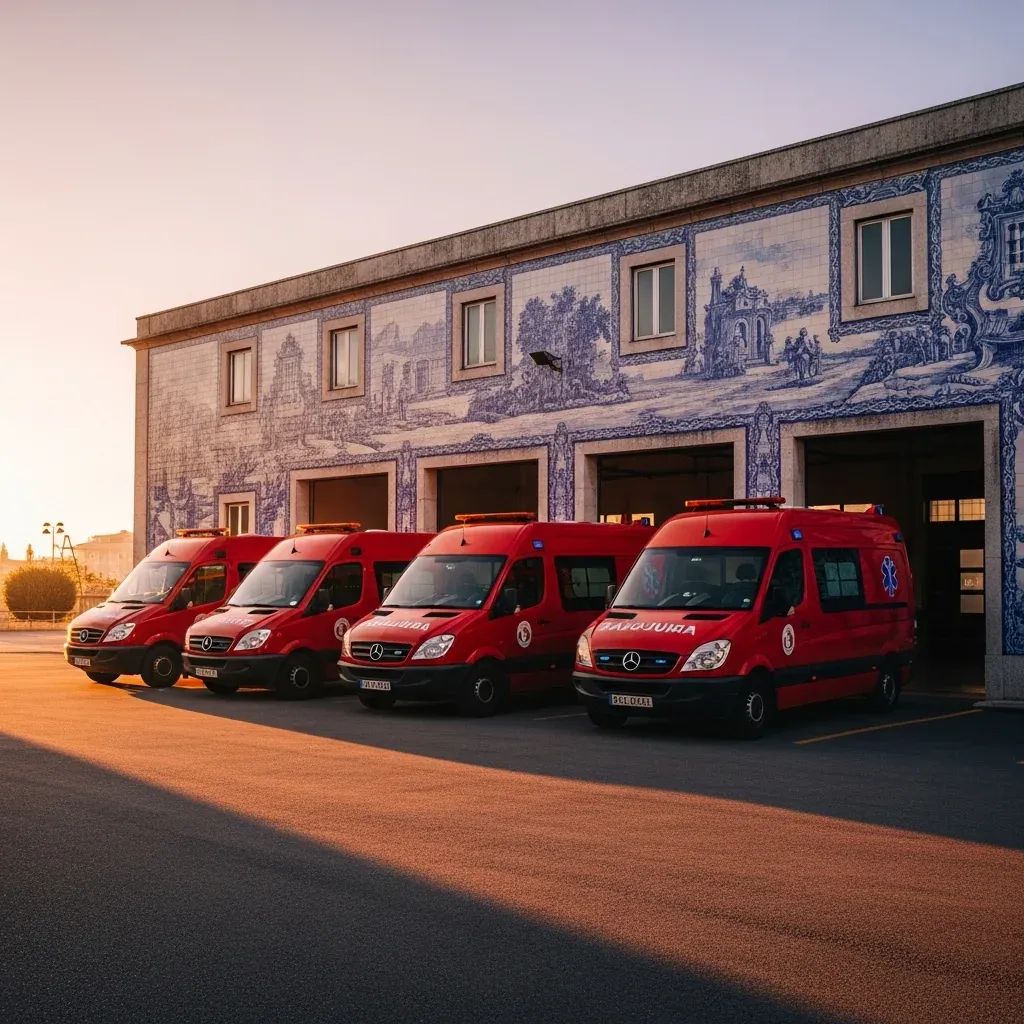
Four ambulances, two government agencies and a string of preventable deaths have turned Portugal’s emergency-medical system into an unlikely political battlefield. At the centre sits the Liga dos Bombeiros Portugueses (LBP), accused of running a parallel fleet even as it insists it is only plugging life-threatening gaps.
What just happened? Key take-aways
• LBP assembled an ad-hoc ‘task-force’ of four extra ambulances after several fatal delays in early January.
• Civil Protection (ANEPC) opened an investigation, calling the move illegal and “marginal”.
• Firefighters reject the charge, arguing that every minute saved is worth the risk.
• INEM and LBP struck a separate deal on 8 January to convert seasonal ambulance contracts into permanent ones, starting on the south bank of the Tagus.
• Government approved €16.8 M for 275 new vehicles, but they will not roll out before summer.
A week Portugal would rather forget
Three high-profile deaths—one in Seixal, another in Almada, a third in Amadora—put a harsh spotlight on the 70-plus ambulances that remain stuck daily in hospital corridors waiting for stretchers. Families shared time-stamped phone logs: calls placed, operators alerted, units dispatched far too late. Within 24 hours social media filled with the hashtag #OndeEstáaAmbulância, forcing officials to admit that Lisbon’s Integrated Medical Emergency System (SIEM) was buckling.
Firefighters take matters into their own hands
Instead of waiting for bureaucracy to unveil a fix, the Liga dos Bombeiros rallied four corps from Setúbal and Santarém. Vans were parked at the LBP headquarters in Belém, radios tuned to the national channel, crews on voluntary overtime. President António Nunes insists the League merely “opened the door” so that ready-to-roll ambulances could stage closer to hotspots. “We organised nothing clandestine,” he told reporters, pointing out that INEM dispatchers actually called the units several times during the weekend surge.
Civil Protection cries foul
The Autoridade Nacional de Emergência e Proteção Civil counters that the pop-up operation violates the 2014 Patient Transport Regulation, chiefly because it was coordinated by a commander on the ‘quadro de honra’—a retired honour roll where operational command is forbidden. Officials say they discovered the convoy on Facebook, not through formal channels, and label it a “system outside the chain of command.” An inquiry now seeks to determine whether disciplinary measures—or even fines—are warranted.
Anatomy of an ambulance shortage
Portugal’s emergency fleet shows its age: nearly half the vehicles exceed 10 years, some topping 1 million kilometres. Personnel shortages keep VMER units idle for 9 172 hours a year, while retained ambulances in A&E bays create a domino effect that stretches response times to the suburbs and rural rings. The €16.8 M procurement package announced this month covers 163 ambulances, 34 VMERs and 78 support vans, but chassis conversion, radio installation and certification mean most will hit the road only by late June.
A rare moment of consensus
Even as ANEPC drafts its report, INEM quietly signed a memo with the firefighters on 8 January. Seasonal reinforcement contracts—once limited to summer fires—become year-round, starting with Margem Sul, where call volumes soared 15 % in 2025. The deal also obliges INEM to settle a backlog of 150 ambulance replacements it owes the fire brigades, a point long cited by local commanders as proof of systemic neglect.
How the dispatch pipeline really works
Emergencies dial 112; calls transfer to CODU, INEM’s clinical nerve centre.
A new triage matrix (Priority 1–4) assigns ideal arrival windows—from 8 minutes to an hour.
CODU triggers the nearest accredited Posto de Emergência Médica (PEM); non-accredited units cannot be legally tapped.
Once at hospital, crews must wait for an available stretcher before returning to service—a bottleneck critics call the “maca trap.”
Why this matters to your neighbourhood
• Longer waits: every ambulance detained in Amadora-Sintra leaves fewer resources for Mafra or Cascais.• Rising local taxes: municipalities shoulder extra overtime when state ambulances are grounded.• Volunteer fatigue: firefighters already cover 95 % of pre-hospital care; morale dips as legal clouds hover.• Reform window: with elections nine months away, any fix must land quickly to avoid becoming campaign ammo.
The road ahead
ANEPC’s inquiry results are due within 30 days. If it confirms illegality, penalties could include suspension of LBP commanders or even removal of radio licences. Meanwhile, hospital directors promise 30 additional stretcher bays in Lisbon’s over-pressed urgências by March. Whether these measures arrive before the next tragic delay will test Portugal’s ability to turn a crisis into lasting systemic change.


