

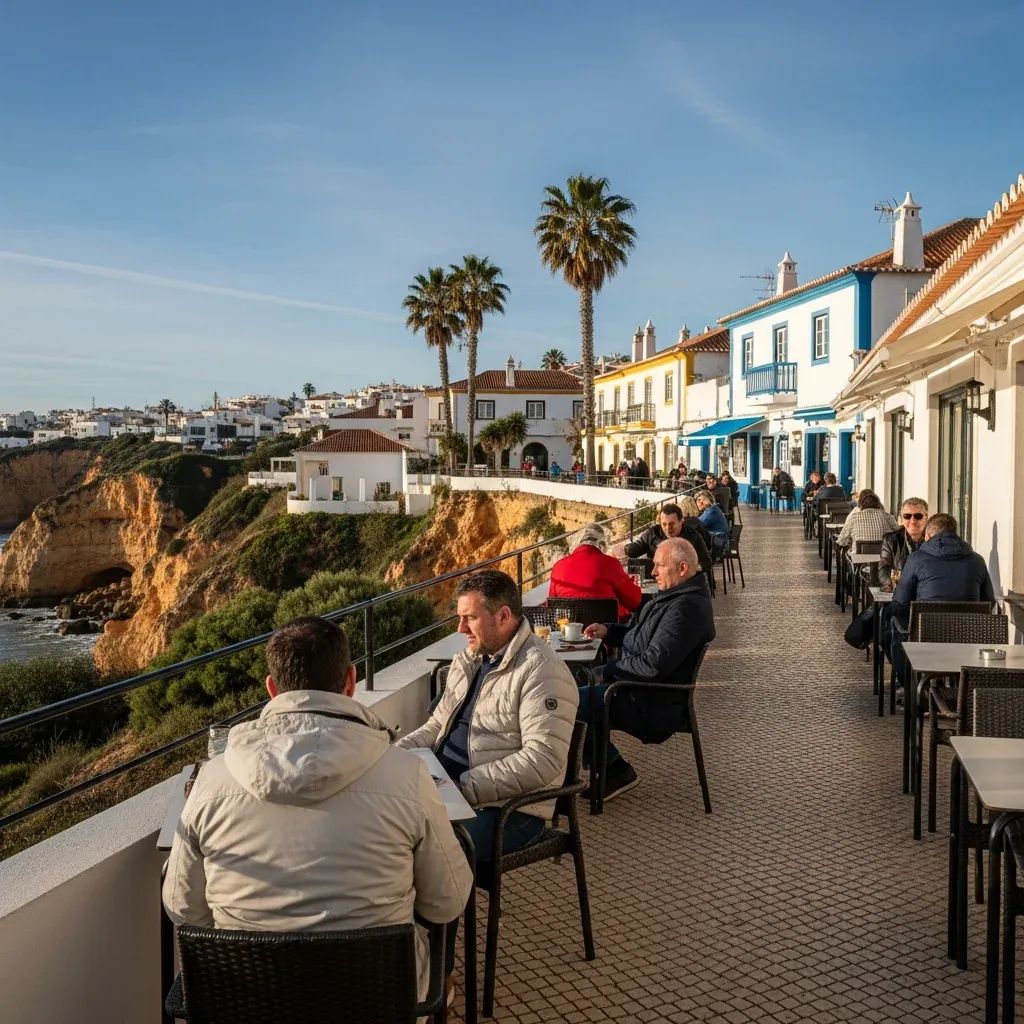
Europe may be wrapped in layers of snow this week, yet south-bound trains from Lisbon still reach Faro to discover cafés serving espresso al fresco. That contrast—the continent in deep-freeze while the Algarve keeps its mild glow—lies at the heart of this winter’s weather story.
Quick glance for the curious
• Flights diverted from Vienna and Prague due to ice-slick runways
• -30 °C possible in parts of Poland before January ends
• Algarve afternoons hovering near 16 °C, even after dawn frost
• Sudden Stratospheric Warming blamed for the chill across Europe
• IPMA models hint at one colder Algarve week in early February
• La Niña phase and eastern QBO emerge as hidden drivers
• Expect more rain than usual over mainland Portugal through mid-February
A polar gate swings open
Meteorologists from ECMWF to the IPMA agree that an unusually energetic Sudden Stratospheric Warming cracked open the polar vortex in late December. Once that swirling moat of super-cold air weakened, Arctic masses cascaded toward Europe. A feeble La Niña, an east-phase Quasi-Biennial Oscillation, and above-average Siberian snow cover all pumped extra energy skyward, buckling the vortex and steering Rossby waves toward the pole. The result: a transport belt carrying -20 °C air from northwest Russia straight into Central Europe.
Transport networks buckle before breakfast
The first full week of January saw 2,200 flight cancellations across the continent. Bratislava International closed entirely for 18 hours; Budapest Ferenc Liszt restricted operations to a single de-iced runway. In France and Germany, more than 700 km of motorway faced speed reductions or closures as black ice accumulated. Polish rail operator PKP Intercity reported 15 % of services delayed, while schools in Lower Saxony moved 250,000 pupils to remote learning. Insurance federations estimate that road-traffic claims doubled compared with the same period last year.
Algarve: familiar sun, unfamiliar shiver at dawn
Residents from Lagos to Tavira woke on 6 January to a rare sight: cars dusted with white frost. Official sensors logged -1.1 °C at Aljezur and -0.9 °C near Loulé—still a far cry from central Europe’s deep freeze but enough to remind locals that winter exists. By lunchtime, however, thermometers bounced to 15-18 °C under clear skies, letting golfers, hikers and café-goers shed their jackets. Sea-surface temperatures near Portimão remain a relatively balmy 16 °C, sustaining the region’s year-round surfing and dolphin-watch tours.
The outlook: a wrinkle for early February
Short-range charts from IPMA show the coming week staying on the mild side, with Faro highs of 15 °C and lows near 8 °C. The agency’s four-week outlook, however, flags the period from 2-8 February as the Algarve’s lone spell of below-normal averages. Even then, departures from the mean amount to only 0.5-1.5 °C. Rain is the bigger storyline: precipitation totals are projected to run above the 30-year norm across Portugal, potentially filling reservoirs that stood at just 63 % capacity at the end of 2025.
Are these shock winters becoming routine?
Climatologists caution against linking any single outbreak to climate change, yet the growing frequency of polar-vortex disruptions is being watched closely. Studies published by the Finnish Meteorological Institute and Columbia University suggest the Arctic is warming four times faster than the global average, altering jet-stream stability. That can produce sharper swings—milder Iberian winters interrupted by brief Arctic dives. January 2026’s cold snap appears to fit that pattern, serving as a rehearsal for winters in a warming world.
What travellers and expats should plan for
Check rail notices: German and Polish operators update snow timetables daily; delays ripple into France and Spain.
Book flexible fares: airlines flying into northern hubs now encourage date changes without penalty.
Pack layers: a morning hoodie in Vilamoura might feel redundant by noon but is welcome at sunrise.
Watch local alerts: IPMA’s app now pushes frost warnings specific to Algarve valleys.
Mind coastal swells: January’s early Atlantic storm produced 4-5 m breakers—a reminder that mild air can still ride wild seas.
Big picture for Portugal
For mainland residents, the story is less about record lows and more about up-and-down variability. While most of Europe stocks up on grit salt and heating oil, Portuguese households face a different challenge: juggling episodic rainbands and the occasional frost pocket. Barring an unexpected second stratospheric shake-up, the Algarve looks set to keep its reputation as the warmest winter corner of continental Europe—perfect, perhaps, for a January tee-time while the rest of the continent digs itself out of the snow.


