

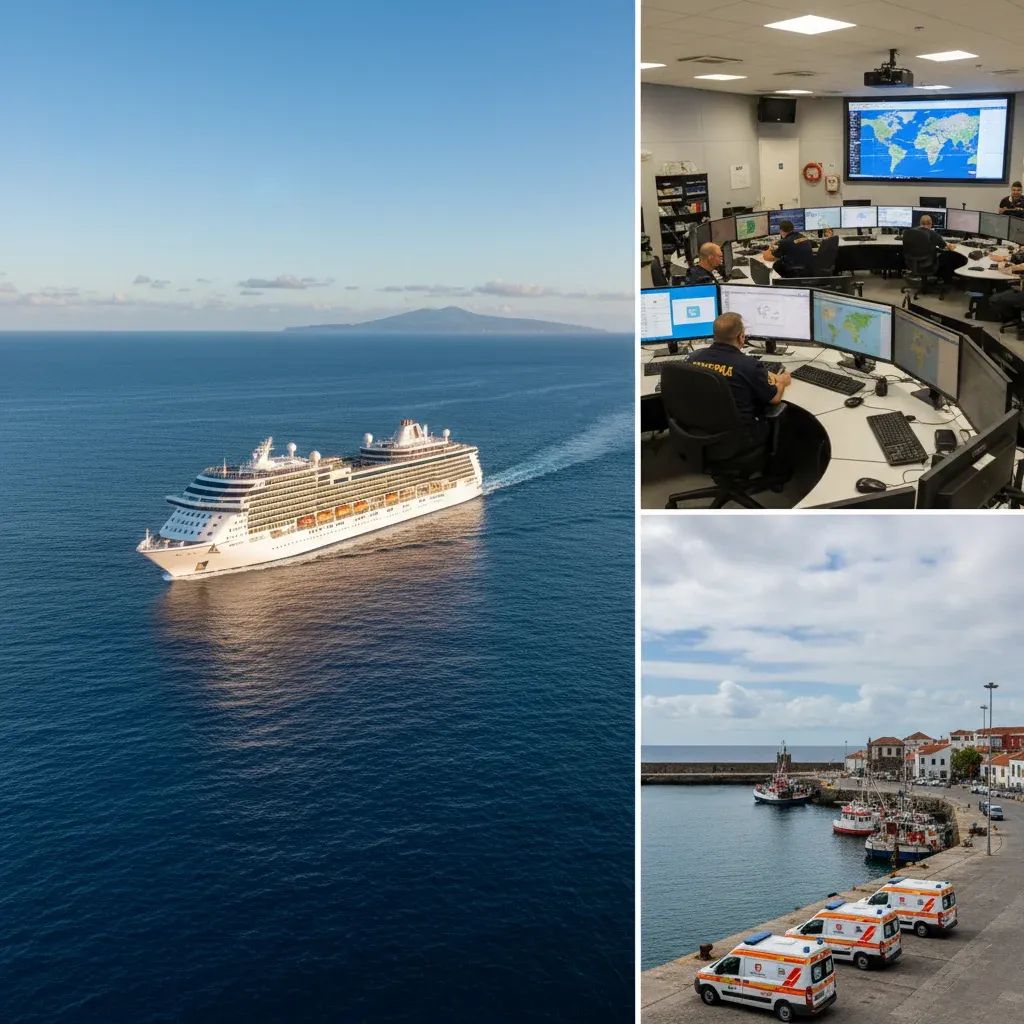
The Portuguese Navy has coordinated a complex medical evacuation operation involving a 76-year-old American passenger who suffered a severe tracheal injury aboard the MSC Meraviglia cruise ship, approximately 1,185 kilometers west of the Azores archipelago. The woman was successfully transferred to a hospital in Ponta Delgada after the Malta-flagged vessel diverted from its route in the early hours of Saturday morning.
Why This Matters
• Multi-agency response: The operation involved coordination between five Portuguese agencies, showcasing the maritime emergency infrastructure protecting waters around the Azores
• Critical timeline: The cruise ship traveled nearly nine hours to port after the Friday evening alert, while the patient remained under mechanical ventilation
• Rising rescue pattern: This marks the 4th maritime medical rescue coordinated by the Navy in the Azores region in April alone
Coordinated Emergency Response in Open Atlantic
The distress call reached authorities at 6:05 PM local Azores time on Friday (7:05 PM in Lisbon), when the MSC Meraviglia reported a passenger in critical condition. According to the Portuguese Navy's official statement, the elderly woman had sustained what medical personnel suspected was a tracheal lesion following an onboard fall, and required mechanical ventilation to sustain breathing.
The Maritime Search and Rescue Coordination Center of Ponta Delgada (MRCC Delgada) immediately initiated protocols, working in tandem with CODU-MAR, Portugal's specialized maritime urgent patient orientation center operated by the National Institute of Medical Emergency. Given the severity of the injury and the distance from land—the vessel was navigating 640 nautical miles offshore—authorities determined that diverting the entire cruise ship represented the safest option rather than attempting a mid-ocean helicopter evacuation.
The MSC Meraviglia altered course toward São Miguel island, docking at Ponta Delgada port at 3:00 AM Saturday. Medical teams were waiting portside to facilitate the immediate transfer of the patient to a local hospital facility. Her current medical status has not been disclosed by health authorities.
Multi-Agency Maritime Safety Network
The rescue operation demonstrated the layered emergency response system that Portugal maintains across its mid-Atlantic territory. Five distinct organizations collaborated on the evacuation:
The MRCC Delgada served as mission command, directing vessel movements and coordinating communications. CODU-MAR provided real-time medical consultation to the ship's onboard medical staff during the nine-hour transit. The Portuguese Air Force, through its Lajes Air Search and Rescue Center (RCC Lajes) on Terceira island, stood ready for aerial intervention if the patient's condition deteriorated beyond the ship's capacity to manage.
Ground-side preparation fell to the Ponta Delgada Port Authority, which managed harbor logistics and expedited the cruise ship's emergency docking clearance. The Regional Civil Protection and Fire Service of the Azores (SRPCBA) coordinated ambulance transport and hospital readiness protocols.
This integrated approach reflects the regulatory framework governing passenger vessels in Portuguese waters, particularly those transiting the isolated Azores archipelago, where hospitals are scarce and distances vast.
What This Means for Cruise Passengers and Azores Residents
Portugal's maritime rescue infrastructure has proven increasingly active this month. Before this incident, the Navy coordinated three separate medical evacuations in the Azores during April:
On April 17, rescuers assisted a solo sailor whose yacht suffered mast damage in rough seas near São Miguel. Just five days later, on April 22, MRCC Delgada managed two simultaneous operations—one involving a 69-year-old German cruise passenger showing stroke symptoms, and another extracting a 60-year-old Ukrainian merchant seaman experiencing heart attack indicators.
The frequency underscores the critical role Ponta Delgada plays as the primary emergency medical hub for hundreds of miles of open ocean. For cruise passengers transiting this corridor, understanding onboard medical protocols becomes essential: ships operating under the Cruise Lines International Association (CLIA) standards must maintain at least one licensed medical professional available around the clock, plus two medical rooms—one equipped for intensive care scenarios.
Portugal's maritime emergency regulations, codified in Decree-Law 93/2020, transpose European Union directives that mandate compliance with the 1974 SOLAS Convention (Safety of Life at Sea) for all passenger vessels. Ships face regular inspections by Portugal's Directorate-General for Natural Resources, Marine Safety and Services (DGRM), which conducts Port State Control checks to verify adherence to both national and international safety standards.
Medical Capacity Aboard Modern Cruise Ships
The MSC Meraviglia, like all major cruise vessels operating in European waters, maintains medical centers designed to function as floating urgent care facilities. According to MSC Cruises' published protocols, these centers meet or exceed guidelines established by the American College of Emergency Physicians, staffed by doctors and nurses trained specifically in emergency medicine.
However, the infrastructure has clear limits. Tracheal injuries, particularly those requiring sustained mechanical ventilation, exceed the capacity of shipboard facilities and demand specialized pulmonary or trauma care available only in land-based hospitals. The most common shipboard medical emergencies—respiratory distress, cardiac events including heart attacks and heart failure, and gastrointestinal issues—can often be stabilized at sea, but critical trauma cases necessitate immediate evacuation.
Passengers are strongly advised to carry comprehensive travel insurance covering medical evacuation, since costs for emergency diversions and ambulance transport can reach tens of thousands of euros. MSC and other operators require travelers with pre-existing conditions, mobility devices, dialysis needs, or pregnancies beyond 23 weeks to submit medical clearance forms at least 30 days before departure (14 days for pregnancy notifications).
Geographic Challenge of Mid-Atlantic Rescues
The 1,185-kilometer distance from the incident site to Ponta Delgada illustrates the unique challenge of providing emergency services in the Azores operational zone. The archipelago sits isolated in the North Atlantic, roughly one-third of the way between mainland Portugal and North America. For vessels in distress west of São Miguel, Ponta Delgada represents the nearest substantial medical facility, though it requires hours of navigation even at cruise ship speeds.
The CODU-MAR service, operating 24/7 from mainland Portugal, provides telemedicine consultation to vessels throughout Portuguese search-and-rescue zones, extending medical expertise across thousands of square kilometers of ocean. This system proved vital during the Friday night emergency, allowing shipboard physicians to receive specialist guidance while managing a patient on mechanical ventilation during a prolonged sea transit.
Residents and maritime professionals in the Azores have grown accustomed to the rhythm of these emergency operations, which form part of Portugal's broader commitment to maintaining safety across its extensive maritime jurisdiction—the 3rd largest exclusive economic zone in Europe. The coordination involved in Saturday's successful rescue reflects years of protocol development and inter-agency training designed specifically for the operational realities of mid-ocean emergency response.
The American passenger's evacuation adds to a growing dataset that maritime safety analysts use to refine emergency protocols, though her ultimate medical outcome remains undisclosed as of Sunday morning.


