
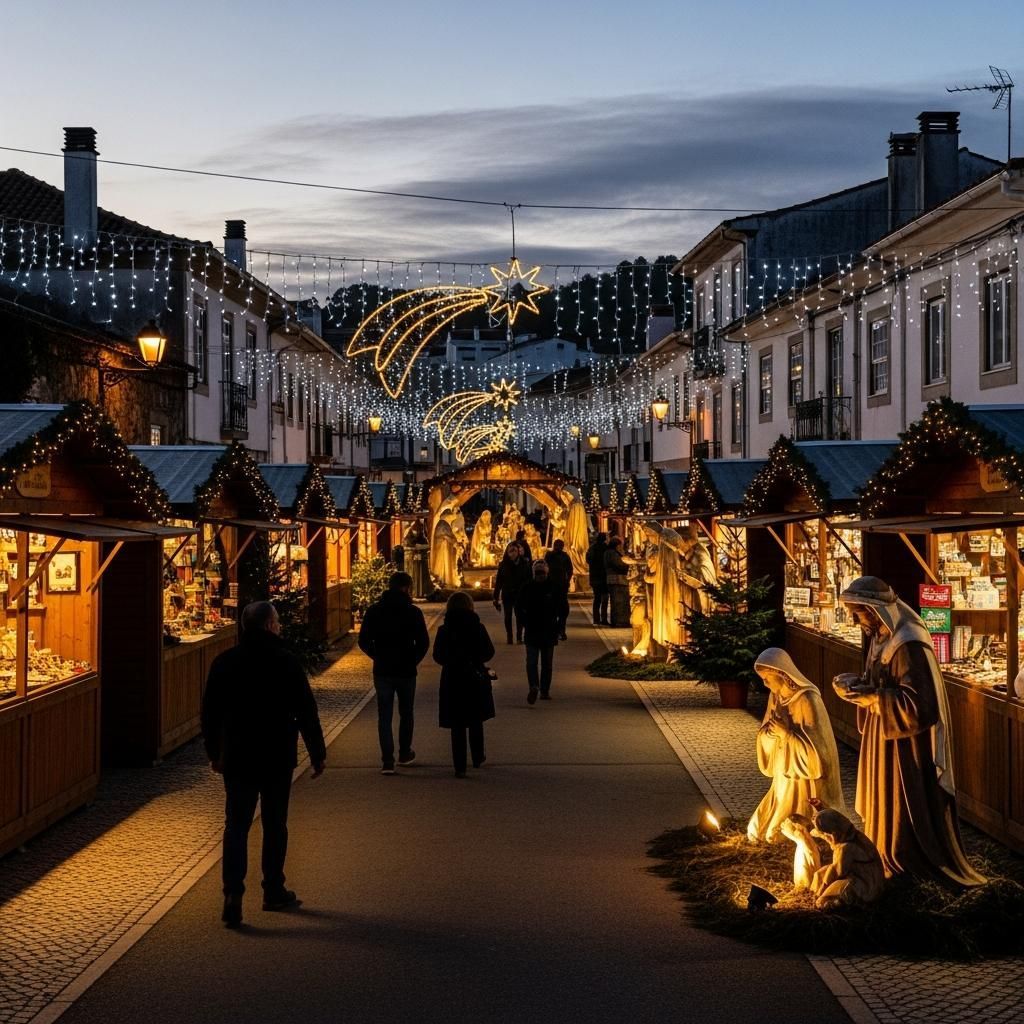
A brisk breeze off the Atlantic, the scent of roasted chestnuts and the promise of live music are about to announce that the Algarve’s holiday season has officially begun. Before December settles in, one of the region’s most beloved markets unfurls its stalls, its Presépio de Rua and its Santa-led parade, setting the tone for a month-long celebration that will ripple across southern Portugal.
Guia turns on the holiday lights
The Guia Christmas Market, now in its latest edition, opens its wooden gates at 14:00, instantly filling the narrow lanes between the Parish Church and the Chapel of Our Lady of Guia with street performers, drummers, fire dancers, stilt-walkers, local choirs, hand-painted ornaments and the unmistakable jingle that precedes the 15:00 appearance of Santa Claus. Admission remains free, a point of pride for organisers who want every family—from Albufeira or beyond—to feel welcome. Although the market runs only on 29 and 30 November, it anchors an entire programme branded “Christmas Guide 2025,” which wraps entertainment, faith and commerce into one weekend.
Beyond carols and confetti: what’s new across the Algarve
Several neighbouring towns have quietly upgraded their own festivities. Vale do Lobo adds a fifteenth-anniversary edition with a food court curated by Algarve Fine Food, and the city of Loulé reimagines its Feira da Serra de Natal inside an old carnival warehouse, highlighting honey from the Caldeirão hills, medronho liqueur and other mountain delicacies. Meanwhile, Lagos transforms its waterfront into “Lagos, Baía do Natal,” complete with a sledding ramp, a mini Ferris wheel, a craft atelier and daily story-telling sessions. Shopping centres are also joining the race: Forum Algarve welcomes Father Christmas by sleigh as early as 8 November, while MAR Shopping turns its atrium into an indoor snow village that shoots artificial flakes every weekend at five o’clock.
An open-air nativity that stretches three hundred metres
What truly distinguishes Guia, though, is sculptor Toin Adams’s Presépio de Rua. Her thirty larger-than-life figures—from the Annunciation to the Three Kings—line a 300-metre route, inviting visitors to walk the biblical narrative rather than passively observe it. The installation stays in place until 6 January, allowing residents to return long after the market stalls are packed away. Adams, a British artist who settled in the Algarve more than a decade ago, rarely discloses the materials she works with, but passers-by easily spot the mixture of recycled metals, painted wood, stone accents, LED highlights and subtler textile details that light up after dusk.
Why artisans keep coming back
For vendors such as ceramist Ana Brito or honey producer José Cavaco, the Guia weekend is worth the logistical headache. They tap into an audience that last year turned the Algarve into Portugal’s most visited region, drawing 5.2 million tourists and generating €1.7 billion in revenue. While no official tally isolates Christmas markets, stallholders report that high-spending Portuguese emigrants returning for the holidays often snap up hand-thrown pottery, locally distilled gin, fig-and-almond cakes, woven palm baskets, custom leather journals, cork toys, aromatic candles and other items that rarely reach mainstream retail shelves.
Getting there, staying late
Guia sits barely eight minutes by car from the A22 motorway and just over thirty from Faro Airport, making a day trip feasible even for travellers landing early afternoon. Public buses on route 7 Albufeira-Ferreiras-Guia will run until 22:30 during the market, and extra parking zones have been sign-posted near the municipal football pitch. Organisers advise wearing layers: daytime temperatures hover around 18 °C, but sea fog can roll in after sunset, dropping the mercury abruptly. Cash is still king at many stalls, though more vendors than ever have adopted MB Way or contactless terminals.
A wider purpose behind the glitter
Local officials see these events as more than postcard moments. By clustering several markets within a fortnight, they aim to lengthen the tourism window, counteract seasonal unemployment and funnel spending toward small-scale producers, youth associations, volunteer fire brigades, choral societies and other community groups. In Guia’s case, proceeds from food sales support upgrades to the century-old parish hall, while donations collected along the Presépio route help finance next summer’s folk-dance festival. For visitors, that civic backstory may be invisible, but every roasted almond or cup of hot chocolate carries a little of the region’s wager: that Christmas cheer can last well beyond the twinkle of December lights.


