

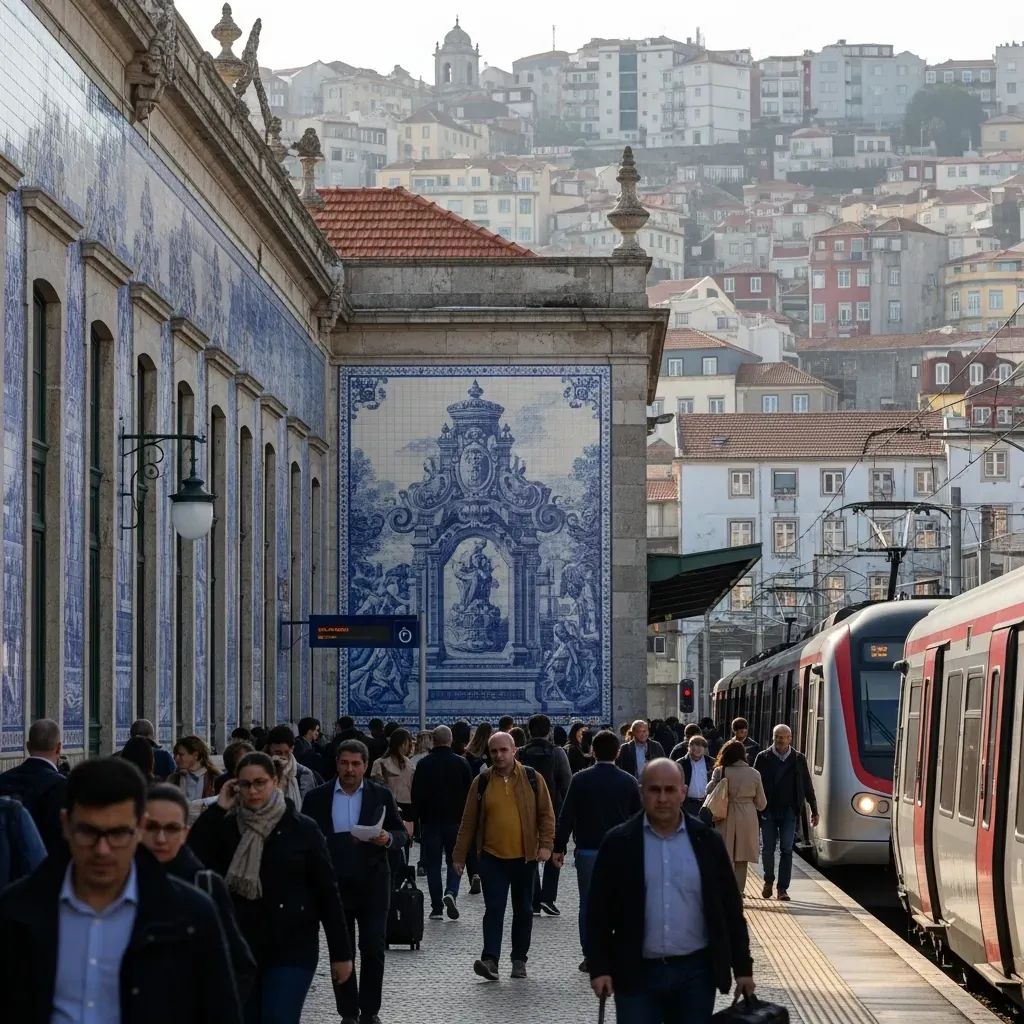
A quietly dramatic countdown has started inside Comboios de Portugal (CP): within three months the public rail operator must hand government officials a blueprint for bringing private companies onto four of the country’s busiest – and, in two cases, most troubled – commuter corridors. The political stakes are high, the economic upside uncertain and passengers in Greater Lisbon and Porto are wondering whether life on the platforms will actually improve.
Quick tour of what is at stake
• 90-day clock: CP must deliver a full sub-concession model by late April.
• Lines involved: Cascais, Sintra/Azambuja, Sado and the Porto suburban network.
• Government goal: invite private operators to bid in the second half of 2026.
• Critics warn of “stealth privatisation”, supporters talk about efficiency and fresh investment.
Why the government pressed the accelerator
The centre-right executive led by Prime Minister Luís Montenegro argues that Portugal’s rail revival cannot rely solely on a state operator still recovering from years of under-investment. Infrastructure Minister Miguel Pinto Luz says a CP study showed "clear market appetite" and potential savings if day-to-day services on selected commuter routes are run under performance-based contracts.For residents of Lisbon’s commuter belt, where rush-hour trains on the Sintra and Cascais lines already run close to capacity, officials promise more frequent departures, newer rolling stock and penalties for delays written into any private contract. The scheme dovetails with the broader Mobilidade 2.0 roadmap, which pairs high-speed construction with a shake-up of suburban services.
The four lines under the microscope
Cascais
Once Portugal’s first electrified heavy-rail route, the seaside corridor carried 38 M passengers in 2024 and posts a healthy operating surplus. Ongoing catenary upgrades, however, are forcing partial closures that test commuters’ patience. A private operator would inherit brand-new wiring but also the risk of future works.
Sintra/Azambuja
Europe’s second most intensively used commuter line after Paris-RER A still relies on 2300- and 2400-series EMUs dating back to the early 1990s. With 99 M riders last year and crowding above 36 %, the corridor is viewed as the jewel of the concession package.
Sado (Barreiro–Praias do Sado)
Serving the Setúbal peninsula, the Sado shuttle has long struggled with outdated trains and sub-30 % occupancy. Even after CP doubled capacity in 2024, the route booked a €3 M EBITDA loss. Supporters of concessioning believe a nimble operator could align timetables with Soflusa ferries and lure motorists off the A2.
Porto suburban network
Stretching 210 km from Aveiro to Guimarães, Porto’s urban services ended 2024 €9 M in the red. Chronic shortages of rolling stock force CP to borrow regional trains, while coordination with Metro do Porto and STCP buses remains patchy. Local mayors want any new contract to guarantee through-tickets and late-night services to the airport.
Who stands to gain, who fears to lose
Business groups such as Grupo Barraqueiro and Transdev see the tender as a natural extension of their footprints on Fertagus and Metro do Porto. They stress the upside of performance-based incentives and claim taxpayers will spend less per train-kilometre.Labour federation Fectrans, left-wing parties and a handful of user associations frame the move as "cherry-picking" the profitable bits of CP while leaving the state to underwrite losses elsewhere. They cite petitions from Fertagus passengers complaining about overcrowding to argue that private management does not automatically mean better service.
Looking abroad for clues
International experience offers mixed lessons:• In the UK, a passenger boom under privatised franchises ended with the pandemic and a switch back to tighter public oversight.• Brazil and Argentina attracted private cash but often underestimated the subsidies still required.• Chile’s separation of infrastructure from operations improved accountability but added contractual complexity.
The common thread: even the most efficient operator needs stable public funding, crystal-clear key-performance targets and the freedom to reinvest surpluses – all elements the Portuguese model will have to pin down within the next 90 days.
The road – or rail – ahead
Once CP delivers its plan, the government intends to publish draft tender documents for public consultation before the summer. Final invitations to bid could follow in early autumn, with contracts signed during 2027 and a go-live date tied to the arrival of 20 new high-speed trainsets CP is already procuring.In practical terms, commuters should not expect overnight change. Any winning bidder will have to absorb CP staff under existing labour agreements, integrate with Navegante passes in Lisbon and Andante in Porto, and maintain service while upgrading depots and trains.Still, with Portugal’s two largest metropolitan areas grappling with congestion and housing sprawl, the outcome will shape how – and how often – millions of passengers ride the rails for the next decade.


